
Last Updated: November 16, 2026
Quick Summary
What is a headstock on a guitar? It is the section at the top of the neck that holds the tuning machines, anchors the strings, and sets the path each string takes from the nut to the tuner post. It is the part players touch every time they tune and the part most likely to break when a guitar falls.
- The nut sets string spacing, first-fret height, and the fixed endpoint defining each string's speaking length.
- Gear ratios of 14:1, 16:1, or 18:1 set how many button turns equal one full post turn.
- Wind three to five wraps for wound strings, with the first wrap over the post and the rest neatly below.
- Solid headstocks mount tuners on the face or edge; slotted headstocks use routed channels with rollers.
- Detune strings immediately when a headstock cracks, keep every splinter, and never flex the break.
Table of Contents
- What a Guitar Headstock Actually Does
- Guitar Headstock Parts and How They Work Together
- Why the Headstock Decides How Well Your Guitar Stays in Tune
- Guitar Headstock Shapes Names Every Player Should Know
- Headstock Angle and String Break Angle: The Trade-Offs
- How Headstock Construction and Materials Affect Strength
- Guitar Headstock Repair: What Breaks and What to Do
- Headless Guitar Designs and What They Change
- Protecting Your Headstock in Transit and Storage
- Choosing Headstock Protection for Your Collection
- Frequently Asked Questions
What a Guitar Headstock Actually Does
If you have ever wondered what is a headstock on a guitar, it is the section at the top of the neck that holds the tuning machines, anchors the strings, and sets the path each string takes from the nut to the tuner post. It is the part of the instrument most players touch every time they tune, and the part most likely to break when a guitar falls.
Ask most beginners what a headstock does and you will hear "it holds the tuners." True, but incomplete. The headstock is where string tension gets managed, where string alignment begins, and where a surprising amount of an instrument's tone and stability are decided. This is the piece of wood where most structural breaks occur, which is why it deserves close attention.
Below, we will break down every component, every shape, and every trade-off, then show you how to keep that joint intact for the life of the instrument. But first, here is what most guides get wrong: they treat the headstock as decoration. It is not.
Guitar Headstock Parts and How They Work Together
Every headstock is built from the same small set of components, and understanding how they interact explains almost every tuning problem you will ever have. The main guitar headstock parts are the tuners, the string posts, the nut, and the wood itself. Most guides list these parts and stop. The useful part is how they load and release string tension together.
Here is a labeled walkthrough of each part and its job:
- Tuning machines (tuners): The button, gear housing, and worm gear that convert hand rotation into post rotation. The gear ratio, commonly 14:1, 16:1, or 18:1, sets how many button turns equal one full post turn. Higher ratios mean finer, more gradual pitch changes.
- String posts: The metal cylinders the string wraps around. The post diameter and height determine how many wraps fit and how steeply the string leaves the post toward the nut.
- Nut: The slotted strip at the neck-headstock junction. It sets string spacing, string height at the first fret, and the fixed endpoint that defines each string's speaking length.
- String trees or retainers: Small guides on some headstocks that pull strings down toward the nut to increase break angle on the highest strings.
- Truss rod access: Many headstocks include a truss rod adjustment nut or cover at the top, which lets a technician correct neck relief without removing the neck.
- Wood and joint: The headstock wood and the neck-to-headstock transition carry the full tension load of the strings.
Tuners, String Posts, and Winding
Tuning machines convert the turn of a button into rotation of a string post. The string wraps around that post, and the winding determines how securely it holds pitch. A sloppy winding job is one of the most common causes of tuning instability, and it has nothing to do with the quality of the tuners.
The mechanism matters: a worm gear drives a spur gear, and the gear ratio multiplies your hand movement. A 14:1 tuner needs 14 button turns for one post revolution; an 18:1 tuner needs 18. That is why higher-ratio tuners feel smoother and allow finer adjustment. The string post then acts as a capstan, the string tension pulls against the wraps, and friction between the wraps and the post holds the string. If the wraps cross over themselves, they never seat evenly, and the string slips under tension.
A common pattern among technicians is to wind the first wrap over the top of the post and the remaining wraps neatly below it, with three to five wraps total for wound strings and more for plain strings. Too few wraps and the string slips; too many and the coils stack and bind.
The Nut: Where the Neck Meets the Headstock
The nut is the slotted strip at the junction of the neck and headstock. It sets string spacing, controls string alignment, and acts as the fixed point that defines the speaking length of each string. A nut cut too tight will pinch a string and send pitch sharp the moment you bend. That single detail explains more tuning complaints than any other.
The nut also sets string height at the first fret. If a slot is too deep, the string buzzes; too shallow, the string sits high and pulls sharp when fretted near the headstock. The slot width should match the string gauge closely enough to guide the string without gripping it. When a string binds in a tight slot, bending or using the tremolo pulls extra string through the nut, and the pitch stays sharp until the string slips back, often with an audible ping.
How the Parts Load Tension Together
String tension runs from the tuning post, over the nut, down the neck to the bridge. The headstock side of the nut holds the string under tension between the post and the nut slot. The wood and joint carry that load continuously. When any one part, post winding, nut slot, or tuner gear, releases tension unevenly, the whole system drifts. That is why tuning stability is a system problem, not a single-part problem.
Watch out: do not assume new tuners will fix tuning drift. If the nut slots are tight or the winding is sloppy, premium tuners will still slip.
Why the Headstock Decides How Well Your Guitar Stays in Tune
Tuning stability is mostly a story about friction and tension. String tension pulls constantly against the nut, the posts, and the wood, and any point where a string binds will release unevenly as you play. Guitars that go sharp overnight usually have a nut issue. Guitars that go flat usually have a winding or tuner issue.
Here is a practical troubleshooting sequence, in order:
- Check the winding at each post: strings should coil neatly downward, never cross over themselves
- Lubricate the nut slots lightly and re-test pitch after a bend
- Stretch new strings before judging tuning stability
- Inspect the string guide or string tree on guitars that have one
- Confirm the tuner buttons turn smoothly with no slack
If pitch drifts after all five checks, the problem is usually hardware or a worn nut, not your playing.
Guitar Headstock Shapes Names Every Player Should Know
Headstock shapes fall into a few recognizable families, and knowing the guitar headstock shapes names helps you identify an instrument and predict how it will behave. The broad categories are solid and slotted, and within solid headstocks the tuner layout splits into inline and 3-on-3. Most guides stop at those labels. A labeled comparison across guitar types makes the differences concrete.
Solid vs. Slotted and Inline vs. 3-on-3
A solid headstock is a flat slab with tuners mounted on the face or edge. A slotted headstock has two routed channels, common on classical guitars, with tuner rollers inside the slots. Inline tuners, sometimes called six-in-line tuners, place all six on one edge, the classic layout on many electric guitars. Split tuners in a 3-on-3 configuration place three per side, the familiar arrangement on many set-neck designs.
Labeled Comparison by Guitar Type
| Guitar type | Typical headstock | Tuner layout | String path | Common construction |
|---|---|---|---|---|
| Classical | Slotted | 3 per side, rollers in slots | Straight through slots to rollers | Solid neck, often Spanish heel |
| Acoustic steel-string | Solid | 3-on-3 | Angled over nut to posts | Scarf joint or one-piece |
| Electric (bolt-on) | Solid | Inline six or 3-on-3 | Straight or angled | One-piece or scarf joint |
| Electric (set-neck) | Solid | 3-on-3 | Angled over nut | One-piece with ears |
Acoustic, Electric, and Classical Headstocks
Acoustic steel-string guitars usually use a solid 3-on-3 headstock with a backward angle, which increases downward pressure at the nut. Electric guitars vary widely: many bolt-on designs use inline six tuners on a flat or slightly angled headstock, while set-neck designs often use a 3-on-3 layout with a sharper angle. Classical guitars use a slotted headstock with rollers, a lighter construction and a shallower string break angle that suits nylon strings.
Inline vs. Split Tuner Configurations
Inline tuners place all six posts along one edge. The string path is straighter from nut to post on the treble side and more angled on the bass side, which is why some inline designs add string trees. Split 3-on-3 tuners place three posts per side, which shortens the average string path and reduces sideways pull at the nut. The trade-off is that 3-on-3 headstocks are often wider and need add-on ears for width, which creates extra glue lines.
Headstock Shapes and Brand Identification
Many players recognize headstock shapes as brand signatures, the outline alone can identify a maker. That is useful when buying used, because a headstock shape and tuner layout are harder to fake than a decal. Check the tuner layout, the number of screws per tuner, and the truss rod access point against known examples.
Watch out: a headstock shape alone does not confirm authenticity. Tuner hardware, screw patterns, and construction details matter more than the outline.
Headstock Angle and String Break Angle: The Trade-Offs
To understand what is a headstock on a guitar in terms of geometry, headstock angle is the backward tilt of the headstock relative to the neck, and string break angle is the downward angle a string takes over the nut. More angle means more downward pressure at the nut, which generally helps sustain and tuning stability. Less angle means less pressure, which reduces the chance of a stress crack at the neck joint.
That is the trade-off in one sentence. Angled designs sound and feel different, and they also concentrate stress exactly where breaks happen. If you play an angled instrument, protection matters more, not less. Our guide on how to protect angled guitar headstocks covers the practical side of that trade-off.
How Headstock Construction and Materials Affect Strength
Construction decides how a headstock fails. A one-piece neck with the headstock carved from the same block is strong but loses material at the transition, while a scarf joint glues an angled headstock onto a straight neck and can actually resist certain breaks better. Add-on "ears" for width are common on 3-on-3 designs and create their own glue lines.
Wood choice matters too. Mahogany is traditional and warm but splits along the grain; maple is denser and more resistant to impact. Hardware mounting holes act as stress risers, so a headstock with fewer holes and cleaner drilling tends to survive drops better. If you want prevention advice rather than repair advice, read our breakdown on preventing costly headstock repairs on angled headstocks.
Guitar Headstock Repair: What Breaks and What to Do
Guitar headstock repair almost always involves the same fracture: a crack running from the nut area diagonally back through the headstock. It is the single most common structural failure on set-neck instruments, and it is repairable when the break is clean and the pieces are kept aligned.
What you should do the moment a headstock cracks:
- Detune the strings immediately to remove tension
- Keep every splinter and fragment, bag them, do not throw anything away
- Do not flex the break to "see how bad it is"
- Get the instrument to a technician with the break supported
Watch out: the biggest mistake is leaving tension on a cracked headstock while you decide what to do. String tension is relentless, and a partial crack becomes a full separation fast. If you are mid-break right now, our step-by-step guide to what happens when a guitar headstock breaks walks through the repair process.
Headless Guitar Designs and What They Change
Headless guitars move the tuners to the body and eliminate the headstock entirely, which removes the vulnerable joint and shortens the overall instrument. The trade-off is that string changes work differently, and tuning at the bridge takes adjustment. For players who travel constantly, a headless design solves the break risk by design rather than by protection.
For everyone else, the headstock stays, and the job becomes keeping it safe.
Protecting Your Headstock in Transit and Storage
Most headstock breaks happen in cases, not on stages. A guitar in a gig bag that gets tossed into a bus bay or handed to a baggage handler takes an impact the headstock-neck junction was never designed to absorb. Extra padding helps, but padding compresses and shifts, and it does not support the joint itself.
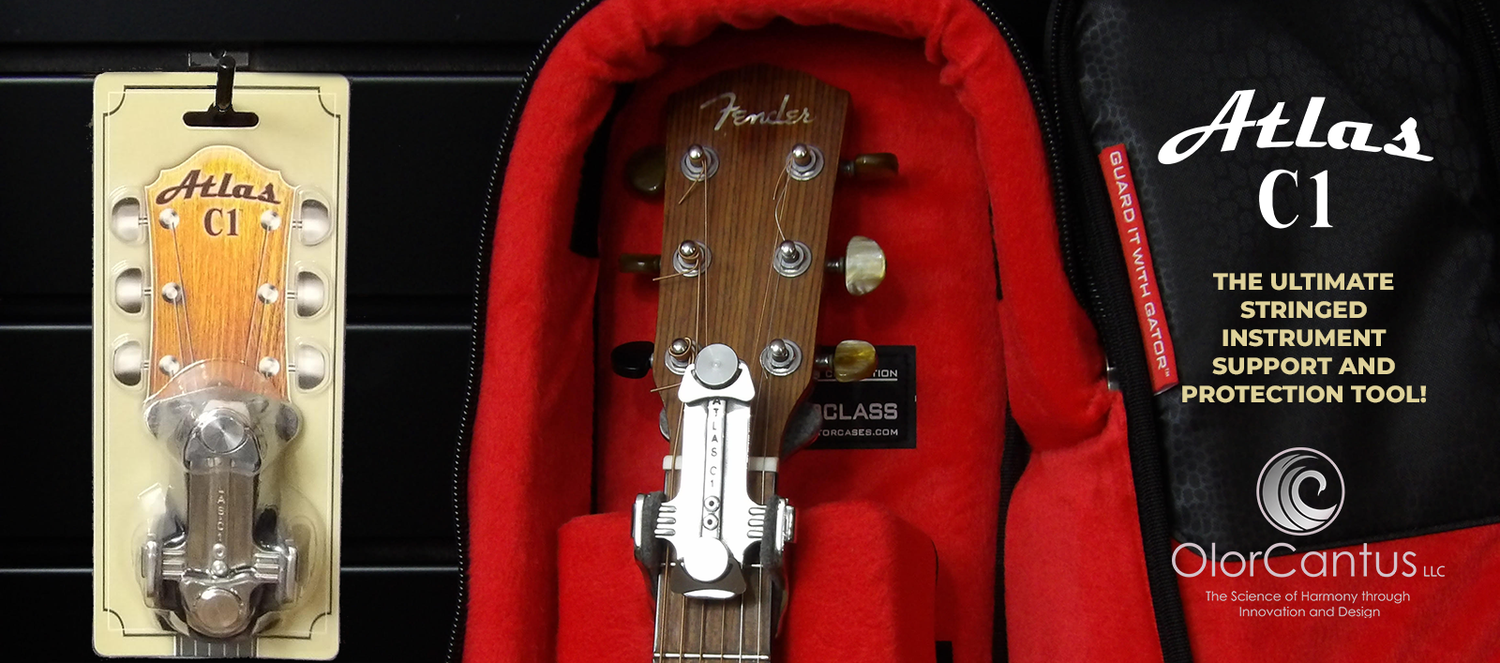
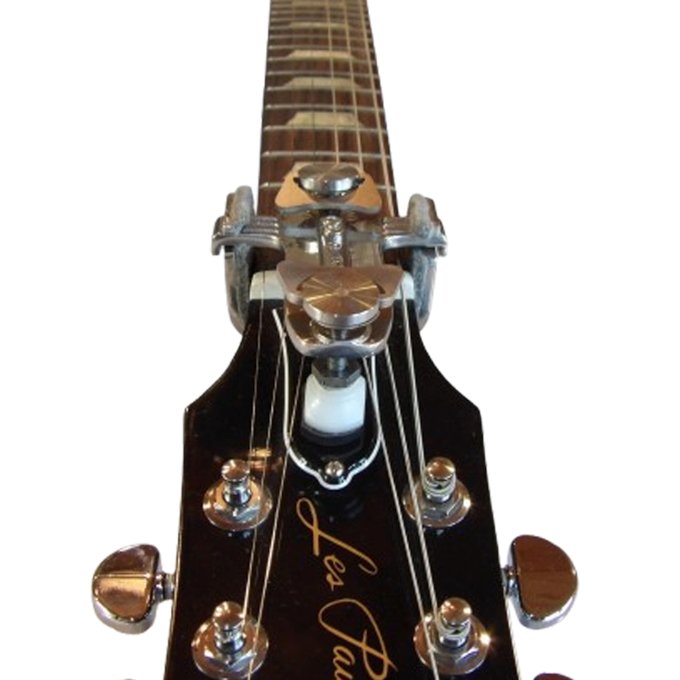
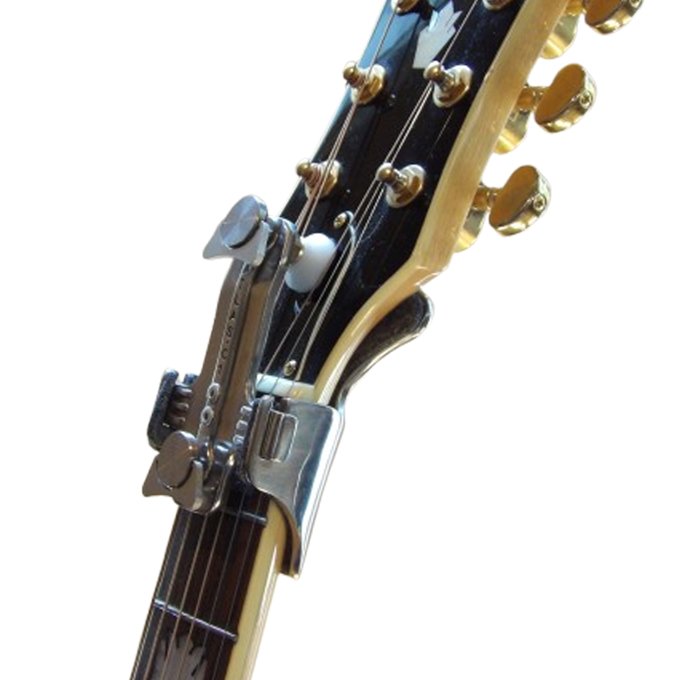
This is exactly the problem the Atlas C1 was built for. It is a U.S. patent-protected headstock support, protection, and repair tool designed to support the headstock-neck junction and counteract string pressure on that joint. It also doubles as a pre-aligned repair jig for headstocks awaiting repair, so the same tool that protects a healthy guitar helps stabilize a broken one. You can see the Atlas C1 headstock support and protection tool on our product page.
Before buying, check that your guitar uses a 3 on 3 tuning machine headstock design, which is what the tool is built around.
Choosing Headstock Protection for Your Collection
Collectors face a different calculation than touring players. A vintage instrument in a climate-controlled room still experiences seasonal movement, and a single slip during a string change can turn a valuable guitar into a repair project. Protection is a practical consideration for a collection.
If you are still deciding whether it is worth it, our article on whether guitar neck protection is necessary makes the case plainly. Traveling musicians, collectors, and working technicians all land in the same place: support the joint before something happens, not after. The Atlas C1 is designed as a lifetime-use investment.
Here is a quick way to match your situation to a next step:
| Your situation | Main risk | First move |
|---|---|---|
| Touring by air or bus | Impact in transit | Support the neck joint in the case |
| Vintage collector | Slips and seasonal movement | Protect during storage and string changes |
| Luthier or tech | Unstable break during repair | Use a pre-aligned jig |
| Casual home player | Occasional travel | Basic support plus a hard case |
Whichever path fits your playing life, the Atlas C1 headstock support and protection tool is the one piece of gear that works as hard in storage as it does on the road. The Science of Harmony through innovation and design. Long Live the Six String ™
Headstock damage is the most common structural failure on a guitar, and it is also the most preventable. Atlas C1 builds one tool for that single job: a patented headstock support, protection, and repair jig that steadies the neck joint in transit, in storage, and during a repair, backed by an unlimited transferable lifetime warranty. Get started with Atlas C1 and stop paying for breaks you could have prevented.
The Science of Harmony through innovation and design
Long Live the Six String ™
Frequently Asked Questions
What is a guitar without a headstock called?
It is called a headless guitar. Instead of a headstock with tuning pegs, the tuners sit at the body end of the instrument, and the strings run straight from the bridge to a clamp near the neck. Headless designs shorten the overall length, which helps with travel, and they remove the angled neck junction where many breaks happen. They still need careful setup, and string changes work differently than on a standard guitar.
Can a guitar headstock be repaired after it breaks?
Yes, in most cases. A clean break along the neck junction is one of the most repairable guitar injuries, and a skilled technician can glue, clamp, and reinforce it so the instrument plays again. The key is alignment: the two pieces must meet in exactly the right position while the glue cures. A pre-aligned repair jig, like the patented Atlas-C1 from Olor Cantus LLC, is designed to hold the headstock steady during the repair.
Does the guitar headstock affect tuning?
It does. The headstock sets the string path from the nut to the tuners, and that path controls how much string bends at each contact point. Sharp angles, poorly wound string posts, and missing string trees all add friction, which lets strings slip and go flat. A clean string path, enough wraps around each post, and a properly cut nut keep a guitar in tune far better than extra tightening of the pegs.
Are acoustic and electric guitar headstocks different?
They usually are. Acoustic guitars often use a slotted headstock with the tuners mounted from the sides, while electric guitars more often use a solid headstock with six-in-line or 3-on-3 tuner layouts. Acoustic headstocks also tend to carry a steeper angle behind the nut to keep string tension on the saddle. The parts are similar, but the shapes and tuner configurations differ enough that a case or support tool must fit the specific design.