
Table of Contents
- Buy an Extra Seat for a Guitar on a Plane: How It Works
- Airline Rules for Musical Instruments You Need to Confirm
- Can You Take a Guitar on a Plane as Hand Luggage?
- Step-by-Step: Booking an Instrument Seat
- Ticketing, Check-In, and Boarding with an Extra Seat
- How to Secure a Guitar in an Airplane Seat
- How to Protect a Guitar When Flying: Cases and Headstock Support
- Costs, Refunds, and Fare Rules for a Guitar Seat
- When an Extra Seat Is Not Available: Backup Plans
- Get Your Guitar Flight-Ready with Atlas C1
- Frequently Asked Questions
Last Updated: November 8, 2026
Buy an Extra Seat for a Guitar on a Plane: How It Works
Yes, you can buy a seat for a guitar on a plane. Most major carriers let you purchase a separate seat for a large musical instrument, but only if you book it as a cabin-seat item and follow each airline's rules. Knowing those rules before you call helps. This guide from Atlas C1 walks you through the booking, the restraint, and the backup plan.
The short version: an extra seat is a real ticket, not a favor. You pay the same fare a passenger would pay, and the guitar rides in the cabin instead of the cargo hold. That single fact changes how you book, check in, and board.
Below, we'll show you exactly how the process works, which questions to ask before you pay, and how to protect the weakest part of the instrument once it's strapped in.
Airline Rules for Musical Instruments You Need to Confirm
Airlines treat a guitar in its own seat as a "cabin-seat item," and the rules vary by carrier. If you're confused by carrier rules, learn how to understand airline musical instrument policy. The U.S. Department of Transportation requires carriers to accept musical instruments as carry-on or checked baggage when they fit the rules, and passengers may buy a seat for a large instrument under DOT airline passenger protections. But each airline sets its own size, weight, and advance-notice terms.
What to Ask Before You Book
Call customer service before you pay for anything. Ask these questions and write down the answers:
- Does your airline allow a guitar to occupy a purchased seat?
- What are the size and weight limits for the instrument in its case?
- How far in advance must I request the extra seat?
- Can the seat be booked online, or only by phone?
- What fare class applies, and is it refundable?
- Where will the instrument sit, and how is it restrained?
A common mistake is assuming every agent knows the policy. Ask for the specific rule and a confirmation number.
Can You Take a Guitar on a Plane as Hand Luggage?
Sometimes, yes. A guitar can fly as hand luggage if it fits the overhead bin or an approved closet, and many smaller instruments do. The catch is space. Overhead compartments fill fast, and a full-size acoustic case often exceeds the bin's dimensions.
Here's how to think about it:
- Small or soft cases fit more bins than hard cases.
- Priority boarding improves your odds of finding overhead space.
- Gate-check is the fallback if the bin is full, and that means the cargo hold.
If you want the instrument in the cabin with certainty, the purchased seat is the reliable route. Hand luggage is a gamble on available space.
Step-by-Step: Booking an Instrument Seat
Booking an extra seat for a guitar is not the same as buying a ticket for a friend, and can you buy a seat for a guitar on a plane depends on it. The airline needs to know the seat is for an instrument, not a passenger, and that distinction affects how the reservation is created, priced, and confirmed. Work through the following sequence in order, and get each step confirmed before you move to the next.
- Call the airline before you book anything online. Most carriers cannot sell a cabin-seat instrument through their website. An agent must create the extra seat as a special item, often under a separate ticket record linked to your own reservation. Ask the agent to read you the policy for cabin-seat items and to note it on your booking.
- Choose a nonstop flight when possible. Every connection adds a handling event where the instrument seat may be reassigned or the guitar may be moved. Nonstop reduces the number of people who touch the reservation.
- Provide the instrument's dimensions and weight. The agent will ask for the guitar in its case, height, width, depth, and weight. Have those numbers ready. If the case exceeds the carrier's cabin-seat limits, the request will be denied, so measure before you call.
- Book the extra seat under your own name with an instrument note. Airlines typically require the instrument seat to be booked in the same name as the traveling passenger, with a notation that the seat carries a musical instrument. Do not book it under a nickname or a second passenger name unless the agent instructs you to.
- Confirm the fare class and refund rules in writing. The instrument seat is usually priced at the same fare as your own ticket, including taxes and fees. Ask whether the extra seat is refundable, whether it can be canceled independently of your ticket, and what happens if you rebook. Request the terms by email or through the airline's messaging system.
- Request a window seat near the rear of the cabin. A window seat gives the guitar a cabin wall to lean against and keeps it out of the aisle. The rear of the cabin often has less foot traffic and more overhead space. Ask the agent to block the adjacent seat if possible, or at least to note that the seat holds an instrument.
- Get a confirmation number for the instrument seat and the policy reference. Save the agent's name, the date and time of the call, the confirmation number for the extra seat, and the specific policy name or number the agent cited. If a gate agent questions the seat later, that record resolves the issue quickly.
Watch out: booking an extra seat online without notifying the airline can cause the ticket to be flagged as a duplicate or no-show and canceled at the gate. Always complete the instrument-seat booking by phone and confirm that the reservation shows the instrument notation.
After booking, check your reservation online to verify that two seats appear, yours and the instrument's, and that the instrument seat shows the correct notation. If the notation is missing, call back and have it added before your flight.
Here is the booking sequence the article lays out, in order.
| Step | What to do |
|---|---|
| 1 | Call the airline before booking anything online |
| 2 | Choose a nonstop flight when possible |
| 3 | Provide the instrument's dimensions and weight |
| 4 | Book the extra seat under your own name with an instrument note |
| 5 | Confirm the fare class and refund rules in writing |
| 6 | Request a window seat near the rear of the cabin |
| 7 | Get a confirmation number for the instrument seat and policy reference |
Ticketing, Check-In, and Boarding with an Extra Seat
The extra seat generates its own boarding pass, and you'll handle two tickets at the airport. At check-in, tell the agent you have a cabin-seat instrument so the seat is not reassigned.
During boarding:
- Board early if the airline allows pre-boarding for passengers with extra seats.
- Keep the instrument with you at all times.
- Show both boarding passes at the gate.
- Ask the flight attendant to confirm the restraint before pushback.
How to Secure a Guitar in an Airplane Seat
Securing a guitar in its seat is a two-minute job that prevents the most common travel damage: the case sliding forward into the seat back or sideways into the aisle during taxi, takeoff, or turbulence. The goal is to make the case behave like a passenger, upright, belted, and unable to move independently.

Follow these steps in order:
- Place the case upright against the seat back, never flat on the cushion. Upright keeps the case within the seat footprint and below the seat-back height. A case lying flat can slide forward and block the row behind or the aisle.
- Route the seat belt through the case handle or around the widest part of the case body. If the case has a sturdy handle, thread the belt through it and buckle. If the handle is flimsy or recessed, wrap the belt around the case body at its widest point and pull snug. Do not rely on a soft gig bag handle alone, wrap the belt around the bag itself.
- Pull the belt tight and test for movement. After buckling, push the case gently in all directions. It should not shift more than an inch. If it moves, reposition and retighten.
- Keep the case below the top of the seat back. The case must not block the view or recline of the passenger behind you. If the case is taller than the seat back, angle it slightly or ask the flight attendant for guidance.
- Do not place the case in the aisle or in front of an exit row. Aisles must remain clear, and exit rows have specific stowage rules. If your assigned seat is an exit row, ask to be moved before boarding.
- Ask the flight attendant to check the setup before pushback. A brief request, "Could you confirm the instrument is secured properly?", gives you a second set of eyes and creates a record that you followed procedure.
Watch out: some flight attendants will ask you to stow the guitar in an overhead bin or closet instead of a seat, even if you paid for the seat. Politely explain that you purchased a cabin-seat ticket for the instrument and show both boarding passes. If the attendant insists, ask for the purser or the gate agent to confirm the policy before the door closes.
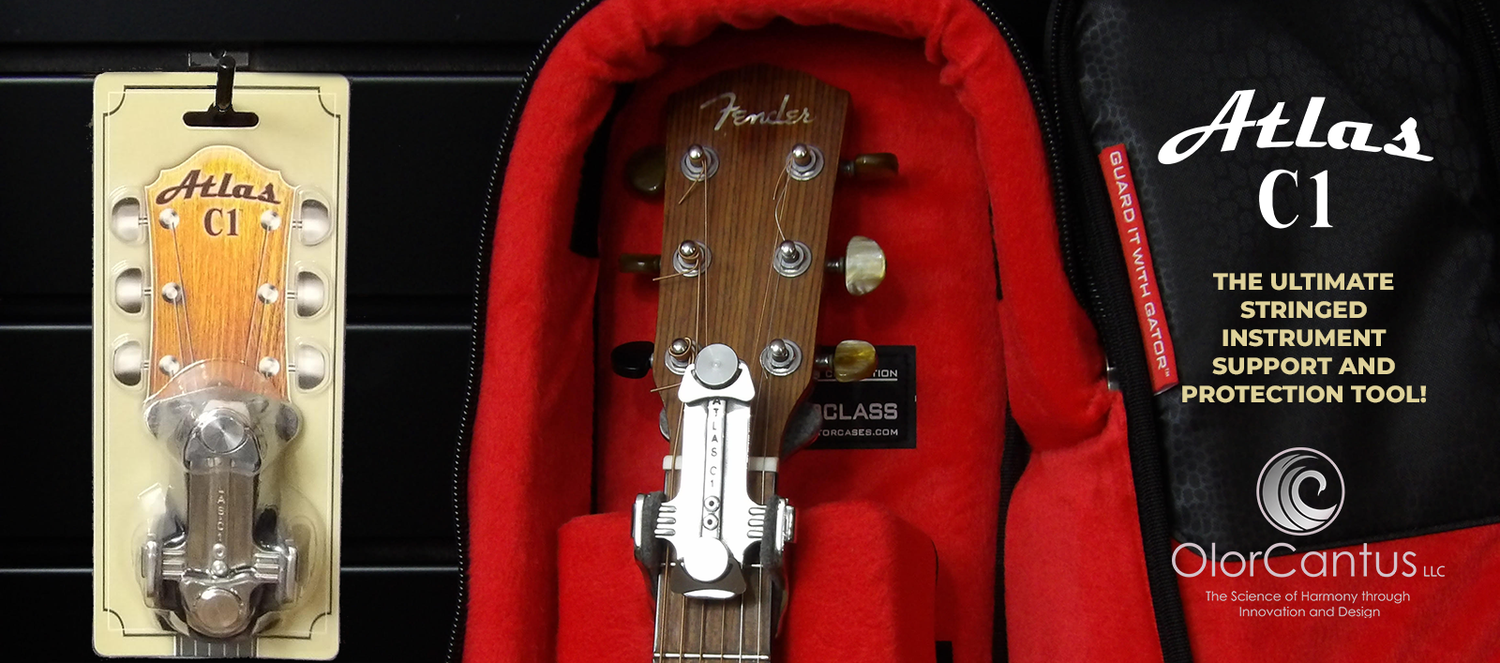
For headstock support that holds the neck steady inside the case, browse the Atlas-C1 collection and see the Atlas-C1 demo to watch the tool in action before your flight.
How to Protect a Guitar When Flying: Cases and Headstock Support
Protecting a guitar when flying starts with the case, and the headstock needs particular attention. A hard case absorbs impact, but the neck junction inside can still take the load when the case shifts.
Use these layers of protection:
- Hard case over soft case. A rigid shell spreads impact across the whole body.
- Headstock support. A support tool holds the headstock-neck junction steady so it does not flex.
- Padding around the body. Fill gaps so the instrument cannot move inside the case.
- Case locked or latched. Confirm every latch before you hand it over.
If you're weighing case options, read our comparison of flight case versus gig bag protection and our roundup of the best guitar flight cases for 2026.
Why the Headstock-Neck Junction Is the Weak Point
The headstock-neck junction is the weakest point on most guitars because it carries the full string tension through a thin piece of wood. The Atlas-C1 is designed to support that junction and counteract the string pressure that stresses it.
Costs, Refunds, and Fare Rules for a Guitar Seat
An instrument seat costs the same as a passenger fare for that flight, and the fare rules follow the ticket class. A refundable fare gives you money back if plans change. A basic economy fare usually does not.
Ask these questions before you pay:
- Is the instrument seat refundable, and under what terms?
- Are taxes and fees charged on the extra seat?
- What happens to the seat if I rebook the flight?
- Can I cancel the instrument seat without cancelling my own?
Fare rules change by carrier and route, so confirm the terms with the airline at booking. Get the refund policy in writing so there are no surprises.
When an Extra Seat Is Not Available: Backup Plans
Sometimes the flight is full, or the airline declines the extra seat. Have a backup ready before you get to the airport.
Your options, in order of preference:
- Ship the guitar ahead. Use a specialist instrument shipper with tracking and insurance.
- Book a different flight. A flight with open seats gives you the room you need.
- Use a reinforced hard case and gate-check. Accept the cargo hold only with a case built for it.
- Rent or borrow at your destination. For short trips, this removes the risk entirely.
Plan the backup before you book. A last-minute scramble at the gate is how instruments get damaged.
Get Your Guitar Flight-Ready with Atlas C1
Air travel with a guitar comes down to preparation. Confirm the airline's rules, book the extra seat by phone, and secure the case in the seat before pushback. The part most players overlook is what happens inside the case, and that is where the Atlas-C1 earns its place.
The Atlas-C1 is a U.S. patent-protected, universal tool that supports the headstock-neck junction during travel and doubles as a pre-aligned repair jig. It is designed to counteract the string tension that stresses that joint, and it is intended to give you peace of mind whether the guitar flies in a seat, ships ahead, or sits in storage.
Get your guitar flight-ready with Atlas C1 and protect the headstock before your next trip. The Science of Harmony through innovation and design. Long Live the Six String TM
Frequently Asked Questions
Can you buy a seat for a guitar on a plane?
Yes, most major U.S. airlines allow you to purchase an additional ticket for a guitar or other musical instrument so it can fly in the cabin beside you. You must book the extra seat in advance, confirm the instrument fits the airline's seat and weight limits, and follow the carrier's rules for restraint. Policies vary, so call customer service before booking to confirm the guitar seat is allowed on your specific flight and aircraft.
How do you book an extra seat for a musical instrument?
Book the extra seat through the airline's reservations line rather than online, because most websites cannot add an instrument seat to a standard booking. Tell the agent you need a separate seat for a musical instrument, provide the guitar's dimensions and weight, and ask them to link the two tickets under your name. Confirm the fare class, whether the seat can be refunded if plans change, and request a window or bulkhead seat where the case can be braced against the cabin wall.
Can you take a guitar on a plane as hand luggage instead of buying a seat?
Sometimes. Many airlines let you bring a guitar as a carry-on if it fits the overhead bin or an approved closet, but space is not guaranteed and gate agents may require you to check it. Buying a guitar seat removes that uncertainty and keeps the instrument under your control. If you choose the carry-on route, board early, ask the crew about closet space, and have a hard case ready in case the guitar must be gate-checked.
How should you secure a guitar in an airplane seat?
Place the guitar in a hard case and set it in the seat with the case upright and the headstock toward the window or cabin wall. Route the seat belt through the case handle or around the body of the case and buckle it tight, then remove slack so the case cannot shift during takeoff, landing, or turbulence. Keep the case closed and latched for the whole flight, and do not stow it in the aisle or under the seat in front of you.