
Table of Contents
- Flight Case vs Gig Bag: Core Protection Differences
- Impact, Drops, and Crushing Pressure: What Each Case Can Handle
- Will a Gig Bag Protect a Guitar During Everyday Transport?
- How to Protect a Guitar When Flying
- How to Ship a Guitar Safely: Case Selection and Preparation
- TSA-Approved Guitar Cases and Airline Requirements
- Weather, Dust, and Environmental Protection
- Instrument Value, Replacement Risk, and Long-Term Investment
- Choosing the Right Case for Your Needs
- Frequently Asked Questions
Last Updated: October 14, 2026
Flight Case vs Gig Bag: Core Protection Differences
A flight case vs gig bag represents one of the most important choices a guitarist makes when protecting their instrument. The difference between these two case types comes down to how much impact protection you need and how often you travel. A gig bag offers portability and convenience for local transport. A flight case delivers maximum protection for valuable instruments during air travel, touring, and long-term storage.
At Atlas C1, we understand that choosing the right case depends on your specific use case and instrument value. Some musicians need both. Others find one solution covers everything they do. The key is understanding what each case type actually protects against and where each one falls short.
The core difference is simple: a gig bag is designed for convenience and everyday use, while a flight case is engineered for maximum protection. A gig bag uses padded fabric and modest foam layers. A flight case uses hardshell construction, internal foam support systems, and reinforced corners that absorb impact energy. This matters because the protection level you choose directly affects whether your guitar survives transport intact or arrives damaged.
Impact, Drops, and Crushing Pressure: What Each Case Can Handle
Flight cases are built to handle impacts that would destroy a gig bag. The hardshell exterior resists crushing pressure from baggage handling, cargo stacking, and accidental drops. Internal foam padding absorbs shock and prevents the guitar from moving inside the case during rough transport.
A gig bag's padded fabric provides minimal protection against crushing force. If your guitar lands hard or gets stacked under other luggage, the padding compresses and offers little resistance. Flight cases, by contrast, feature rigid construction that distributes impact energy across the entire case rather than concentrating it at the point of impact.
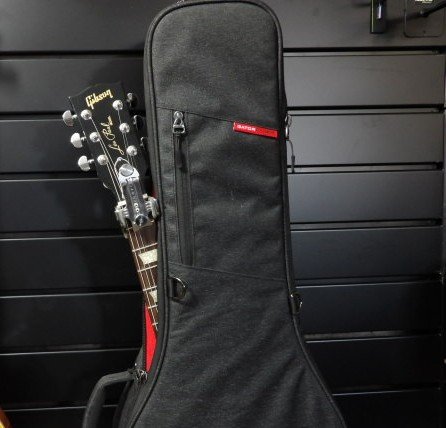
The difference becomes critical during air travel. Baggage handlers drop suitcases, stack heavy items on top, and pack cases tightly into cargo holds. A flight case protects against this rough handling. A gig bag does not. The neck junction, where the headstock connects to the neck, is especially vulnerable. Tools like the Atlas C1 provide targeted support at this junction, counteracting the 130+ pounds of string pressure tension that makes headstocks prone to breaking during impact.
For everyday drops from waist height or minor bumps, a gig bag usually survives. For airline baggage handling or touring with repeated loading and unloading, a flight case is essential.
Will a Gig Bag Protect a Guitar During Everyday Transport?
Yes, a gig bag works well for local transport and everyday use. If you're driving to a nearby venue or keeping your guitar in your home, a quality gig bag provides adequate protection against dust, minor impacts, and weather exposure.
The gig bag's strength is convenience. You can sling it over your shoulder, carry it easily, and access your guitar quickly. For musicians playing local gigs a few times per month, a gig bag is practical and sufficient. The padding protects against minor bumps and dings that occur during normal handling.
The limitation appears when transport becomes more demanding. Multi-day tours, frequent air travel, or storage in variable conditions expose weaknesses in gig bag protection. Repeated impacts accumulate damage. Weather exposure degrades the fabric and allows moisture to reach the instrument. Extended storage without climate control can cause wood damage.
A gig bag is not designed to prevent headstock breaks or protect against the kind of impact that occurs during airline baggage handling. If your guitar is valuable or you travel frequently, a gig bag alone is insufficient.
How to Protect a Guitar When Flying
Flying with a guitar requires a flight case or equivalent hardshell protection. Airline baggage handling is rough. Your guitar will be dropped, stacked under other luggage, and subjected to pressure it never experiences in normal use.
A flight case is the standard protection for air travel. The hardshell exterior and internal foam support protect against impacts that occur in cargo holds. Check the airline's specific requirements for case dimensions and weight before you book, as some airlines have restrictions on what qualifies as checked baggage.
Beyond the case itself, proper packing matters. Loosen the strings slightly to reduce tension on the neck during flight. Wrap the headstock and neck with extra padding to prevent movement inside the case. Fill empty space with soft materials to immobilize the guitar and prevent shifting during transport.
Some musicians use additional protection tools like the Atlas C1, which provides targeted support at the headstock-neck junction. This extra layer of protection is especially important for valuable instruments or vintage guitars with angled headstocks that are prone to breaking.
Arrive at the airport early and hand-deliver your guitar to the baggage handler if possible. Request that it be handled with care. While this does not guarantee careful treatment, it signals that the item is valuable and fragile.
How to Ship a Guitar Safely: Case Selection and Preparation
Shipping a guitar requires the same protection level as air travel, because the guitar experiences similar handling during transit. Use a flight case or hardshell case rated for shipping. Never ship a guitar in a gig bag.
Prepare the guitar for shipping by loosening the strings to reduce neck tension. Wrap the headstock and neck with padding to prevent movement. Place the guitar in the case and fill all empty space with foam, bubble wrap, or other protective material. The goal is to prevent any movement inside the case during transport.
Seal the case securely and label it clearly as "FRAGILE" and "THIS SIDE UP." Use a reputable shipping service that offers insurance for high-value items. For guitars worth more than a few hundred dollars, declare the full value and purchase shipping insurance to protect against loss or damage. When you order a flight case with free shipping, you eliminate one barrier to getting the protection your instrument deserves.
Some shipping services require that guitars be shipped in flight cases specifically. Check with your carrier before packing. If you ship frequently, investing in a quality flight case pays for itself through protection and peace of mind.
TSA-Approved Guitar Cases and Airline Requirements
There is no such thing as a TSA-approved guitar case. TSA screens bags; it does not certify cases. What matters is whether your case survives the journey and whether it fits the airline's rules. Those are two separate problems, and conflating them is how guitars get damaged.
Carry-on versus checked. Under federal rules, an airline must allow a small musical instrument as carry-on if it fits in the overhead or under the seat and there is space at boarding. A guitar in a gig bag often fits this exception. A full-size flight case usually does not, which means it gets checked. That is the central trade-off: the case that protects best in the cargo hold is the case you cannot carry on. Confirm dimensions and weight limits with your specific airline before you book, because they vary and change.
What actually happens in the cargo hold. Checked baggage is stacked, sorted by machine, and transferred between aircraft. Bags are dropped from conveyor belts, compressed under other luggage, and exposed to unheated, unpressurized conditions at altitude. A gig bag offers essentially no resistance to this. An ordinary hard case resists some compression but can flex and transfer shock to the instrument. A flight case with a rigid shell, internal foam that immobilizes the guitar, and reinforced corners is built for exactly this environment. The keyword distinction matters here: a flight case is not just "a hard case," it is a case engineered for repeated rough handling.
The limits of relying on the case alone. Even the best case cannot prevent damage if the guitar moves inside it. Before you check a guitar, loosen the strings slightly to reduce tension on the neck, support the headstock so it cannot whip forward or back, and fill empty space so the instrument cannot shift. A case that fits loosely is a case that lets the guitar build momentum before it hits the wall. Fit and immobilization matter as much as shell thickness.
Documentation and insurance. Declare the instrument's value if your carrier offers excess valuation, and keep a receipt or appraisal. If you fly often with a valuable instrument, a separate instrument policy is worth pricing against the replacement cost. No case is a substitute for insurance on a high-value guitar.
Practical checklist before you fly. Confirm the airline's checked-bag dimensions and weight limit. Weigh the loaded case at home. Loosen strings, support the neck, and fill voids. Label the case with your contact information inside and out. Arrive early, and ask about gate-checking if the case is borderline for carry-on. If you can hand the case to a gate agent rather than drop it at the ticket counter, you reduce one handling step.
Current rules for musical instruments as carry-on and checked baggage

Weather, Dust, and Environmental Protection
Most comparisons treat "weather protection" as one rating. It is not. Water intrusion, humidity swings, temperature shock, dust, and UV exposure each attack a guitar differently, and a gig bag, an ordinary hard case, and a true flight case handle each one differently. Breaking the hazard apart is the only way to know what you are actually buying.
Liquid water and rain. A gig bag's padded fabric is water-resistant at best. A light drizzle beads up; sustained rain soaks through seams, zippers, and the fabric itself. An ordinary hard case with a molded shell sheds rain but often leaks at the lid seam and around latches. A flight case with a gasketed lid and recessed, sealed latches keeps liquid water out during a downpour or a spilled drink in a cargo hold. If you load in and out in bad weather, this is the difference between a damp case and a wet guitar.
Humidity and moisture vapor. Water vapor passes through fabric and through unsealed seams. A gig bag does almost nothing to slow humidity exchange, so a guitar stored in a damp basement or a dry winter room tracks the room. A sealed flight case slows that exchange dramatically, which cuts both ways: it protects against rapid swings, but it also traps moisture already inside. That is why players who store in a flight case often add a hygrometer and a small humidity-control packet, and why you should never case a guitar while it is still cold or damp from a load-in.
Temperature shock. Wood, finish, and glue expand and contract at different rates. Moving a cold guitar into a warm room can check the finish and stress glue joints. A gig bag offers almost no thermal buffer. A flight case's foam and dead-air space act as a modest insulator, slowing the rate of change so the instrument equalizes gradually. The practical rule is the same for every case type: let the closed case sit and come to room temperature before you open it.
Dust and fine grit. Dust works into tuners, potentiometers, and bridge saddles. A zippered gig bag keeps out most visible dust but not fine grit at the zipper line. A hard case with a foam seal does better. A gasketed flight case does best. If you play outdoor festivals, beach gigs, or dusty rehearsal spaces, this is a real wear factor, not a cosmetic one.
UV and long-term storage. Sunlight degrades fabric, foam, and finish. A gig bag left in a hot car fades and its foam can crumble. A hard shell blocks UV but can bake the interior in direct sun. A flight case blocks UV and, with its foam liner, buffers heat somewhat, but no case is a climate-controlled room. For long-term storage, keep any case out of direct sun and out of a parked vehicle.

Instrument Value, Replacement Risk, and Long-Term Investment
The value of your guitar directly influences which case type makes sense. A budget-friendly beginner guitar worth $200-400 can be replaced relatively easily. A vintage Gibson or handcrafted instrument worth $2,000-10,000 cannot.
For valuable instruments, the cost of a flight case is negligible compared to the replacement cost. A flight case costs a fraction of what you would pay to replace a damaged guitar or repair a broken headstock. The investment protects your instrument and your financial stake in it.
Replacement costs for high-end guitars include not just the purchase price but also the loss of vintage tone, playability characteristics, and sentimental value. A vintage 1959 Les Paul is not interchangeable with a new one, even if both cost the same. Once damaged, the unique qualities that made the original valuable are diminished.
For touring musicians, the risk compounds over time. A gig bag might survive one tour without damage. Over five years of regular touring, the probability of impact damage increases significantly. A flight case reduces this risk to near zero, making it the logical choice for long-term instrument protection.
Choosing the Right Case for Your Needs
Your choice between a flight case and gig bag depends on three factors: how often you travel, how valuable your guitar is, and what kind of travel you do.
Use a gig bag if: You play local gigs a few times per month, your guitar is worth less than $500, and you never fly with it. The convenience and lower cost make sense for casual local musicians.
Use a flight case if: You fly with your guitar, tour regularly, or your instrument is worth more than $1,000. The protection justifies the investment and added weight.
Use both if: You tour internationally or play frequent local gigs. Keep a gig bag for everyday transport and a flight case for air travel and storage.
For musicians who travel constantly with valuable instruments, the Atlas C1 provides an additional layer of protection. It targets the headstock-neck junction, the most vulnerable part of your guitar, and doubles as a pre-aligned repair jig if damage does occur. Combined with a quality flight case, this approach delivers maximum protection for your investment.
Protecting your guitar during travel and storage is not optional if your instrument has real value. A flight case is the industry standard for a reason: it prevents the kinds of damage that occur during airline baggage handling, touring, and long-term storage. The Atlas C1 takes this protection further by providing targeted support at the headstock-neck junction, where breaks are most likely to occur. When you invest in a flight case and the Atlas C1, you're securing your instrument's future. Take advantage of our 10% product discount to make this protection more accessible, and enjoy free shipping on your order. Whether you choose a flight case alone or add the Atlas C1 for extra security, the investment protects your guitar and your peace of mind for a lifetime of playing.
Frequently Asked Questions
Will a gig bag protect a guitar during air travel?
A gig bag provides minimal protection during air travel. Checked baggage undergoes rough handling, compression, and stacking that can cause headstock breaks, body cracks, and neck damage. Flight cases and hardshell cases distribute impact across reinforced shells and internal padding, protecting against crushing pressure and drops. For frequent flyers or valuable instruments, a flight case is the safer choice.
How do I protect a guitar when flying with it as a carry-on?
Use a hardshell or flight case small enough to fit overhead bins. Remove the guitar's strings partially to reduce neck tension during pressure changes. Position the guitar neck-up inside the case with adequate foam support around the headstock. Keep the case with you rather than checking it. Even as carry-on luggage, guitars benefit from the shock absorption and internal support that flight cases provide.
What's the best way to ship a guitar safely?
Use a hardshell case or flight case, never a gig bag alone. Wrap the guitar in bubble wrap or foam padding, then place it in the case with additional padding around the headstock, body, and neck. Fill empty space with packing peanuts to prevent movement. Reinforce the case exterior with shipping tape and use a shipping service that tracks and insures the package. Flight cases offer superior protection for high-value instruments.
Are TSA-approved guitar cases necessary for flying?
TSA regulations don't prohibit guitars in checked or carry-on baggage, but the case must comply with carry-on size limits if you want to bring it aboard. A case that meets size and weight restrictions for overhead bins is often preferred for carry-on. For checked baggage, any hardshell or flight case works, but flight cases provide better protection against baggage handling than soft gig bags, regardless of TSA approval.