
Table of Contents
- Quick Comparison: Best Accessories for Touring Guitarists 2026
- Guitar Headstock Protection Tools: The Accessory That Saves Guitars
- The Best Way to Ship Guitars Safely on Tour
- Essential Guitar Maintenance Tools for Life on the Road
- Performance and Stage Accessories That Hold Up Night After Night
- Hearing Protection and Signal Chain Gear for Touring Guitarists
- Travel-Friendly Guitar Equipment and Protection and Storage Solutions
- Frequently Asked Questions
Last Updated: September 17, 2026
Quick Comparison: Best Accessories for Touring Guitarists 2026
The right accessories for touring guitarists 2026 fall into a few clear categories: headstock protection, maintenance tools, stage gear, hearing protection, and travel-ready equipment. This guide from Atlas C1 breaks down what actually earns its place in your case versus what just adds weight.

| Accessory | Category | Best For | Standout Feature |
|---|---|---|---|
| Atlas C1 | Headstock protection | Angled-headstock guitars in transit | Doubles as a pre-aligned repair jig |
| Soundbrenner Core 2 | Timing and tuning | Loud stage environments | Vibrating metronome |
| Minuendo Earplugs | Hearing protection | Long, loud sets | Adjustable 7dB to 25dB attenuation |
| Fender Flash 2.0 Tuner | Tuning | Dark stages | Rechargeable USB battery |
| Gator GBE Gig Bag | Storage and transport | Regional touring | Reinforced headstock area |
| Traveler Guitar Mark III | Travel practice | Hotel-room practice | Built-in headphone amp |
Guitar Headstock Protection Tools: The Accessory That Saves Guitars
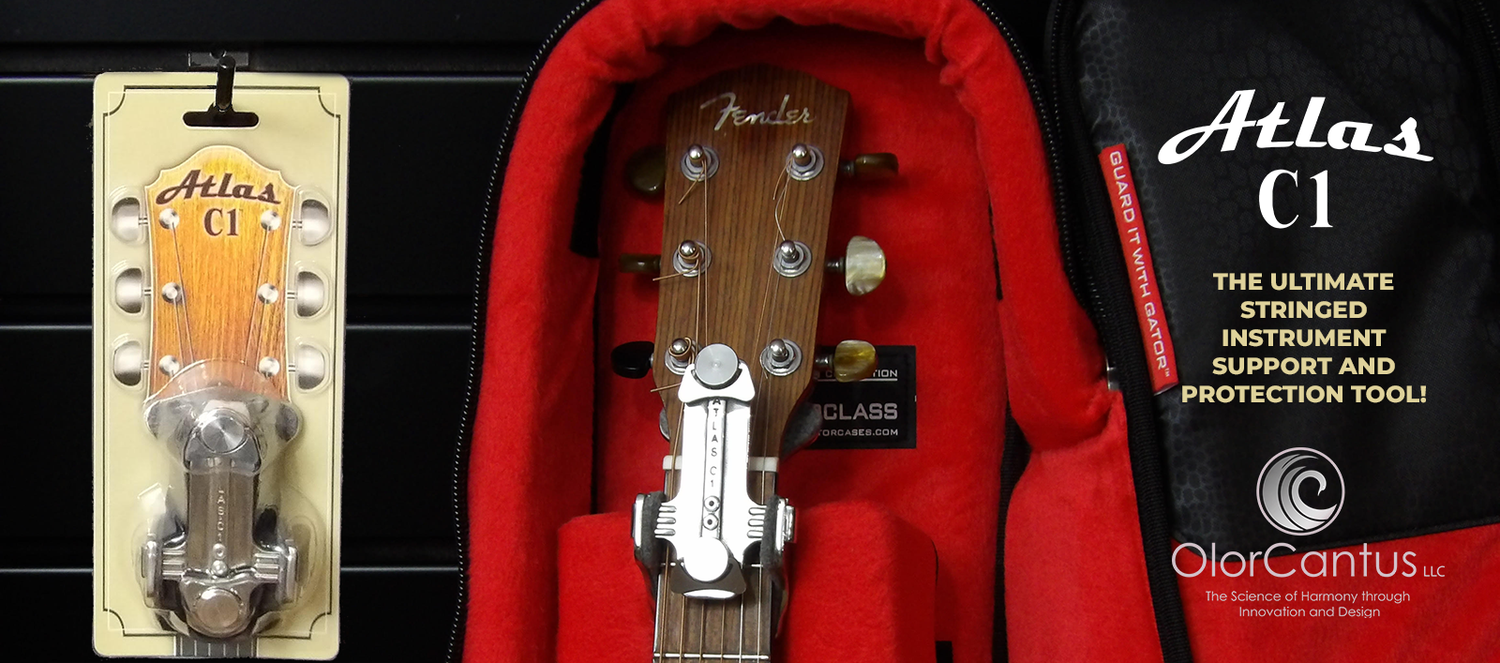
Guitar headstock protection tools are devices that support the headstock-neck junction, the weakest point on most guitars, during travel and storage. The Atlas C1 is the strongest example of this category.
How the Atlas C1 Works as a Pre-Aligned Repair Jig
The Atlas C1 does two jobs. In transit, it holds the headstock steady. During a repair, it acts as a pre-aligned jig that keeps a broken headstock in position while glue sets.
The Best Way to Ship Guitars Safely on Tour
The best way to ship guitars safely is to combine a hard shell case with internal headstock support, then pack the case so the neck cannot shift. Padding alone does not stop the headstock from moving inside the case.
- Use a hard shell case for air and freight travel
- Add headstock support such as the Atlas C1
- Loosen string tension slightly for long hauls
- Label the case as fragile and keep it climate-aware
Essential Guitar Maintenance Tools for Life on the Road
A touring maintenance kit is not a scaled-down workshop. It is a triage kit built around the failures that actually end a set: a dead cable, a stripped strap button, a broken string at the worst moment, or a jack that starts cutting out mid-song. Most practitioners find that a small, purpose-built kit outperforms a big toolbox because you can actually find what you need in a dark venue.
The Touring Survival Kit Checklist
Pack these in a single pouch that lives in the case, not in the van:
- Hex key multi-tool sized for your truss rod, bridge saddles, and strap buttons. Confirm the sizes against your specific instrument before you leave.
- String winder and cutter combined into one tool to cut restringing time in half.
- Spare strings in your two most-used gauges, plus one heavier and one lighter set for emergencies.
- Spare output jack and a spare 1/4-inch plug end, the jack is one of the most common failure points on a working guitar.
- Small soldering iron (battery or butane powered) with a bit of solder for cable and jack repairs.
- Gaffer tape for cable strain relief, securing a loose pedal, or taping a setlist down.
- Spare strap buttons and a strap lock set so a strap failure does not become a dropped guitar.
- Spare fuses and a backup patch cable for the amp and pedalboard.
- A small multi-screwdriver for tightening input jacks, control cavity screws, and pedal enclosures.
Why Redundancy Beats Repair
The most reliable touring rigs are built so that no single failure stops the show. That means carrying a backup for every link in the chain that you cannot fix in under two minutes: a spare instrument cable, a spare patch cable, a spare power supply, and a backup tuner. A common pattern is to keep the backups in a separate bag from the primary gear, so a lost or stolen case does not take both.
Digital vs. Analog Redundancy
If your rig depends on a digital modeler or a software-based amp sim, plan for the moment it will not boot. A small analog backup, a compact amp or a simple overdrive pedal that can go straight to the house PA, keeps the show moving while you troubleshoot. This is one of the most overlooked gaps in most touring guides, and it is the difference between a five-minute hiccup and a canceled set.
Climate and Humidity on the Road
Wood moves. A guitar that was set up in a dry climate will buzz or fret out after a few days in a humid coastal venue, and the reverse happens in winter. A small humidity pack in the case and a quick truss rod tweak with your hex key handle most of it. Check neck relief at the start of every tour leg rather than waiting for a problem to show up on stage.
Performance and Stage Accessories That Hold Up Night After Night
Stage gear has to survive repeated setup and teardown. The accessories worth carrying are the ones that fail least often.
Hearing Protection and Signal Chain Gear for Touring Guitarists
Hearing protection and signal chain gear protect two things that are hard to replace: your ears and your tone.
- Use quality patch cables and one instrument cable you trust
- Add a power supply instead of daisy-chaining pedals
- Keep a DI box for venues with weak sound reinforcement
- Label every cable so cable management stays fast
Travel-Friendly Guitar Equipment and Protection and Storage Solutions
Travel gear has to balance protection with portability, and the right mix depends on how you move: regional van runs, domestic flights, or international touring. Most guides stop at "get a good case." The real work is in the logistics around the case.
Protection and Storage by Transport Mode
- Van and regional touring: A well-padded gig bag such as the Gator GBE Electric Gig Bag is light and easy to load, but it offers less impact protection than a hard shell. If you go this route, add internal headstock support so the neck cannot shift inside the bag.
- Air and freight travel: A hard shell case is the baseline. Pair it with internal headstock support such as the Atlas C1, loosen string tension slightly for long hauls, and label the case as fragile. Padding alone does not stop the headstock from moving a few millimeters on every bump, and that movement stresses the neck junction.
- Overhead-bin travel: The Traveler Guitar Mark III is a full 25.5-inch scale electric built for overhead bins, with a built-in headphone amp for silent practice. It is a practice and small-set tool, not a replacement for your main instrument on a full tour.
International Touring Logistics
This is the section most guides skip entirely. If you are crossing borders with gear, plan for three things:
- Voltage and plug adapters. Confirm the input voltage range on every powered device, amps, pedal power supplies, chargers, before you plug into a foreign outlet. A plug adapter alone does not change voltage, and a device that is not dual-voltage needs a step-up or step-down converter sized for its wattage.
- Airline and customs policy. Check the carrier's musical instrument policy before you fly, and carry documentation for high-value instruments. Rules vary by carrier and by route, so verify rather than assume.
- TSA-compliant packing. Keep tools, spare strings, and any lithium batteries accessible and within current carry-on rules. A packed case that gets opened at security is far less stressful when everything is organized.
Ergonomic Touring Gear
Long tours are a physical job. A wide, padded strap distributes weight better than a thin one and reduces shoulder fatigue over a two-hour set. A lightweight case matters more than most players expect when you are loading in and out night after night. If you stand for long sets, a small footrest or a stool that packs flat can take pressure off your lower back.
Compact Amplification and Practice Solutions
There are many products available to assist Guitarist with making their sound and instrument care more professional , but only a few , quietly do the real heavy lifting necessary to keep the show on the road! The Atlas-C1 headstock protection tool is one of them.
Frequently Asked Questions
What are the most essential guitar accessories for touring musicians in 2026?
The essentials split into protection, maintenance, and performance. For protection, a hard shell case or high-quality gig bag with reinforced headstock areas is non-negotiable. For maintenance, carry spare strings, a string winder, multi-tool, and humidity control packs. For performance, a reliable clip-on or pedal tuner, high-fidelity earplugs, and quality patch cables round out the kit. The Atlas C1 headstock protection tool addresses the most vulnerable point on Gibson-style guitars, making it a strong addition for anyone flying or busing between shows.
How can I protect my guitar headstock while traveling?
The headstock-neck junction is the weakest point on angled-headstock guitars like Les Pauls. String tension alone exerts over 130 pounds of pressure on that joint. Use a hard shell case with a snug neck support, loosen strings slightly during transit, and add a dedicated headstock protection tool like the Atlas C1 that supports the neck junction directly. Avoid packing soft items around the headstock that shift during transport. For shipping, double-box with padding at least two inches thick on all sides.
What is the best way to ship guitars safely?
The best way to ship guitars safely starts with a hard shell case, then a double-box with at least two inches of padding on all sides. Detune strings by a step or two to reduce tension on the neck. Support the headstock with a dedicated protection tool so it cannot move inside the case. Use gaffer tape on latches, mark the box fragile, and always ship with insurance. For international shipping, check voltage requirements if sending any electronic gear alongside the instrument.
Why is headstock support critical for touring guitarists?
Headstock breaks are the most common serious damage on angled-headstock guitars. The neck junction takes 130+ pounds of string tension even before a drop or impact. A repair costs $200-$300 or more at a luthier, and the instrument is out of rotation for weeks. A headstock protection tool like the Atlas C1 counteracts that tension and absorbs impact during transit. For touring guitarists playing 200+ dates a year, that protection prevents the downtime that costs far more than the tool itself.
What gear is necessary for professional guitar maintenance on the road?
A road maintenance kit should include spare strings in your gauges, a string winder, wire cutters, a multi-tool with hex keys for your bridge and truss rod, a clip-on tuner, contact cleaner for scratchy pots, and gaffer tape for emergency fixes. Add a small emergency repair kit with super glue (for temporary nut fixes) and a spare output jack. Humidity control packs prevent fret sprout and neck warping in dry climates. The Atlas C1 doubles as a pre-aligned repair jig if a headstock break happens mid-tour.