
Table of Contents
- Why Vintage Guitars Demand Extra Protection During Travel
- The Best Way to Ship Guitars Safely: Core Preparation Steps
- Hard Cases vs. Gig Bags: Which Offers Real Protection
- Guitar Headstock Protection During Transit: Preventing the Most Costly Break
- Managing Humidity and Temperature During Air Travel
- Shipping Vintage Instruments Insurance and Documentation
- Flight-Rated Cases and Airline Regulations for Guitars
- Post-Transit Acclimation: Protecting Your Guitar After Arrival
- Frequently Asked Questions
Last Updated: September 3, 2026
Why Vintage Guitars Demand Extra Protection During Travel
Vintage guitars represent irreplaceable investments. A 1959 Gibson Les Paul, a pre-CBS Fender Stratocaster, or a hand-built classical guitar from the 1970s isn't just an instrument, it's a piece of music history. When these guitars leave your studio or home, they face real danger. A single impact during transit can crack the headstock, warp the neck, or compromise the finish in ways that diminish both playability and value.
The vulnerability isn't theoretical. According to Reverb's instrument damage survey, headstock breaks rank among the most common damage claims for guitars shipped by musicians. The physics are unforgiving: when a guitar drops or gets jostled in transit, the headstock, which extends from the neck at an angle on Gibson-style instruments, experiences forces that a standard case alone cannot fully absorb.
This guide from Atlas C1 covers the essential strategies for protecting vintage guitars during transit. Whether you're flying to a gig, shipping an instrument across the country, or traveling by bus, the methods you use determine whether your guitar arrives unscathed or damaged. Below, we'll show you exactly how to prepare your vintage guitar for travel, what protection methods actually work, and how to restore it properly after arrival.

The Best Way to Ship Guitars Safely: Core Preparation Steps
Preparation is where most musicians either succeed or fail. A properly prepared guitar can survive rough handling; an unprepared one can break even in a quality case.
Transit damage occurs through direct impact, internal shifting, and environmental stress. Each requires different protection.
Loosening Strings and Relieving Tension
Before packing your vintage guitar for trips longer than a day, loosen the strings. A guitar under full tension carries 130+ pounds of pressure on the neck. During air travel, cabin pressure and temperature changes stress aged wood, increasing the risk of neck warping or finish checking.
Loosen strings to half tension to reduce load on the truss rod and neck, dramatically reducing structural stress.
Do not adjust the truss rod before travel, only a qualified luthier should do this. Loosening strings is standard pre-travel preparation requiring no technical knowledge.
Inspecting for Existing Damage
Before packing, inspect for hairline cracks, neck-body separation, loose internal braces, finish damage, and loose hardware. Document any existing damage with photos for insurance purposes. For valuable instruments, have a luthier perform a pre-transit inspection.
Hard Cases vs. Gig Bags: Which Offers Real Protection
A hard-shell case with proper padding absorbs significant impact by distributing force across the case walls. A gig bag's thin padding (10-15mm) compresses under impact and provides minimal headstock or neck protection.
For air or bus travel, a hard-shell case is essential. Flight-rated cases feature reinforced corners, secure latches, and internal bracing designed for commercial aviation's rough handling.
Look for cases with at least 2 inches of firm foam padding on all sides that holds the guitar without shifting or creating pressure points. When ordering your protective equipment, take advantage of free shipping to get your case and accessories delivered without extra cost.
Guitar Headstock Protection During Transit: Preventing the Most Costly Break
The headstock is where most vintage guitars fail during transit. It's also the most expensive damage to repair. Understanding why headstocks break, and how to prevent it, is critical for anyone traveling with a valuable instrument.

Why Headstocks Fail Under Pressure
Gibson-style headstocks angle back 17 degrees, creating a weak point at the neck junction. Impact forces the headstock forward while the neck resists, concentrating stress where the truss rod channel ends. Straight-headstock guitars also fail at this junction under impact.
Standard case padding doesn't address the specific structural vulnerability at the headstock-neck junction, where concentrated stress causes breaks.
Headstock Support Solutions for Travel
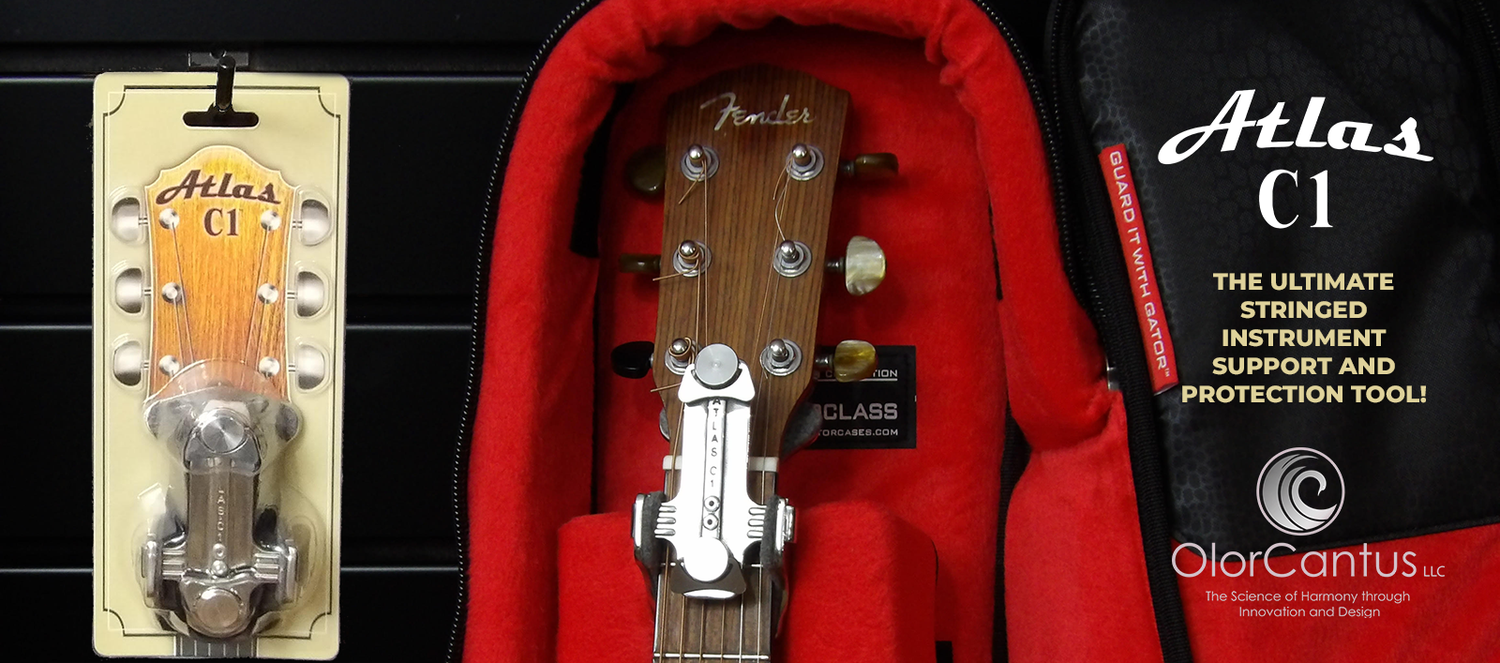
Use a dedicated headstock support tool like the Atlas C1, which stabilizes the headstock-neck junction by clamping the headstock and neck together. This eliminates movement at the most vulnerable point and prevents inertia forces that cause breaks.
Add soft padding around the headstock area inside your case, focusing on the neck-junction. Ensure the guitar cannot shift inside the case by using firm internal supports.
For nitrocellulose finishes, use glassine paper or acid-free tissue between the guitar and padding to prevent sticking.
Managing Humidity and Temperature During Air Travel
Vintage guitars are sensitive to environmental changes. A guitar built in 1959 spent decades acclimating to specific humidity and temperature ranges. When you fly with that guitar, it experiences rapid changes that stress the wood.
Aircraft cabins maintain 10-20% humidity and experience 30+ degree temperature fluctuations, causing wood expansion and contraction that can crack or lift the finish.
For flights longer than 4 hours, place 2-3 silica gel desiccant packs around the guitar (not touching the finish) to stabilize internal humidity.
When you arrive, leave the guitar in its case for 2-3 hours to allow gradual acclimation to the new temperature and humidity, preventing finish checking and neck warping.
For significant climate changes, use a hygrometer inside your case to monitor relative humidity, aiming for 40-50% for most vintage guitars.
Shipping Vintage Instruments Insurance and Documentation
If you're shipping your vintage guitar rather than traveling with it, proper insurance and documentation are essential. A shipping claim without proper documentation often gets denied or significantly reduced.
Document your guitar's condition with detailed photos from multiple angles. Get a written valuation from a luthier or appraiser for insurance purposes, many companies require this before covering high-value instruments.
Purchase insurance covering full replacement value. Specialty music shipping insurance typically covers 100% of declared value. Keep documentation, policy, and photos together for quick claim filing if needed.
Flight-Rated Cases and Airline Regulations for Guitars
Airlines have specific rules about what constitutes carry-on luggage versus checked baggage for instruments. Understanding these rules prevents problems at the airport.
Most airlines allow guitars as carry-on if the case meets size restrictions. Check your airline's website before flying, as policies vary.
If you must check your guitar, use a flight-rated hard case with reinforced corners, heavy-duty latches, and internal bracing for cargo hold protection.
Ensure case latches are easy to open for TSA inspection. Consider TSA-approved locks to allow inspection without breaking the lock.
When flying, inform the gate agent that you're carrying a guitar. Some airlines require advance notice for instruments. Having documentation of your guitar's value and condition also helps if there's any dispute about what constitutes acceptable carry-on luggage.
Post-Transit Acclimation: Protecting Your Guitar After Arrival
The moment your vintage guitar arrives at its destination, the protection process isn't finished. How you handle the guitar after travel determines whether it suffers delayed damage.
Leave the guitar in its case for 2-3 hours after arrival for gradual acclimation. Then inspect the headstock, neck, body, and finish for any new damage.
If you notice damage, have a qualified luthier evaluate it. Some damage is cosmetic; other damage requires professional repair.
Loosen strings before storing at your destination. After a full day of acclimation, gradually retighten to full tension rather than immediately bringing the guitar to full tension.
For long-term storage at your destination (more than a week), keep the guitar in a climate-controlled environment. Avoid direct sunlight, which can fade the finish and stress the wood. Store the guitar at 40-50% relative humidity and 65-72 degrees Fahrenheit.
Protecting your vintage guitar during transit requires planning, the right equipment, and understanding the specific vulnerabilities of your instrument. A quality hard-shell case forms the foundation of protection, but it's not enough alone. Loosening strings before travel, using a dedicated headstock support tool like the Atlas C1, managing humidity and temperature, and following proper acclimation protocols after arrival all work together to keep your instrument safe.
The Atlas C1 headstock support tool addresses the single most common failure point for vintage guitars in transit, the vulnerable headstock-neck junction. By providing rigid support that counters string pressure and prevents movement during handling, it eliminates the structural stress that causes breaks. Beyond protection during travel, it doubles as a pre-aligned repair jig, giving you a long-term solution for instrument care. Customers can take advantage of a 10% product discount when ordering, and enjoy free shipping on their purchase. Get started with the Atlas C1 and travel with confidence that your vintage guitar will arrive in the same condition it left.
Frequently Asked Questions
Should you loosen guitar strings before shipping a vintage instrument?
Yes. Loosening strings reduces string tension that can stress the neck and headstock during transit. For vintage guitars with nitrocellulose finishes or weakened wood, this step is critical. Loosen strings gradually over a day or two rather than all at once to avoid shock to the truss rod. Leave strings slightly slack but not completely loose, this protects the instrument without requiring full restringing upon arrival.
How does protecting vintage guitars during transit prevent expensive repairs?
Headstock breaks are a common and costly guitar damage. Proper padding, headstock support, and climate control during transit prevent the impacts, pressure, and humidity fluctuations that can cause breaks. A preventive approach with the right protection tools costs less than emergency repair and preserves the instrument's structural integrity and resale value.
What is the best way to ship guitars safely if I'm flying frequently?
Use a flight-rated hard case with internal shock absorption and padded compartments. Loosen strings, add silica gel desiccant packs to manage humidity, and include a headstock support tool to counteract the 130+ pounds of string pressure. Document your guitar's value and condition before shipping, and consider instrument insurance for high-value vintage pieces. Keep your guitar in carry-on luggage when possible to avoid baggage handling damage.
Can the Atlas-C1 work on guitars with straight headstocks, or is it only for Gibson-style angled necks?
The Atlas-C1 is engineered as a universal multi-function tool that works on both angled and straight headstocks. Its design targets the vulnerable headstock-neck junction regardless of headstock angle, providing support and protection for Fender Telecasters, Stratocasters, and other straight-headstock designs just as effectively as it does for Gibson-style instruments. It doubles as a pre-aligned repair jig for any headstock break repair.
This article was written using GrandRanker