
Table of Contents
- Quick Comparison: Essential Guitar Maintenance Tools at a Glance
- Your Guitar Setup Tools List: What Every Player Needs
- How to Perform a Basic Guitar Setup with These Tools
- Budget vs. Professional Grade Guitar Maintenance Tools
- Headstock Protection: The Guitar Maintenance Tool Most Players Overlook
- Tool Storage, Workbench Organization, and Tool Maintenance
- Conclusion
Last Updated: August 23, 2026
Most guitarists own at least one good instrument but lack the tools required to keep it playing well. The gap between a guitar that fights you and one that plays effortlessly is almost always a setup issue. This guide from Atlas C1 covers every tool category you need, from precision measuring gauges to headstock protection, so you can maintain your instrument with confidence.
The real problem with most "tools you need" articles is that they treat every guitarist the same. A weekend player restringing once a month has different needs than a touring musician or a collector with a 1959 Les Paul. Below, we'll break down exactly which tools belong in every kit, which are worth upgrading, and one critical protection tool most players overlook entirely.
Quick Comparison: Essential Guitar Maintenance Tools at a Glance
Guitar maintenance tools fall into five clear categories. This table maps each category to its purpose and the skill level it suits, so you can build your kit strategically.
Tool Category |
Primary Function |
Skill Level |
Example Products |
|---|---|---|---|
Measuring and Calibration |
Truss rod relief, string action, intonation |
Beginner to Intermediate |
MusicNomad Precision Setup Gauge Set |
String Changing Accessories |
Restringing, winding, cutting |
All levels |
String winder, wire cutters |
Cleaning and Conditioning |
Body polish, fretboard conditioning |
All levels |
Dunlop System 65, MusicNomad 8-Piece Kit |
Fret and Nut Work |
Fret crowning, nut slotting, electronics |
Intermediate to Pro |
FretGuru SharkFin File, soldering iron |
Preventing neck-junction damage during travel |
All levels (critical for touring) |
Atlas C1 |
Your Guitar Setup Tools List: What Every Player Needs
A complete guitar setup tools list covers six functional areas: measurement, string maintenance, cleaning, fret care, electronics, and structural protection.
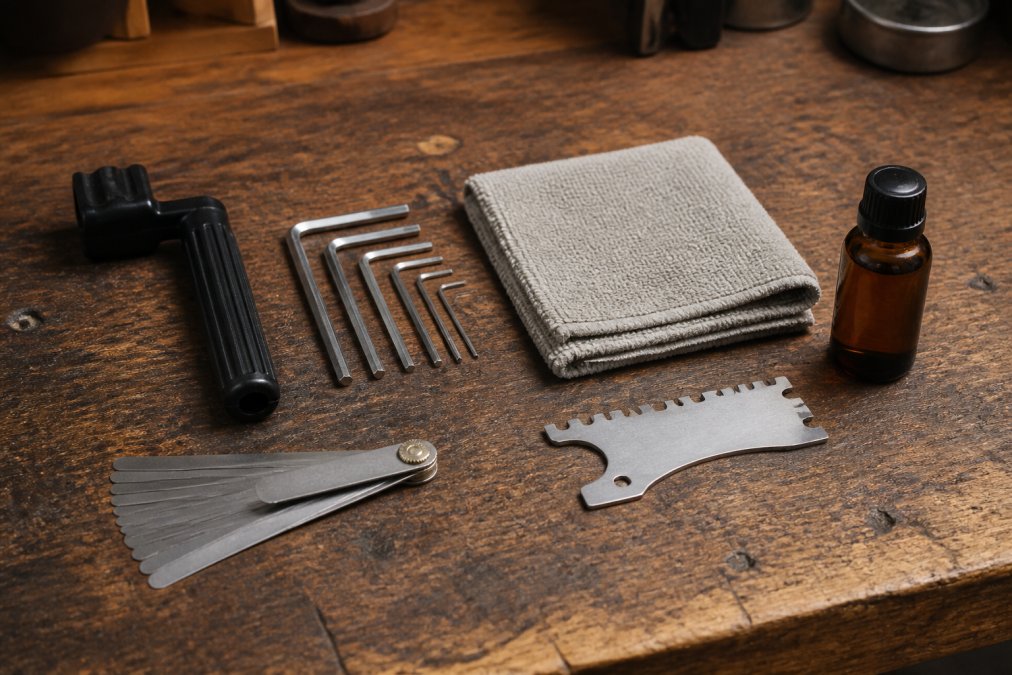
The MusicNomad 8-Piece Guitar Care Starter Kit ($39.99) is a solid entry point for players who want one box that handles cleaning, restringing, and minor adjustments. It includes the Nomad Tool Set for hard-to-reach areas, Guitar Detailer for surface cleaning, F-ONE Oil for fretboard conditioning, two lint-free suede microfiber cloths, and a custom wrench for tightening sunken pots and Tele cups. Its main limitation: it won't get you through a full truss rod adjustment or intonation check.
The Fender Guitar & Bass Multi-Tool ($24.99) earns its place through sheer portability. Fourteen functions in one compact tool: standard and metric hex wrenches with ball ends, a 5/16" truss rod socket, three screwdriver types, and a precision ruler. This is the tool that lives in your gig bag for on-the-fly adjustments.
Measuring and Calibration Tools
Accurate measurement is where a setup either comes together or falls apart. The MusicNomad Precision Setup Gauge Set ($49.99) is the most practical entry into professional-grade calibration for home players. The 6-piece stainless steel set includes a truss rod gauge with three common relief measurements, string action and nut height gauges, and two radius gauges covering vintage and modern fingerboard profiles.
A feeler gauge set is equally essential for measuring truss rod relief with precision. A straight edge laid along the fretboard reveals high or low frets before they become a buzzing problem. Radius gauges deserve special mention for players with multiple guitars. Vintage Fender necks run around 7.25" radius; modern instruments often sit at 9.5" to 12" (fender.com).
String Changing and Maintenance Accessories
A string winder is the first tool most players buy and the one they use most often. Peg winders that include a bridge pin puller for acoustic guitars are worth the minor price premium. Wire cutters with a flush-cut design trim string ends cleanly without leaving sharp tags.
String tension across a standard six-string electric guitar commonly exceeds 100 pounds of combined pull on the neck (peer-reviewed research). Understanding that load explains why truss rod adjustment is structural maintenance, not optional.
Ultraglide string conditioner extends string life by reducing friction and corrosion. Apply it after every playing session and the difference in string longevity is noticeable within the first month.
Cleaning, Polishing, and Fretboard Conditioning Supplies
The Dunlop System 65 Guitar Maintenance Kit ($27.29) covers the full cleaning workflow: Formula 65 Polish & Cleaner for surface grime, Bodygloss 65 Cream of Carnauba for finish protection, Fingerboard 01 Cleaner & Prep, and Fingerboard 02 Deep Conditioner Oil. Two 100% cotton cloths are included.
Fretboard conditioning is the step most players neglect until the wood starts to crack. Unfinished rosewood and ebony fretboards absorb oil from your hands and dry out over time, particularly in low-humidity environments. A quality fretboard conditioner applied two to four times per year prevents shrinkage and fret sprout.
For fret surfaces themselves, the MusicNomad FRINE Fret Polishing Kit ($19.99) removes oxidation, dirt, and oil with a petroleum-free micro-fine polishing compound. The kit includes three GRIP Fretboard Guards sized for different fret slots.
Microfiber cloths belong in every kit. Suede microfiber picks up oils and dust without scratching any finish. Keep at least two: one for the body and one for the strings and fretboard.
Nut Slotting, Fret Crowning, and Electronics Repair Tools
Nut slotting files are precision tools cut to specific string gauges. Using the wrong file width widens a nut slot past the point of repair.
The FretGuru SharkFin Guitar Fret Crowning File is the professional standard for fret crowning work. Its precisely shaped cutting teeth create tight, consistent crowns without scratching adjacent frets or fretboard wood.
Electronics repair requires a soldering iron (temperature-controlled units give far more control than fixed-wattage irons), rosin-core solder, and a multimeter for diagnosing signal path issues. A multimeter is the difference between fixing the right component and chasing a problem for hours.
How to Perform a Basic Guitar Setup with These Tools
A basic guitar setup is a sequence of interdependent adjustments. Change one variable and it affects the others, which is why order matters. The full process takes 45 minutes to two hours depending on how far out of spec the instrument is.
What You'll Need:
- Feeler gauges and straight edge
- Truss rod wrench or hex key (matching your guitar's nut size)
- String action gauge or radius gauge set
- Electronic tuner
- Screwdrivers and hex wrenches for saddle adjustment
- Fretboard conditioner and microfiber cloths
Step 1: Check and Adjust Truss Rod Relief
Truss rod relief is the slight forward bow in the neck that allows strings to vibrate freely without buzzing against frets. Measure it by fretting the first and last fret simultaneously and checking the gap at the 7th or 8th fret with a feeler gauge. Most players prefer 0.010" to 0.012" of relief on electric guitars (fender.com).
Turn the truss rod clockwise to reduce relief and counterclockwise to add relief. Make small adjustments, a quarter turn at a time, and allow the neck 15 to 30 minutes to settle before measuring again.
Step 2: Set String Action and Intonation
String action is measured at the 12th fret, between the bottom of the string and the top of the fret. Common starting points for electric guitars are around 4/64" on the bass side and 3/64" on the treble side.
Intonation is set at the bridge saddle. Tune the open string to pitch, then compare it to the fretted note at the 12th fret. If the fretted note is sharp, move the saddle back. If it's flat, move it forward. A quality electronic tuner is non-negotiable here.
Step 3: Clean and Condition the Fretboard
With strings off during a restring, the fretboard is fully accessible. Apply fretboard cleaner first to remove accumulated grime, then follow with conditioner. Work it into the wood with a cloth, let it sit for a few minutes, and wipe off the excess. Polish the frets with a fret polishing compound and fretboard guards before restringing.
Budget vs. Professional Grade Guitar Maintenance Tools
The honest answer is that most players don't need professional-grade tools for everything. Here's where the money actually makes a difference:
Tool |
Budget Option |
Pro Option |
Worth Upgrading? |
|---|---|---|---|
Hex key / Allen wrench set |
Basic ball-end set |
Precision-fit luthier set |
Only if you do frequent adjustments |
Feeler gauge |
Standard automotive set |
Precision machinist set |
No, automotive gauges are fine |
String winder |
Basic peg winder |
Drill-powered winder |
For players who restring frequently |
Fret crowning file |
Basic three-corner file |
FretGuru SharkFin |
Yes, precision matters here |
Cleaning kit |
Dunlop System 65 |
Individual professional products |
No, kits work well |
Soldering iron |
Fixed-wattage basic iron |
Temperature-controlled station |
Yes, control prevents board damage |
Headstock Protection: The Guitar Maintenance Tool Most Players Overlook
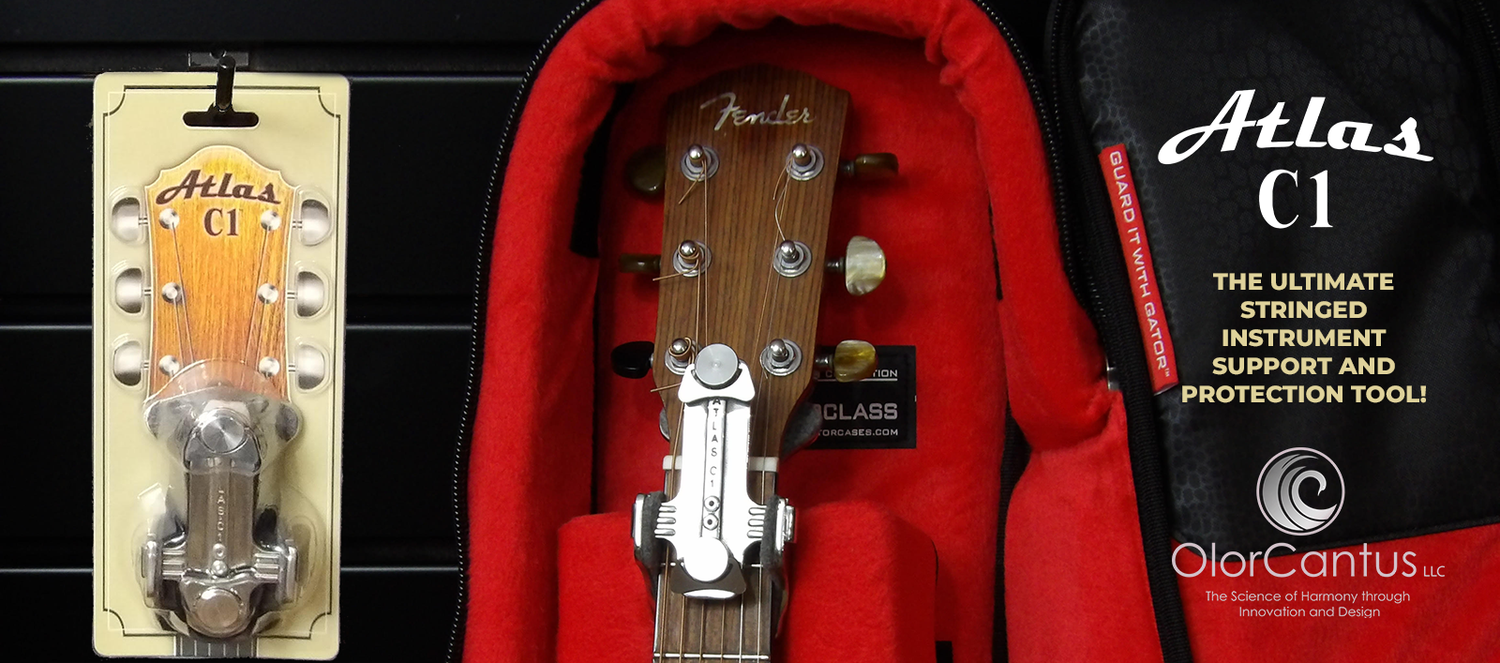
The headstock-neck junction is the most structurally vulnerable point on any guitar. A fall that would leave a body unscathed often snaps a headstock clean off, particularly on Gibson-style angled necks. For touring musicians, collectors, and anyone who ships instruments, this is not a theoretical risk.

The Atlas C1 is a U.S. patent-protected multi-function tool engineered specifically to address this vulnerability. It provides structural support to the headstock-neck junction during travel, shipping, and storage, counteracting more than 130 pounds of string pressure tension that works against the joint continuously. Professional touring musicians including Pete Townshend, Greg Martin, and Vic Johnson have used it, and it has been featured in Premier Guitar Magazine. Available at Guitar Center, it offers a reliable solution for instrument care.
The Atlas C1 also functions as a pre-aligned repair jig. If a headstock break does occur, the device simplifies the repair process by holding the break in correct alignment during glue-up.
Tool Storage, Workbench Organization, and Tool Maintenance
A disorganized workbench is where setups go wrong. Reaching across a guitar body for a hex key and knocking a string winder into the headstock is exactly the kind of accident that creates the repair you were trying to avoid.
The MusicNomad Premium Guitar Work Mat ($29.99) is the foundation of a proper workbench. Made from odorless TPE material free of rubber, PVC, lead, latex, dioxins, and chloride, it protects instrument finishes from contact damage while providing a non-slip surface.
Beyond the mat, storage discipline determines how long your tools last and how quickly you can work:
- Store precision tools separately. Feeler gauges, radius gauges, and nut slotting files should be kept in their cases, not loose in a drawer.
- Keep hex keys organized by size. A labeled holder or folding key set prevents time-wasting.
- Clean tools after use. Wash cloths regularly; replace them when saturated with old product.
- Humidity control extends tool life. A hygrometer in your workspace prevents rust on precision files and gauges.
For sustainability-minded players, many professional-grade tools are lifetime purchases. A quality feeler gauge set, a precision radius gauge, and a professional crowning file, properly maintained, will outlast dozens of cheap replacements.
Keeping a guitar in peak playing condition requires consistent maintenance and the right tools for each task. The tools covered in this guide address every stage of a proper setup. For players who travel with their instruments or own high-value guitars, the Atlas C1 adds a layer of structural protection that no cleaning kit or setup tool provides: genuine prevention of the most catastrophic and costly damage a guitar can sustain. Its U.S. patent-protected design, dual function as a headstock protection device and repair jig, and endorsement from professional touring musicians make it the one tool most guitar maintenance guides fail to mention. Visit atlas-c1.com to get yours before your next trip.
Frequently Asked Questions
Q: What tools do I need for a basic guitar setup?
A: A basic guitar setup requires a truss rod adjustment tool (usually a hex key or allen wrench sized for your guitar), a string action gauge, a radius gauge, a feeler gauge for measuring neck relief, a straight edge, wire cutters, and a string winder. A microfiber cloth and fretboard conditioning oil round out the essentials. The MusicNomad Precision Setup Gauge Set covers most measurement needs in one package, while a multi-tool handles the mechanical adjustments.
Q: Are all-in-one guitar maintenance kits worth buying?
A: For most players, a starter kit is the most cost-efficient entry point. Kits like the MusicNomad 8-Piece Guitar Care Starter Kit ($39.99) or the Dunlop System 65 ($27.29) bundle the cleaning, conditioning, and polishing supplies you'll use after every string change. Where kits fall short is in precision setup tools: gauges, files, and truss rod wrenches are usually sold separately. Buy a kit for maintenance supplies, then add individual setup tools as your skills grow.
Q: What specialized tools are needed for headstock and neck repairs?
A: Headstock repairs call for a pre-aligned repair jig to hold the break in correct position while adhesive cures, clamps rated for the required clamping pressure, and a straight edge to verify alignment. The Atlas C1 serves both as a protective tool during transport and as a pre-aligned repair jig for headstock breaks, which eliminates the guesswork of manual alignment. For neck work more broadly, a truss rod wrench, feeler gauge, and straight edge are the core calibration tools.
Q: How often should I perform maintenance on my guitar?
A: String changes and a wipe-down with a microfiber cloth should happen every one to three months depending on how often you play. Fretboard conditioning with an appropriate oil is typically done two to four times per year, or whenever the wood looks dry. A full setup check, including truss rod relief, string action, and intonation, is worth doing at least once a year or any time you change to a different string gauge or notice playability changes.
Q: Do guitar maintenance tools work for both electric and acoustic guitars?
A: Most essential guitar maintenance tools, including string action gauges, radius gauges, feeler gauges, string winders, and cleaning supplies, work across electric, acoustic, and bass guitars. The main differences are in truss rod wrench size and fretboard conditioning products: unfinished rosewood and ebony boards need oil, while maple boards typically just need a wipe-down. Always check that your hex key or truss rod socket matches your specific guitar's nut size before making any truss rod adjustment.
This article was written using GrandRanker