
Last Updated: November 4, 2026
Quick Summary
To prevent humidity damage during guitar shipping, detune the strings to slack tension, wipe the instrument dry, and place a humidity control pack in a hard-shell case. Seal the case in a vapor barrier, cushion every gap with foam, and pack it in an outer box with two inches of clearance. Inspect and acclimate the guitar slowly after arrival.
- Detune strings to a slack but not fully loose tension before shipping.
- Target a relative humidity of roughly 45 to 55 percent, using a hygrometer to check.
- Seal the case in a plastic bag to slow moisture exchange with outside air.
- Leave at least two inches of cushioned clearance on every side of the case.
- Acclimate the guitar in its case for 24 to 48 hours before tuning up to pitch.
Table of Contents
- Why Humidity Damage Happens During Guitar Shipping
- Ideal Humidity Range and the Risks of Getting It Wrong
- Step 1: Prepare the Guitar Before It Leaves
- Using a D'Addario Humidity Pack the Right Way
- Step 2: Pack the Guitar to Protect the Neck and Body
- Shipping Vintage Guitar With Original Case: What to Know
- Step 3: Inspect and Acclimate the Guitar After Arrival
- Booking Your Next Shipment With Atlas C1 Protection in Mind
- Frequently Asked Questions
Shipping a guitar is one of the riskiest moments in its life. Humidity swings, rough handling and long stretches in a cargo hold can crack a top, lift a bridge or open a seam. Guitars rarely fail in one dramatic moment. They fail slowly, in conditions nobody checked. This guide explains how to protect a guitar from humidity damage in shipping, step by step.
Why Humidity Damage Happens During Guitar Shipping
Wood is hygroscopic, which means it gains and loses moisture as the air around it changes. A guitar packed in a warm, humid room and then shipped to a dry climate will release moisture quickly. The reverse is also true. Cold, dry cargo holds can pull moisture out of a guitar's top and back faster than the wood can adjust.

The problem is that shipping moves a guitar through several climates in a few days. A box may sit on a loading dock in summer heat, ride in a truck with no climate control and then wait in a warehouse. Each stop is another chance for the wood to move.
Watch out: a guitar that feels fine on arrival can still have stress cracks forming inside the wood. The damage often shows up weeks later, once the guitar sits in its new home.
Ideal Humidity Range and the Risks of Getting It Wrong
Many guitar makers and technicians aim for a relative humidity in a moderate range, often cited as roughly 45 to 55 percent. This is a common working range, not a law, and your own climate may call for small adjustments. A hygrometer, a cheap digital gauge, tells you what the case or room is actually holding. Learn seven steps to keep humidity stable year-round once the guitar is home.
Problems tend to fall into two groups:
- Too dry: The top can sink, cracks can open along the grain, and the fretboard can shrink and expose fret ends.
- Too humid: The neck can swell, the action may rise, and the wood can warp or bind.
Many damage reports involve a guitar that moved from one extreme to the other. A sudden change does more harm than a steady, moderate level. Acclimation, meaning letting the guitar slowly match its new environment, is the simplest way to reduce that stress.
Step 1: Prepare the Guitar Before It Leaves
Start with a clean, dry instrument. Wipe off sweat, dust and fingerprints, because grime can hold moisture against the finish. Check the setup too. A guitar with very low or very high action may shift more visibly under humidity changes, so note any issues before you pack.
Next, measure the case or room where the guitar currently lives. If you can, record the reading. This gives the receiving player a baseline for acclimation later.
Detuning Strings for Transit
Loosen the strings to a lower tension before shipping. Full string tension puts constant force on the neck and top, and a guitar in transit can be jostled or exposed to temperature shifts. Many technicians drop strings to a slack but not fully loose level, enough to take pressure off the neck without letting strings tangle or slip off the bridge.
Keep the strings on the guitar, unless you have a specific reason to remove them. Removing strings can change how the neck and bridge sit.
Using a D'Addario Humidity Pack the Right Way
Humidity control packs are small sachets that release or absorb moisture to hold a steady level inside a sealed space. Humidity control packs designed for instrument cases are available from several manufacturers.
To use one well:
- Check the pack's rated humidity level and match it to the target range above.
- Place it inside the case, away from direct contact with the finish.
- Keep the case sealed once the pack is in, so it can do its job.
- Replace the pack when the manufacturer says to, since spent packs lose effect.
A humidity pack does not replace good packing. It works inside a case that already protects the guitar from impact and temperature swings.
Step 2: Pack the Guitar to Protect the Neck and Body
Packing is where most shipping damage is prevented, and it is also where humidity protection is won or lost. The goal is threefold: keep the guitar from moving, cushion the neck and headstock, and seal the instrument off from the air outside the box. Impact protection and moisture protection are separate problems, and a pack that solves one can fail the other.
Work in layers, from the guitar outward.
Layer 1, The instrument. Detune to a slack-but-not-loose tension as described above, wipe the instrument dry, and confirm the case interior is dry and free of mildew or loose lining. Place a humidity control pack inside the case, away from direct contact with the finish.
Layer 2, The case. Use a hard-shell case whenever possible. A hard case holds its shape, resists stacking pressure and gives the humidity pack a semi-sealed volume to work in. Fill every gap around the body and neck with foam or soft padding so the guitar cannot slide. Pay special attention to the headstock: wrap the neck and headstock junction with foam so a sharp knock cannot lever the headstock against the case wall.
Layer 3, The vapor barrier. This is the step most shippers skip. A sealed plastic bag or a purpose-made vapor barrier around the case slows moisture exchange with the outside air, which is what actually protects the guitar during the days it spends in trucks, warehouses and cargo holds. Without a barrier, a humidity pack fights an open system and loses. With a barrier, the pack has a chance to hold a steady level. Use a bag large enough to fully enclose the case, twist or fold the opening, and seal it with packing tape. Leave a small pocket of air inside, do not vacuum-seal the bag against the case.
Layer 4, The outer box. Choose a box with at least two inches of clearance on every side of the case. Fill that clearance with foam sheets, bubble wrap or moving blankets, not loose packing peanuts around the neck. Peanuts shift, leave gaps and crush unevenly, which is exactly how headstocks break. Double-box high-value instruments: an inner box around the case, then an outer box with cushioning between them.
Layer 5, Labeling. Mark the box clearly as a musical instrument and as fragile on at least two sides. Some carriers route instrument boxes differently when the label is clear, and handlers respond to visible warnings.
Adjusting the Pack for the Humidity Delta Between Origin and Destination
A pack that works for a short trip within one climate can fail on a cross-country shipment. The variable that matters is the humidity delta, the difference between the relative humidity where the guitar is packed and the relative humidity where it will be opened. A guitar leaving a damp coastal room and arriving in a dry high-desert climate will lose moisture fast if the barrier is weak. A guitar leaving a dry heated room and arriving in a humid climate faces the opposite stress.
A practical approach:
- Large delta, dry destination: Use a humidity pack rated near the low end of the target range, add a second sealed bag around the case, and include a small hygrometer inside the case so the recipient can read what actually happened in transit.
- Large delta, humid destination: Use a humidity pack rated near the high end of the target range and prioritize the vapor barrier, since the risk is moisture moving in rather than out.
- Small delta: A single humidity pack and a well-sealed case are usually enough, provided the outer box is properly cushioned.
You can estimate the delta by checking a local weather service for the origin and destination zip codes on the day of packing and the expected arrival day. You do not need precision, you need to know whether you are shipping from wet to dry, dry to wet, or like to like, and to pack accordingly.
Packing Materials: DIY Versus Professional
You have two main choices. DIY packing uses materials you probably already own, such as bubble wrap, moving blankets, foam sheets and tape. It can work well for a careful packer, but results vary with the materials and skill involved. Household blankets cushion well but do almost nothing for moisture; a plastic bag does the moisture work but nothing for impact. The strongest DIY pack combines both.
Professional packing uses purpose-built cases, custom foam inserts and tested sealing methods. It costs more, but it is often the safer choice for vintage or high-value instruments. A reputable instrument shipper can also advise on what their carrier allows and whether climate-controlled transit is available for the route.
Either way, avoid loose packing peanuts around the neck. They can shift, leave gaps and crush unevenly.
The table below summarises the five packing layers covered in this section, so you can check each one before the box is sealed.
| Layer | What to do | Key point |
|---|---|---|
| 1. The instrument | Detune to slack tension, wipe dry, add humidity pack | Pack stays away from finish |
| 2. The case | Use hard-shell case, fill gaps with foam | Protect headstock junction |
| 3. Vapor barrier | Seal case in plastic bag, leave a small air pocket | Slows moisture exchange |
| 4. Outer box | Allow two inches clearance, use foam or blankets | Avoid loose packing peanuts |
| 5. Labeling | Mark as musical instrument and fragile on two sides | Visible warnings aid handling |
Shipping Vintage Guitar With Original Case: What to Know
Vintage instruments often come in their original cases, and many collectors prefer shipping them that way. An original case can be a strong protective shell, but it may not seal or cushion as well as a modern case. Older cases can also hold moisture from years of use or storage.
Before shipping, open the case and check the interior lining for dampness, mildew or loose foam. Replace or repair anything that could fail in transit. If the case does not close tightly, you can add a secondary box or bag to protect it.
Be cautious about altering a vintage case in ways that affect its value.
Step 3: Inspect and Acclimate the Guitar After Arrival
Arrival is the moment when damage becomes evidence. Handle it in the right order and you protect both the guitar and your ability to file a claim if something went wrong in transit.
Document before you open. Photograph the box on all six sides before you cut tape. Capture any dents, crush marks, water staining or punctures, and photograph the shipping label in the same frame so the tracking number is visible. If the box shows obvious damage, photograph it before the carrier leaves and, where possible, note the damage with the driver. Carriers generally require this record to process a claim.
Open in a clean, dry space. Avoid opening a cold box in a warm, humid room, because condensation can form on the instrument. Let the sealed box sit in the room where it will be unpacked for a few hours so the outside of the box can equalize before you open it.
Inspect in a fixed sequence. Work from the outside in and check the same points every time, so nothing is missed:
- Case exterior: cracks, crushed corners, latches that no longer align, hinges that bind.
- Case interior: damp lining, mildew smell, loose or crumbling foam, moisture visible on the humidity pack.
- Top and back: new lines along the grain, a sunken or bellied top, finish checking that was not present before shipping.
- Bridge and bridge plate: lifting at the edges, a gap under the bridge, movement when you gently press.
- Neck and fretboard: twist, bow, a hump where the neck meets the body, fret ends that protrude or feel sharp.
- Binding and seams: separation at the waist or along the back, gaps at the neck joint.
- Headstock and nut: cracks at the headstock-neck junction, a nut that has shifted, tuners that bind.
Photograph each finding with the guitar in frame and a close-up of the issue. Keep the box, packing materials and humidity pack until the claim is resolved, carriers and insurers often ask for them.
Acclimate before you tune. Keep the guitar in its case, in the room where it will live, for at least 24 to 48 hours. For large temperature or humidity differences between origin and destination, extend that to several days and check a hygrometer inside the case during the wait. Do not tune up to pitch straight away. A guitar that has been detuned for transit needs time to settle before it goes back to full tension, and a guitar that has just crossed a large humidity delta needs time for the wood to move gradually rather than all at once.
Watch out: a guitar that looks fine on arrival can develop stress cracks weeks later, so re-check the top, bridge and fret ends after the first week in its new home.
Signs of Humidity Damage to Look For
Common warning signs include:
- New cracks along the grain, especially on the top or back
- A bridge that lifts or pulls away from the top
- Fret ends that stick out or feel sharp
- A neck that bows, twists or moves out of its usual position
- Binding that separates from the body
- A top that has sunk or bellied noticeably
- A musty smell or damp lining inside the case
If you see any of these, stop playing the guitar and have it checked by a qualified luthier or technician. Photograph the issue before any repair work begins, since repair can obscure the original damage for claim purposes.
Booking Your Next Shipment With Atlas C1 Protection in Mind
Atlas C1 offers a 10 percent product discount and free shipping. Check the Atlas C1 site for current terms and eligibility.
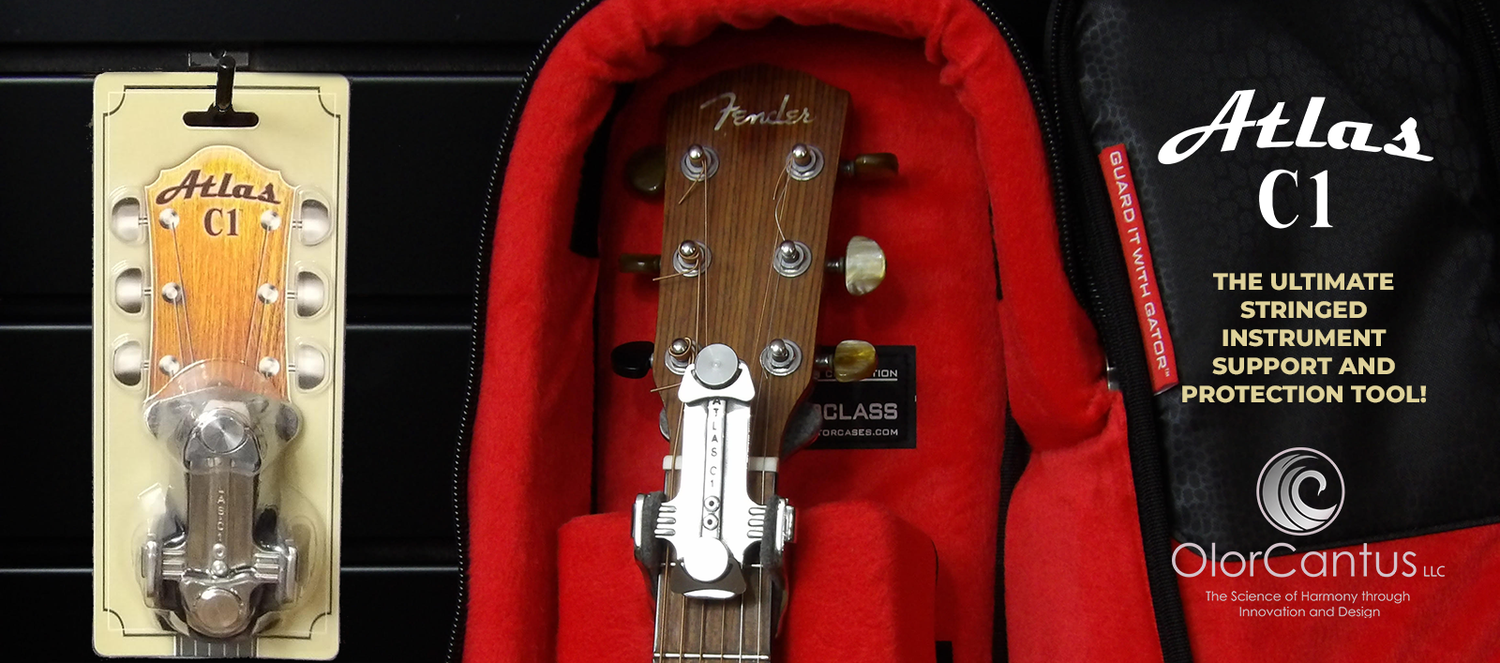
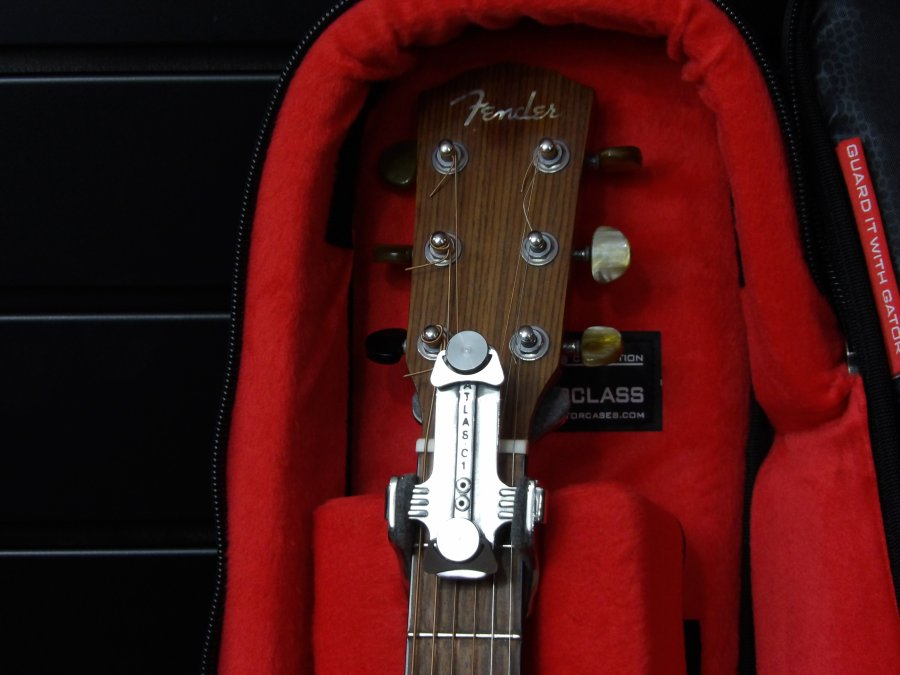
For guitars with headstocks at risk during travel, the Atlas-C1 is a universal multi-function tool built to protect the vulnerable headstock-neck junction during travel, shipping or storage. It also doubles as a pre-aligned repair jig. Its design is protected by a U.S. patent, and it counteracts more than 130 pounds of string pressure tension. Professional touring musicians have used it, and the tool is available at Guitar Center.
The Atlas-C1 is not a substitute for good packing or a humidity pack, but it adds a layer of protection where many guitars are most likely to break. Pair it with the steps above for the strongest protection your guitar can get.
Long Live the Six String™. The Science of Harmony through innovation and design.
Frequently Asked Questions
Can humidity ruin a guitar during shipping?
Yes. Wood absorbs and releases moisture as the air around it changes, so a guitar moving through humid cargo holds or sitting in a hot truck can swell, crack or warp. The top and back are most exposed, and a neck can shift if the wood moves unevenly. Sealing the instrument in its case with a humidity pack and allowing time to acclimate after arrival lowers the risk considerably.
Is 40% humidity bad for guitars?
Forty percent relative humidity sits near the low end of the range most guitar makers recommend, which is commonly cited as roughly 40 to 60 percent. Readings below that can cause the top to sink and fret ends to protrude over time. Use a hygrometer to check conditions in the case before you ship, and adjust with a humidity pack if the reading falls outside the target range.
Should I use a humidifier inside the guitar case when shipping?
A two-way humidity control pack is usually the better choice for transit. It adds moisture when the air is dry and absorbs excess when it is wet, which helps hold the guitar near its ideal range. A standard humidifier can overshoot in a sealed case and introduce too much moisture, so match the pack to your case size and the climate you expect along the route.
How can I protect my guitar from humidity while in transit?
Start by checking the case's seal and fit, then add a humidity control pack sized for the case volume. Detune strings slightly to reduce neck tension, pad the headstock and neck, and pack the guitar in a hard-shell case inside a sturdy outer box. Avoid leaving the package in a hot vehicle or on a loading dock for long periods. On arrival, let the guitar rest in its case for several hours before opening it.