
Table of Contents
- How String Tension Affects Your Guitar Neck
- Understanding String Gauge and Total Tension Load
- Guitar Neck Relief Measurement: Diagnosing Alignment Issues
- Truss Rod Adjustment Guide for Tension Management
- Wound vs. Plain Strings: Tension Differences Explained
- How to Fix Broken Guitar Headstock Damage from Tension
- Protecting Your Instrument During Travel and Storage
- Safe Tension Limits and Structural Integrity
- Frequently Asked Questions
Last Updated: October 1, 2026
How String Tension Affects Your Guitar Neck
String tension is one of the most underestimated forces acting on your guitar. When you tune to pitch, you apply enormous mechanical stress to the neck, the strings pull backward with tremendous force, and your neck must resist that pull while staying straight.
A standard set of strings exerts 130+ pounds of pressure on the neck and headstock junction. Vintage guitars often develop forward or back-bow because the wood adapts to sustained load over time.
String tension and neck alignment are directly related: increased tension causes forward bow, decreased tension allows backward relaxation. Understanding string tension neck alignment matters for every player.
The truss rod exists to counteract this force. It's a metal rod running through the neck that can be tightened to create a slight back-bow, counteracting the forward pull of the strings. Without proper truss rod adjustment, excessive string tension will eventually cause playability issues or structural damage.
Understanding String Gauge and Total Tension Load
String gauge directly determines total tension: heavier gauges apply more force, lighter gauges less. Switching gauges often requires truss rod adjustment.
Standard electric strings come in gauges like .009-.042 or .010-.046. Wound strings carry more tension than plain strings because of their mass.
A .009 set produces around 110-120 pounds of total tension; a .012 set reaches 140-160 pounds. Switching without truss rod adjustment forces your neck to handle 30-40 additional pounds, causing forward bow.
Touring musicians must understand that humidity and temperature changes compound string tension stress. A perfectly set-up neck at home may need adjustment after a week on the road.
Guitar Neck Relief Measurement: Diagnosing Alignment Issues
Neck relief is the intentional slight forward curve in most guitar necks. A perfectly straight neck under string tension develops fret buzz because strings vibrate in an arc. The truss rod maintains the right relief, enough for free vibration, but not so much that action becomes unplayable.
How to Measure Neck Relief Accurately
Use a metal straightedge at least 24 inches long (a machinist's straightedge is ideal, or a level). Place it along the frets, applying light pressure. Look for a gap around the 7th-9th fret, that gap is your neck relief.
Measure the gap with a feeler gauge or business cards (approximately 0.010 inches each). Most guitars need 0.010-0.020 inches of relief:
- 0.005 inches or less: Minimal relief. Risk of fret buzz, especially in the middle of the fretboard. The neck is too straight under string tension.
- 0.010-0.015 inches: Ideal range for most players. Strings vibrate freely without hitting frets. Action is comfortable.
- 0.020-0.030 inches: Moderate relief. Action will be higher than ideal. The neck is bowing forward more than necessary, often a sign of increasing string tension or truss rod looseness.
- 0.030+ inches: Excessive relief. High action, stiff feel, and a clear sign the neck is responding to string tension by bowing forward. Adjustment is needed.
Visual Signs of Tension-Induced Neck Bow
Forward bow (up-bow): The neck curves forward with the headstock pulling away. Signs include increasing action height (7th-12th frets), fret buzz in the middle fretboard, visible growing gaps under the straightedge, and reduced responsiveness. The 130+ pounds of string pull gradually pushes the neck forward; the truss rod must counteract it.
Back-bow (relief loss): The neck curves backward with the headstock pulling toward the body. Signs include fret buzz across the entire fretboard, unplayably low action, and a straightedge flush against frets with no gap. Back-bow usually means over-tightened truss rod or relief loss from age or humidity. It requires immediate attention.
When to Measure and How Often
Measure your neck relief when acquiring a guitar (baseline), after string gauge changes (within a week), seasonally (October and April), after travel, and if playability changes.
If the gap grows consistently (more than 0.005 inches per month), reduce string gauge, adjust the truss rod, or consult a luthier.
Truss Rod Adjustment Guide for Tension Management
The truss rod manages how your neck responds to string tension. Turning the nut clockwise tightens the rod and creates back-bow; counterclockwise loosens it and allows forward bow.
Loosen strings slightly, place a straightedge along the frets, measure the gap at the 7th fret, and turn the truss rod nut clockwise in quarter-turn increments if relief is excessive. Wait 10 minutes for wood to settle, recheck, and retune. Make small adjustments, rushing damages necks.
The truss rod has mechanical limits. If your neck is severely bowed forward under 130+ pounds of tension, the truss rod alone won't fix it, you may need professional help or neck replacement.
Wound vs. Plain Strings: Tension Differences Explained
Wound strings create more tension than plain strings of equivalent gauge because of their mass. A .046 wound string pulls much harder than a .046 plain string. Most sets use wound strings on lower notes for the extra mass needed to vibrate at lower frequencies.
Switching from .009-.042 to .009-.046 adds measurable tension, the .046 wound string adds 10-15 pounds compared to the .042.
Different string brands and gauges behave differently. Low-tension sets reduce total tension significantly, requiring different truss rod adjustments than standard strings.
Understanding this relationship helps you make informed decisions about your setup. If you're constantly adjusting your truss rod, it might be that your string gauge doesn't match your neck. Switching to a lighter gauge or a low-tension set might solve the problem without needing any truss rod work.
How to Fix Broken Guitar Headstock Damage from Tension
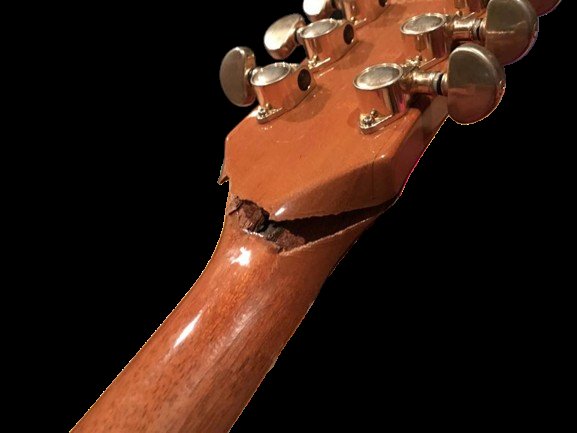
A broken headstock is usually the result of impact during travel or a fall. But string tension plays a role in how quickly a headstock crack grows. Once a headstock has a small crack, the constant 130+ pounds of string pressure tension acts like a wedge, forcing the crack open a little more each day.
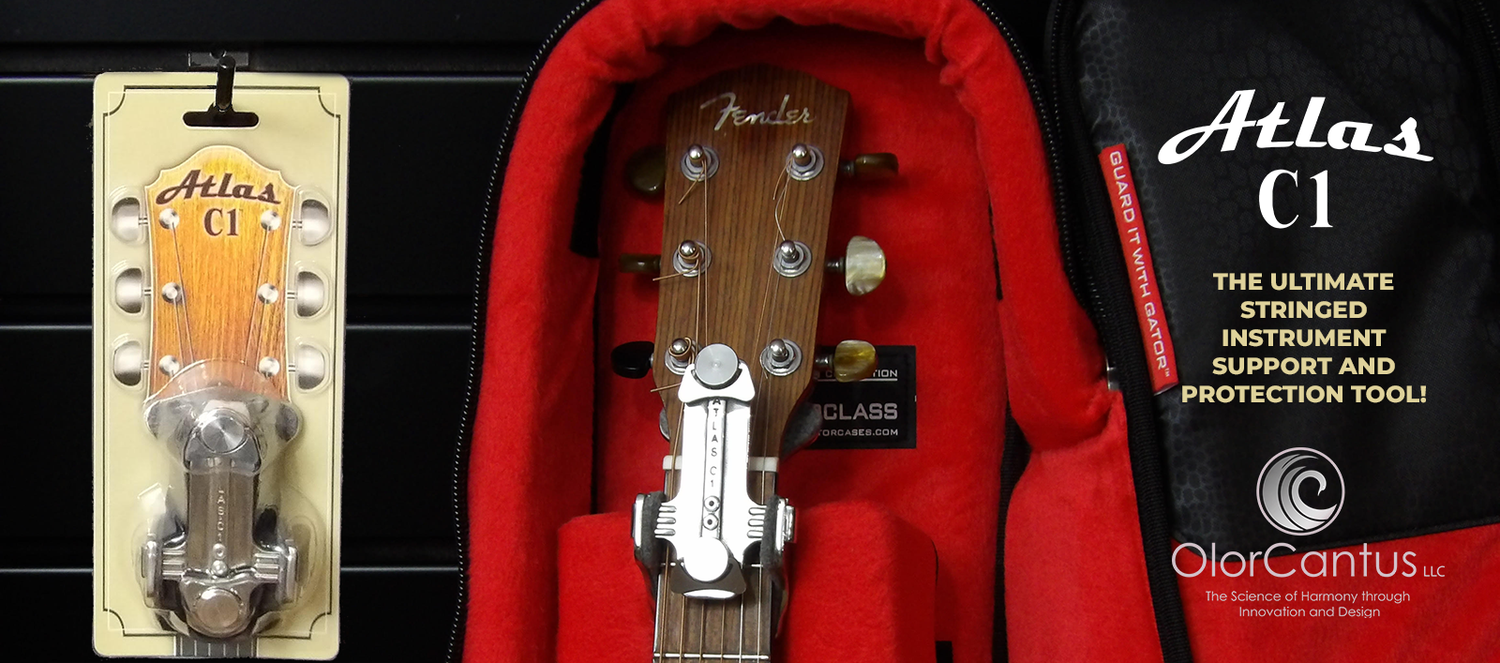
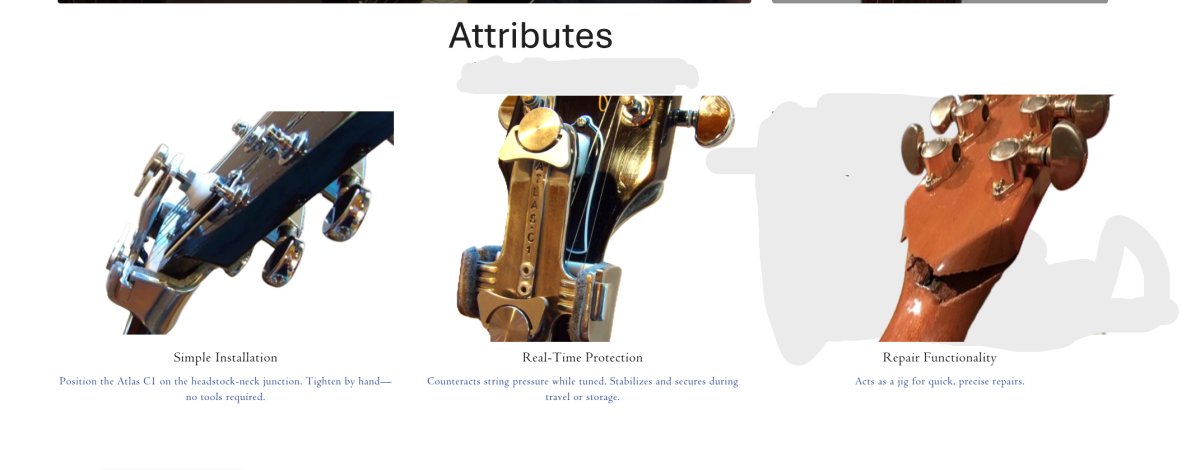
This is where the Atlas C1 becomes valuable. It's designed as a pre-aligned repair jig that counteracts the string pressure pulling your headstock apart. When you're repairing a broken headstock, the Atlas C1 holds the pieces in proper alignment while the glue cures. It does the work of the truss rod in reverse, instead of managing forward bow, it manages the lateral forces trying to separate the headstock from the neck.
The repair process looks like this:
- Clean the break surfaces thoroughly
- Apply wood glue to both surfaces
- Clamp the pieces together using the Atlas C1 as your alignment guide
- The tool holds the headstock at the correct angle to the neck
- Let the glue cure fully (usually 24 hours)
- Remove the clamp and inspect the repair
Without proper alignment during repair, a headstock break will never be as strong as it was originally. The pieces might be glued, but if they're misaligned, stress will concentrate at the repair line and the break will reopen under string tension.
The Atlas C1 simplifies this process by providing the correct alignment automatically. You don't need luthier experience to use it. The tool does the precision work for you, which is especially valuable for touring musicians who can't afford weeks without their instruments.
Protecting Your Instrument During Travel and Storage
String tension is always working on your neck, but travel amplifies the risk. When your guitar is in a case in a cargo hold or a tour bus, temperature and humidity change rapidly. The wood expands and contracts. Meanwhile, the strings are still pulling with full force.
Here's what happens during typical travel:
- Cabin pressure changes as the plane climbs and descends
- Temperature drops significantly in the cargo hold
- Humidity might swing from 40% to 80% within hours
- The neck experiences stress from both string tension and environmental change
- A headstock that was fine at home might crack under the combined load
Prevention is simpler than repair. Use a hard case, not a soft gig bag. Hard cases protect against impact. Place your guitar in the case with the headstock supported. Many musicians use a rolled towel under the headstock to provide extra support.
The Atlas C1 can stay attached to your guitar during storage and transport. It's designed to be left on the instrument, providing constant support to the vulnerable headstock-neck junction. This means your guitar arrives at the venue with the same neck alignment it had when you packed it. Plus, when you're ready to invest in protection, take advantage of our free shipping on your purchase, making it easier to protect your instrument.
For collectors storing guitars long-term, this protection matters even more. A vintage instrument sitting in a climate-controlled room for months still experiences slow wood movement. The Atlas C1 provides passive support that prevents the gradual stress that leads to cracks.
Safe Tension Limits and Structural Integrity
Every guitar neck has a structural limit. Push it beyond that limit and you'll get permanent damage. Understanding where that limit is helps you make smart decisions about setup and string choice.
Tension Limits by Wood Type and Truss Rod Capacity
Most modern guitars are built to handle 130-150 pounds of total string tension safely. This is why standard gauge strings (.010-.046 or similar) are engineered to produce tension in that range. But the actual limit depends on three factors: the wood species, the truss rod design, and the age of the instrument.
Maple necks (common on electric guitars) are stiffer and stronger than rosewood. A maple neck can typically handle 140-160 pounds of tension before showing permanent forward bow. The wood has a higher modulus of elasticity, meaning it resists bending more effectively. However, maple is also more brittle, so it's more prone to headstock breaks under impact.
Rosewood necks (common on acoustic and vintage guitars) are denser but slightly more flexible. They typically handle 120-140 pounds before showing permanent deformation. Rosewood is more forgiving under sudden stress, but it fatigues faster under sustained tension.
Mahogany necks (some acoustics and vintage electrics) fall between maple and rosewood: 130-150 pounds is the safe range. Mahogany is lighter and more prone to long-term creep (permanent deformation) under constant tension.
These limits assume a modern truss rod in good condition. A single-action truss rod (tightens only in one direction) has less capacity to counteract forward bow than a dual-action rod (tightens and loosens). Vintage guitars with single-action rods should stay below 120 pounds of total tension to avoid exceeding the rod's mechanical limit.
The Headstock-Neck Joint: The Structural Weak Point
The headstock-to-neck joint is where most failures occur, and it's where 130+ pounds of string tension concentrates most intensely. This joint is glued (usually with hide glue on vintage instruments, epoxy or polyurethane on modern ones) and sometimes reinforced with a wooden dowel or scarf joint.
Under string tension, the headstock experiences a pulling force that acts like a wedge at the joint. The strings pull the headstock back and down, while the neck resists. This creates shear stress at the glue line.
Structural limits at the headstock joint:
- Healthy joint (new guitar): Can safely handle 140-160 pounds of sustained tension.
- Fatigued joint (10+ years of use): 120-140 pounds. The glue has micro-cracks; additional stress accelerates failure.
- Vintage joint (30+ years): 100-120 pounds. Hide glue hardens and becomes brittle over decades. The wood has fatigued. Even moderate tension can cause a crack to propagate.
- Previously repaired joint: 80-110 pounds. A repaired headstock is never as strong as the original. The glue line is a permanent weak point.
If you have a vintage guitar or a previously repaired headstock, using a heavy string gauge (.012-.056) is risky. The cumulative stress of 150+ pounds of tension will eventually crack the joint again. Switching to a lighter gauge (.009-.042) or a low-tension set reduces the load and extends the life of the repair.
Recognizing When You're Approaching the Limit
Your guitar will show warning signs before catastrophic failure:
- Neck relief growing visibly: If your straightedge gap increases from 0.015 inches to 0.030+ inches over a few months, the truss rod is losing the battle. The wood is deforming faster than the rod can counteract.
- Fret sprout: Frets at the headstock end start to protrude above the fretboard. This happens when the neck bows forward so much that the frets, which are fixed in slots, can't follow the curve.
- Hairline cracks at the headstock: Visible cracks radiating from the headstock-neck joint indicate the glue is failing under tension. This is a critical warning sign.
- Tuning instability: The neck is moving slightly under string tension, causing tuning to drift. This suggests the joint is flexing rather than staying rigid.
- Headstock angle changing: If the headstock appears to be pulling back more than it used to, the joint is deforming. This is permanent and requires professional repair.
If you see any of these signs, reduce string tension immediately. Switch to a lighter gauge or a low-tension set. Then have a luthier inspect the neck and headstock joint. Catching the problem early prevents a break that costs hundreds to repair.
String Tension vs. Environmental Stress
String tension doesn't work alone. It combines with humidity and temperature changes to stress the wood. A neck that handles 130 pounds fine in a stable climate might fail at 130 pounds during a tour with rapid humidity swings.
Wood expands when humidity rises and contracts when it drops. If the neck is already under maximum tension from the strings, environmental stress adds to the load. The wood has nowhere to move, so it cracks.
This is why touring musicians and travelers need to be especially careful. A guitar that's perfectly set up at home might be at risk after a week in different climates. If you travel with your instrument, consider using a lighter string gauge or a low-tension set. The reduction in string tension gives the wood room to expand and contract without exceeding its structural limit.
Protecting Against Cumulative Stress
Structural integrity isn't just about peak tension, it's about cumulative stress over time. A neck that handles 130 pounds for a week might fail if it handles 130 pounds for a year without relief.
This is where the Atlas C1 becomes valuable for long-term protection. By supporting the headstock-neck junction during storage and transport, it reduces the cumulative stress that leads to cracks. The joint isn't constantly fighting the full 130+ pounds of pull; the support tool shares the load.
For collectors and touring musicians, this passive support prevents the slow creep that eventually causes failure. A guitar that stays in a case with the Atlas C1 attached experiences less cumulative stress than one without it. Over years of ownership, that difference adds up to the difference between a guitar that stays playable and one that needs expensive repair. When you're ready to invest in protection, take advantage of our 10% product discount to make your purchase more affordable.
Frequently Asked Questions
How much tension does a standard set of guitar strings exert?
A standard set of strings on a guitar typically exerts between 150 and 200 pounds of total tension on the neck, depending on string gauge and tuning. Lighter gauge strings (like .009) produce around 130-150 pounds of tension, while heavier gauges (.012 or higher) can exceed 200 pounds. This massive load is why proper neck relief and structural support are critical to preventing damage and maintaining playability.
Should I adjust my truss rod after changing string gauge?
Yes, adjusting your truss rod after changing string gauge is essential. Moving to heavier strings increases total tension on the neck, which may require counteracting back-bow to maintain proper relief. Lighter strings reduce tension and may require adjusting toward up-bow. Always measure neck relief before and after a gauge change, and make small quarter-turn adjustments to the truss rod, allowing the wood time to settle between changes.
What happens if I have too much neck relief on my guitar?
Excessive neck relief creates a banana-shaped curve in the fretboard, causing high action and difficult playability, especially in the lower frets. Too much relief also reduces the structural integrity of the neck under string tension, making it more susceptible to permanent deflection or damage. The goal is minimal relief, just enough to prevent fret buzz while maintaining proper action height and protecting the neck from the mechanical stress of 130+ pounds of string pressure.
What tools are best for supporting a headstock during repairs?
A precision repair jig designed to counteract string tension and stabilize the headstock-neck junction is essential for safe headstock repairs. The Atlas C1 is engineered specifically for this purpose, providing unparalleled support during both transport and repair work. It doubles as a pre-aligned repair jig, eliminating guesswork and ensuring proper neck alignment when fixing breaks. This approach prevents additional damage and simplifies the repair process for both professionals and DIY musicians.