
Table of Contents
- StewMac vs D'Addario Repair Tools: What Actually Changes Your Decision
- Side-by-Side Specs: StewMac vs D'Addario Repair Tools Compared
- Specialized Luthier Tools vs General Hardware: Where Each Brand Fits
- How to Fix a Broken Guitar Headstock With the Right Repair Tools
- Essential Guitar Setup Tools Every Player Should Own
- Metric vs Imperial: Measurement Standards in Guitar Repair Tools
- Durability, Warranty, and Tool Longevity: What Lasts
- Cost of Ownership: Where Repair Tool Money Actually Goes
- Which Repair Tools Fit Your Instrument and Skill Level?
- Frequently Asked Questions
Last Updated: September 19, 2026
StewMac vs D'Addario Repair Tools: What Actually Changes Your Decision
The stewmac vs daddario repair tools debate misses the real point. Both brands sell dependable gear, and neither one will fix a broken headstock for you. What separates a good repair outcome from a bad one is whether your tool kit matches the job in front of you, and whether you have a way to hold the instrument steady while you work.
This guide from Atlas C1 breaks down where each brand genuinely fits, what you actually need at each skill level, and the hidden costs that decide whether a tool earns its place on your bench for a decade.
Here is the uncomfortable truth most forum threads skip: the tool that saves your instrument is often the one that stops the break from happening at all.
Below, we compare both brands on specs, durability, and cost of ownership, then walk through a real headstock repair so you can see which tools earn their keep.
Side-by-Side Specs: StewMac vs D'Addario Repair Tools Compared
StewMac and D'Addario sit at different points on the spectrum. StewMac builds specialist luthier gear for people who work on instruments weekly. D'Addario covers a broader catalog of strings, accessories, and general maintenance hardware that most players already recognize.
That difference shows up in the details: steel hardness, handle ergonomics, and how precisely a tool holds a setting.
| Category | StewMac | D'Addario |
|---|---|---|
| Primary focus | Luthier-specific bench tools | Player maintenance and accessories |
| Typical materials | Hardened steel, machined brass | Hardened steel, composite handles |
| Measurement format | Metric and imperial options | Mostly imperial |
| Best for | Fretwork, nut slotting, setup work | Truss rod adjustment, cleaning, restringing |
| Warranty support | Varies by tool | Varies by product line |
Neither brand publishes a universal warranty across its whole catalog, so check the specific item before you buy. A common mistake is assuming a brand-wide guarantee exists when coverage is decided tool by tool.
Specialized Luthier Tools vs General Hardware: Where Each Brand Fits
Specialized luthier tools exist because general hardware stores do not sell a fret crowning file or a nut slotting gauge. That is the gap StewMac fills. If you are doing fretwork, cutting nut slots, or setting string action with any precision, you need tools built for stringed instruments, not a hardware store approximation.
D'Addario fits a different job. For truss rod adjustment, cleaning, and routine setup, their gear is approachable and widely stocked. A player who adjusts relief twice a year does not need a machinist-grade tool.
Here is the practical split:
- Fretwork and nut slotting: luthier-specific tools, no substitute
- Truss rod adjustment: either brand works, pick on ergonomics
- String action and intonation: a good steel ruler and a tuner matter more than the brand
- Cleaning and hardware swaps: general maintenance kits are fine
How to Fix a Broken Guitar Headstock With the Right Repair Tools
Fixing a broken guitar headstock is a clamping and alignment problem before it is a gluing problem. The wood joint only holds if the two surfaces line up exactly while the adhesive cures. Get the alignment wrong and the repair fails no matter how good your glue is.

The steps look like this:
- Remove string tension completely. Angled headstocks carry significant load, and releasing it slowly prevents the crack from spreading.
- Dry-fit the break. Line up the two pieces and check how cleanly they meet before any adhesive touches the wood.
- Align and clamp. This is where most first-timers fail. A pre-aligned jig holds the headstock at the correct angle so the joint cannot shift while you tighten clamps.
- Glue and cure. Use a wood adhesive rated for the joint, then leave it clamped for the full cure window.
- Reassemble and check intonation. New tension can pull a weak joint, so tune gradually.
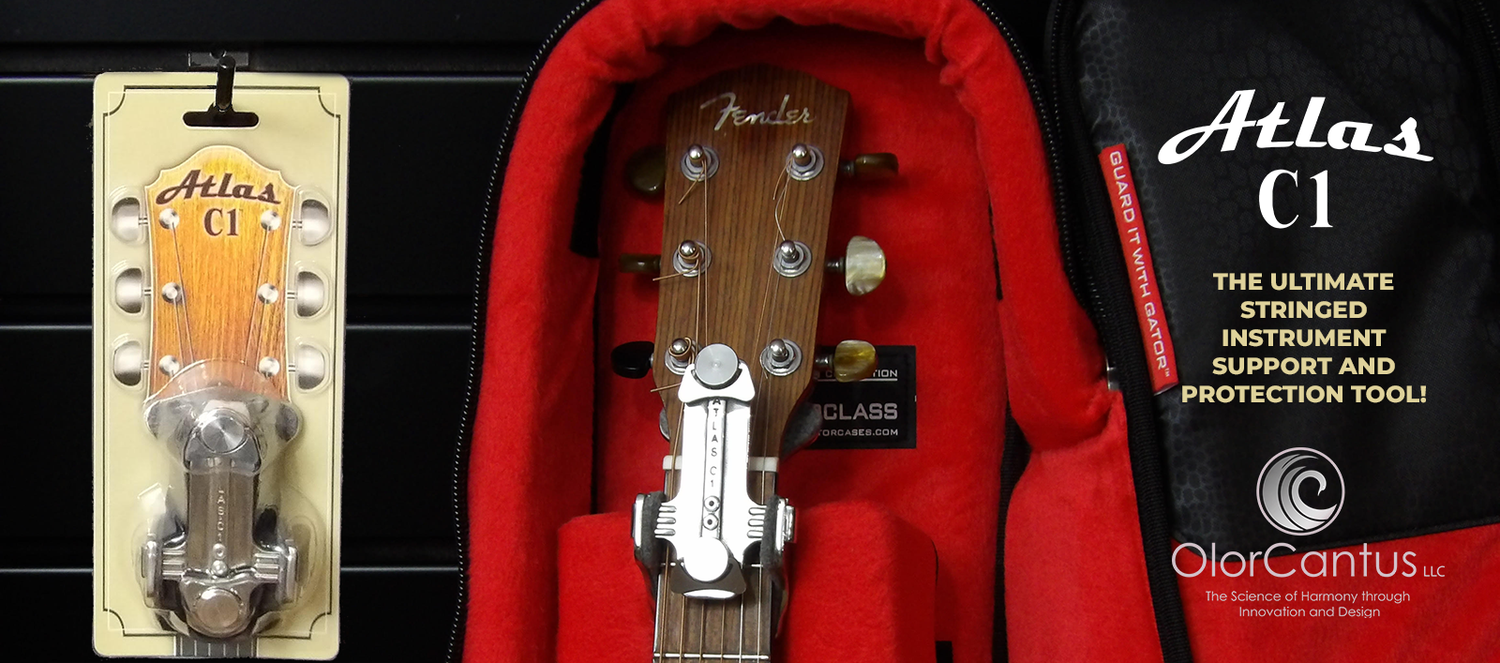
A universal headstock tool such as the Atlas C1 doubles as a pre-aligned repair jig, which removes the guesswork from step three. That matters because the headstock-neck junction is the weakest point on an angled design, and it is exactly where alignment errors show up.
Essential Guitar Setup Tools Every Player Should Own
Essential guitar setup tools come down to five items: a truss rod wrench that fits your instrument, a steel ruler with fine graduations, a string winder, a capo, and a reliable tuner. Everything past that list is a specialty purchase.
A beginner kit does not need fret files or nut slotting gauges. Those tools reward practice, and buying them early usually means buying them twice.
- Truss rod wrench sized to your guitar
- Steel ruler reading to 0.5 mm
- String winder and cutter
- Capo for checking relief
- Chromatic tuner
- Feeler gauges for action height
Metric vs Imperial: Measurement Standards in Guitar Repair Tools
Guitar repair sits awkwardly between two measurement standards. Many classic designs were built to imperial dimensions, while most of the world now works in metric. That mismatch causes real setup errors.
A string action spec written in thousandths of an inch does not convert cleanly to a metric ruler, and a half-millimeter difference is audible. Pick one system, buy measuring instruments in that system, and convert only when a spec forces you to.
| Measurement | Imperial | Metric |
|---|---|---|
| String action (treble) | 0.060 in | 1.5 mm |
| String action (bass) | 0.090 in | 2.3 mm |
| Relief at 8th fret | 0.010 in | 0.25 mm |
| Nut slot height | 0.018 in | 0.46 mm |
The National Institute of Standards and Technology guide to SI units is the reference to trust when you need an exact conversion. Keep a printed conversion card on your bench rather than doing the math in your head mid-setup.
Durability, Warranty, and Tool Longevity: What Lasts
Tool longevity tracks material composition, machining quality, and how the tool is used, not the logo on the handle. Hardened steel cutting edges hold their shape across hundreds of uses. Softer steel dulls, and a dull fret file tears wood instead of shaving it, which turns a five-minute job into a refinish.
Here is the structured comparison most forum threads never build:
| Longevity factor | What to look for | Why it matters |
|---|---|---|
| Cutting-edge hardness | Hardened steel rated for repeated edge contact | Dull edges tear grain instead of slicing it |
| Handle and body material | Machined brass, hardened steel, or reinforced composite | Flex and wobble ruin precision settings |
| Measurement accuracy | Fine graduations, stable reference surfaces | A drifting instrument is worse than none |
| Adjustment mechanism | Locking screws, detents, or friction locks | Settings that slip mid-job cause rework |
| Serviceability | Replaceable cutters or wear parts | Extends usable life without full replacement |
Calibration matters as much as hardness. A measuring instrument that drifts out of spec is worse than no instrument, because you trust a wrong number. Most practitioners find that a steel ruler or feeler gauge should be checked against a known reference at least once a season, and replaced the moment it reads inconsistently.
Warranty coverage is the part buyers get wrong most often. Neither brand publishes a single universal warranty across its entire catalog. Coverage is decided tool by tool:
- Some cutting tools carry a lifetime guarantee against manufacturing defects.
- Some precision instruments carry a limited term.
- Consumables and accessories often carry none at all.
- Wear items such as cutters and blades are typically excluded.
Read the terms on the exact item before you buy. A common mistake is assuming a brand-wide guarantee exists when coverage is decided product by product.
Build quality you can verify beats a brand promise you cannot. Check the steel, the machining, the adjustment mechanism, and the stated warranty on the specific tool, not the logo on the handle.
Cost of Ownership: Where Repair Tool Money Actually Goes
Cost of ownership is not the sticker price. It is the purchase price plus replacement, calibration, consumables, and the cost of the repair you failed to prevent. Most competitors stop at the sticker. This section builds the full picture.
Start with the replacement cycle. A cheap cutting tool that dulls after a handful of jobs gets replaced several times over the life of one professional-grade tool. That replacement math is the hidden cost nobody puts in a table:
| Cost category | Cheap alternative | Professional-grade tool |
|---|---|---|
| Upfront purchase | Lower | Higher |
| Replacement frequency | Frequent, dulls or breaks | Rare, holds edge and setting |
| Calibration and upkeep | Often none possible | Checked against a reference |
| Rework from poor results | High, stripped nuts, torn grain | Low, clean, repeatable cuts |
| Resale or hand-down value | Minimal | Retains usefulness for years |
The cost-effectiveness math changes by skill level:
- Hobbyist: buy the essentials, rent or borrow the specialty tools. The replacement cycle rarely catches up to you at low volume.
- Regular player: invest in measuring instruments and a solid setup kit. These are the tools you touch every setup.
- Repair shop: professional-grade bench tools and jigs pay back fastest because they are used daily and downtime is expensive.
- Touring musician: protection and portable repair capability beat a full bench. A single prevented break outweighs a drawer of unused specialty files.
A single professional headstock repair can be costly, and that figure does not include shipping or the weeks your instrument spends off the road. A tool that prevents even one break pays for itself against that number.
The unique angle most competitors miss: the highest-return tool is not the most expensive one. It is the one that removes a recurring failure. A pre-aligned jig that prevents an alignment error, or a protector that prevents the break entirely, changes the cost equation more than any single file or gauge.
Touring musicians and collectors who transport instruments regularly and want protection plus repair capability in one tool.
Which Repair Tools Fit Your Instrument and Skill Level?
Tool compatibility depends on your headstock design. Angled, Gibson-style headstocks carry more tension at the neck junction and are more vulnerable to impact breaks. Straight headstock designs such as most Fender and Tele-style guitars are more forgiving.
A universal tool solves the compatibility problem by adjusting to fit either design, which is why the Atlas C1 works across angled and straight headstocks rather than locking you into one profile.
Match your kit to your reality:
- Casual player, home storage: essentials only, plus a case that fits properly
- Frequent flyer: protection first, then a portable repair setup
- Vintage collector: professional-grade measuring instruments and a jig for any repair work
- Working tech: full bench kit with calibration on a schedule
For players who move instruments constantly, protection is the higher-value purchase. The Federal Aviation Administration guidance on musical instruments confirms you can carry an instrument onboard, but the case handling before and after the flight is where damage happens.
The real challenge is not choosing between two tool brands. It is protecting the headstock-neck junction before a break forces the decision.
Atlas C1 built the Atlas C1 for exactly that problem. Its U.S. patent-protected design supports the vulnerable headstock-neck junction, counteracts 130+ pounds of string pressure tension, and doubles as a pre-aligned repair jig when a break does happen. It is a lifetime-use tool, and it is available at Guitar Center, and if you order direct, you can take advantage of a 10% product discount plus free shipping.
Get started with Atlas C1 and give your instrument the protection that makes every other repair tool a backup plan.
Frequently Asked Questions
Are StewMac repair tools worth the higher price point?
StewMac tools cost more because they are built for repeated pro use: hardened steel cutters, machined fret pullers, and calibration-friendly measuring instruments. If you do fretwork or truss rod adjustment weekly, that build quality pays off in accuracy and lifespan. For occasional hobbyist setups, a smaller kit from either brand covers most jobs. Compare the specific tool you need, not the catalog as a whole.
How do D'Addario maintenance tools compare to professional luthier brands?
D'Addario leans toward accessible maintenance kits: string winders, cutters, peg winders, and cleaning supplies that cover string changes and basic care. Professional luthier brands focus on fretwork, nut slotting, and precision measuring instruments. If your work stops at string action and intonation checks, D'Addario covers it. If you level frets or cut nuts, you need the specialist side.
What tools do I need to fix a broken guitar headstock?
You need clamps, a flat reference surface, wood glue, and a way to hold the break in alignment while it cures. A pre-aligned repair jig removes most of the guesswork: it holds the headstock at the correct angle so the crack closes evenly. Add a scraper for glue cleanup and a set of measuring instruments to check string action and intonation once the repair is done.
What are the essential guitar setup tools for a beginner?
Start with a truss rod wrench sized to your instrument, a capo, feeler gauges, a string action ruler, a hex key set, and a good string cutter. Add a tuner and a notched straightedge if you plan to check neck relief. That set handles relief, action, and intonation on most stringed instruments. Buy precision tools once rather than replacing cheap ones every year.