
Quick Summary
Nut slotting files are gauged files used to cut or widen the slots in a guitar's nut so each string sits at the right height and spacing. Beginners should match each file to a string's gauge, mark slot centers carefully, and file in small increments, because removed material cannot be replaced.
- Match each file's width to the gauge printed on your string pack.
- Mark each slot center with a fine pencil line before filing.
- File in small increments and recheck clearance after each pass.
- Angle each slot slightly toward the tuning peg.
- Confirm the nut is the cause before filing, since neck relief and bridge height can also cause buzzing.
Table of Contents
- Why Nut Slots Matter and When to File Them
- Choosing Guitar Nut Files by String Gauge
- Beginner Tool and Safety Checklist
- Measuring and Marking Slot Positions and Spacing
- Filing a Guitar Nut Slot Step by Step
- Guitar Nut Slot Depth: How Deep Is Too Deep
- Filing a Nut for Thicker Strings
- Filing Without a Nut File: What Works and What Doesn't
- Troubleshooting Common Nut Problems and Deciding When to See a Tech
- Booking Your Next Step: Protecting the Headstock and Neck Junction
- Frequently Asked Questions
7 Nut Slotting File Steps Every Beginner Needs
Last Updated: November 14, 2026
Why Nut Slots Matter and When to File Them
The nut is a small strip of bone, plastic, or graphite at the top of the neck. It holds each string at the right height and spacing. When a slot is cut too deep, too narrow, or in the wrong place, strings can buzz, bind, or drift out of tune. A simple slot problem is often blamed on the wrong part of the guitar.
Filing a nut slot is the right fix when a string sits in its slot without seating properly, or when you install a new set with a different gauge. It is not the right fix for every problem. Neck relief, action at the bridge, and fret wear can all cause buzzing, and filing the nut will not solve them, so confirm the nut is the cause before you reach for nut slotting files.
Nut slots are permanent. Once metal or bone is removed, it cannot be put back. That is why the first step is always deciding whether a slot really needs work.
Choosing Guitar Nut Files by String Gauge
A nut slotting file is sized to match a string's diameter. The file's width should be close to the string gauge, so the string sits snugly without pinching. Most beginners need a small set that covers the gauges they use most.
Check the gauge printed on your string pack, then pick the file that matches each string.
-
Match file width to each string's gauge
-
Keep the files labeled so you do not mix them up
Gauged Files Versus Flat Files
Gauged files come in sets with one file per string size. Each file is cut to the exact width of that string. They are the safer choice for beginners because you can match the file to the string without guessing.
Flat files are single files used in several slots. They work for experienced repairers who know how to angle the file and control the width. For a first project, a gauged set is easier and less risky.
Choosing a beginner-friendly set is simple. Look for one that includes the gauges you use and has clearly marked sizes.
Beginner Tool and Safety Checklist
Before you touch the nut, gather your tools and protect your guitar. A few minutes of setup prevents most mistakes. This checklist covers the bench setup, safety gear, and file-set selection criteria.
Bench and workholding
- Padded, stable workbench or table at a comfortable height
- Neck support or cradle so the headstock and neck do not flex while you file
- Painter's tape to protect the headstock face and fretboard edges
- Soft cloth or tray to catch filings
- Bright, adjustable task lighting aimed at the nut
Measuring and marking
- Feeler gauges for first-fret clearance checks
- Small ruler or calipers for slot spacing
- Fine-tip pencil for marking slot centers
- String gauge chart or the gauge printed on your string pack
Files and lubrication
- Gauged nut slotting file set matched to your string gauges
- Graphite powder or a soft pencil for lubricating the file
- Small brush for clearing filings from slots
Safety gear
- Eye protection, because filings can fly
- Good ventilation if you are working with bone or synthetic nut material
- Strings loosened, not removed, so the neck can move as you work
Choosing a beginner-friendly file set
A gauged set of nut slotting files with one file per string size is the safer first purchase because you match each file to the string without guessing. Look for clearly marked sizes and coverage of your current gauges. Check the gauge printed on your string pack before buying.
Flat files are single files used across several slots. They work for experienced repairers who can angle the file and control width, but for a first project a gauged set is easier and less risky. If you are choosing between sets, weigh coverage against cost.
Watch out: Working on an unsupported neck or in poor light is how beginners cut a slot in the wrong place or too deep. Set up the bench, the light, and the eye protection before the first stroke.
Measuring and Marking Slot Positions and Spacing
Good slots start with good measurements. Each string needs a slot centered over its path from the tuner to the fret. Spacing should match the string spacing at the bridge and nut, which usually differs slightly.
Mark the center of each slot with a fine pencil line. Check that the marks are evenly spaced and that the outer strings sit close to the edges of the nut without touching them. Measure from the edge of the nut to the first mark, then check the spacing between marks with your ruler.
Keep the measurements consistent. A mark that is off by a millimeter can cause a string to bind or drift.
Filing a Guitar Nut Slot Step by Step
Once your marks are set, you are ready to file. Work slowly and check often. Taking off too little is always safer than taking off too much.
Step 1: Lubricate the file. Rub a little graphite onto the file so it cuts smoothly and clears filings.
Step 2: Start with the matching file. Choose the file that fits the string you are working on.
Step 3: Angle the file toward the tuner. The slot should slope slightly toward the tuning peg. This keeps the string from pulling out of tune.
Step 4: File with light strokes. Push the file forward and lift it back. Do not saw back and forth.
Step 5: Check the fit. Place the string in the slot. It should sit down with no binding and no gap.
Step 6: Smooth the slot bottom. A correct slot has a rounded bottom that matches the string's shape.
Step 7: Test the open strings. Tune up and check for buzz or sticking. Adjust only if needed.
Repeat for each string. Clean out filings with a small brush before testing.
Watch out: Once the file removes too much material, the slot is too deep and cannot be fixed. Stop early and check often.
The steps below summarise the filing process, with the time or check each one calls for.
| Step | What to do | Time or frequency |
|---|---|---|
| Lubricate the file | Rub graphite onto the file | Before each slot |
| Choose the matching file | Pick the file that fits the string | Once per string |
| Angle toward the tuner | Slope the slot toward the peg | During each cut |
| File with light strokes | Push forward, lift back, no sawing | Repeat as needed |
| Check the fit | Seat the string with no binding or gap | After each pass |
| Smooth the slot bottom | Match the string's rounded shape | Final pass per slot |
| Test open strings | Tune up and check for buzz | After all slots |
Guitar Nut Slot Depth: How Deep Is Too Deep
Slot depth controls how high each string sits above the first fret. Too shallow and the open string buzzes against the first fret. Too deep and the string sits too low, which causes first-fret buzz, poor intonation up the neck, and a string that feels sloppy under the fingers. The target is a slot that lets the string clear the first fret by a small, consistent margin when the string is open and seated in the slot.

A repeatable workflow beats eyeballing. Most practitioners find the following sequence works for beginners:
- Tune the string to pitch first. Depth only means something when the string is under normal tension. A slack string sits lower and will mislead you.
- Measure first-fret clearance with a feeler gauge. With the string seated in its slot and tuned, slip a feeler gauge between the bottom of the string and the top of the first fret. A common starting reference is a clearance in the range of a few thousandths of an inch, with the exact target varying by guitar type and string gauge. Compare against the guitar's original setup or a reliable reference for your model rather than a single universal number.
- File in small increments. Make a few light strokes with the matching file, clean the slot, reseat the string, retune, and recheck with the feeler gauge. Remove a little, recheck, repeat. Most beginner problems come from filing too deep in one pass.
- Confirm the slot bottom is rounded. A U-shaped bottom that matches the string's curve seats the string evenly. A flat or V-shaped bottom lets the string rock and buzz.
- Check the angle toward the tuner. The slot should slope slightly down toward the tuning peg so the string breaks cleanly over the nut and holds tune.
Watch out: Once the file removes too much material, the slot is too deep and cannot be put back. Stop early, check with the feeler gauge, and only continue if the clearance is still above your target.
A common pattern is that beginners confuse nut depth with bridge action or neck relief. If the open string buzzes but fretted notes are clean, the nut is the likely suspect. If fretted notes buzz across the neck, check relief and bridge height before touching the nut. Feeler gauges, a small ruler, and a fine-tip pencil are the basic measuring tools to have on the bench before you start.
Filing a Nut for Thicker Strings
Switching to heavier strings often means the existing slots are too narrow or too shallow. The strings may sit high or bind. You can widen and deepen the slots carefully using the matching file for each new gauge.
Start with the slot that the new string will use. Work with a file one size up from the old gauge only if the new string will not seat. Check the fit after each pass.
If a slot needs a lot of work, stop. Widening a slot too far makes the string rattle, and fixing that is harder than the original job.
Filing Without a Nut File: What Works and What Doesn't
You may be tempted to use a regular needle file, a sandpaper strip, or a jeweler's file in place of a nut file. Some of these can work for light touch-ups, but they make it easy to cut the wrong shape or the wrong width.
Needle files and sandpaper can leave a rough slot bottom that causes buzzing. Hacksaws and utility knives are too coarse and too hard to control. For a clean result, a proper gauged nut file is the safer choice.
If you have no nut file on hand, the honest answer is to wait. A slot cut wrong without the right tool is hard to correct.
Troubleshooting Common Nut Problems and Deciding When to See a Tech
Most nut problems fall into a few patterns. Use the symptoms below to decide your next step.
- String buzzes on open strings: Slot may be too shallow or the bottom is rough.
- String sticks or binds when tuning: Slot may be too narrow or the angle is wrong.
- String sits too low at the first fret: Slot may be too deep.
- Strings drift out of tune: Slot angle or width may be off.
- Headstock or nut looks cracked or loose: Stop and see a technician.
If the neck is warped, the frets are worn, or the bridge height needs adjusting, a nut file will not fix the problem. A guitar technician can check the full setup. Consider a professional if you are unsure, the slot is badly damaged, or the guitar is valuable.
Does your guitar need a professional setup? Signs include persistent buzzing after nut work, uneven action across the neck, and tuning that will not hold.
Booking Your Next Step: Protecting the Headstock and Neck Junction
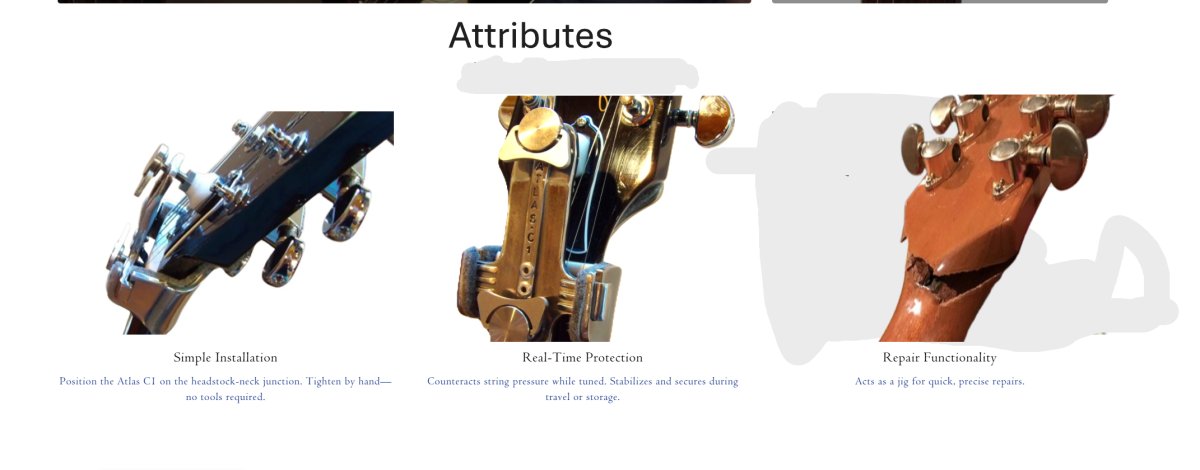
When you work on the nut, the headstock is under stress. A support tool keeps the neck and headstock stable while you file, which reduces the chance of a crack. The Atlas C1 is a universal multi-function tool that supports the headstock-neck junction and doubles as a pre-aligned repair jig.
A repair jig can also be useful for future headstock repairs. Pricing depends on quantity, dates, and delivery, so check the Atlas C1 website for current prices and shipping options.
The Science of Harmony through innovation and design.
Long Live the Six String™
Frequently Asked Questions
How do you file a guitar nut slot?
Start by marking the slot positions with a pencil, then choose a nut file that matches the width of the string you are fitting. File gently with short strokes, checking the fit often with the string. Stop as soon as the string sits in the slot without binding, and keep the slot bottom rounded. Because filing removes material you cannot put back, work in small increments and test the fit after each pass.
How deep should a guitar nut slot be?
A nut slot should be deep enough that the string sits in it with only a small amount of its diameter above the nut surface, and it should not leave the string resting on the bottom of the slot. Cutting too deep lowers the string's contact point and can make the open strings buzz or the string spacing feel loose. Filing in small steps and checking the fit each time is the safest way to reach the right depth.
Can you file a guitar nut without a nut file?
A dedicated nut file is the right tool because its width and rounded profile match a string's diameter, and generic files tend to cut wide or square-bottomed slots. Some players use small needle files or a carefully shaped substitute for minor adjustments, but this raises the risk of an irregular slot. If the slot needs significant work, consider a technician with the proper set of nut files.
What size nut files do I need for guitar strings?
Choose a file that matches the diameter of each string, measured in thousandths of an inch. A standard beginner file set usually covers the common string gauges, and gauged files let you match each slot to its string. Starting with a set that includes the widths you use most keeps the job simpler and reduces the chance of filing too wide.