
Table of Contents
- Why Guitar Headstocks Break During Travel
- Loosening Guitar Strings Before Flight
- The Best Way to Ship Guitars Safely
- How to Pack a Guitar for a Flight
- TSA Guitar Travel Regulations and Inspection
- Managing Humidity and Temperature During Transport
- Pre-Flight Checklist for Musicians
- Using Headstock Support Tools for Maximum Protection
Last Updated: August 26, 2026
Why Guitar Headstocks Break During Travel
The guitar headstock is the most vulnerable point on any stringed instrument. When a guitar drops or gets knocked over, it fails under combined forces of inertia, kinetic energy, and 130+ pounds of string pressure pulling on the neck joint should the strings not have been loosened (peer-reviewed research). That junction between the headstock and neck is where structural integrity fails first.
The headstock-neck joint is inherently weak because it's a glued connection designed to withstand vertical string tension, not lateral impact or bending forces. When a guitar falls or shifts inside a case, the headstock acts like a lever, multiplying force at the neck joint. A soft case offers minimal protection, and even quality hard cases can't prevent the headstock from moving during sudden deceleration or rough baggage handling.
Vintage instruments, high-end guitars, and angled headstocks (like Gibson-style designs) face greater risk. The angle creates a structural weak point; the more acute the angle, the greater the bending stress during impact. Protecting your guitar headstock during travel is essential insurance against expensive repairs or permanent damage.

Loosening Guitar Strings Before Flight
Before your guitar enters a travel case, loosen the strings to about half tension. This reduces the total tension pulling on the neck and headstock joint, lowering stress on the glue and wood at the most vulnerable connection point.
Use the tuning pegs to lower the pitch gradually across all six strings to maintain even pressure. This takes about two minutes and requires no tools. When cabin pressure changes during flight or the case experiences temperature and humidity shifts, wood expands and contracts slightly. Reduced string tension gives the instrument room to move without placing additional stress on the headstock joint.
Professional luthiers routinely loosen strings on instruments stored long-term. After you land and the guitar acclimates to the new environment, retune to pitch gradually over several minutes rather than all at once, giving the wood time to adjust.
The Best Way to Ship Guitars Safely
When shipping a guitar, combine multiple layers of protection: proper case selection, internal padding, string tension management, and documentation.
Start with a hard case, either a flight case or quality ABS plastic hard case designed for instruments. Soft cases and gig bags offer no real protection during shipping.
Inside the case, the guitar must be immobilized completely. Wrap the headstock with bubble wrap, foam padding, or specialized headstock guards. Fill all empty space with padding to prevent the case from having any internal voids where the guitar could shift. Professional shippers use custom foam inserts molded to the guitar's shape for valuable instruments.
Include a packing slip with your contact information and a note requesting careful handling. Tape a "FRAGILE - MUSICAL INSTRUMENT" label on the outside. Use a carrier offering tracking and signature confirmation. Declare the full value and verify the carrier covers musical instruments. Ship during cooler months when possible to avoid temperature extremes. When ordering protective equipment like the Atlas-C1 headstock support tool, take advantage of Olorcantus ‘s free shipping to reduce your overall travel preparation costs.
How to Pack a Guitar for a Flight
Packing a guitar for a flight requires preparation and attention to detail. Start by loosening the strings to about half tension to reduce stress on the neck joint during cabin pressure changes and temperature fluctuations.
Internal Padding and Neck Support Techniques
Most musicians use generic bubble wrap or foam sheets, which offer some protection but leave critical areas vulnerable. The headstock needs dedicated support that prevents movement in any direction.
Start with a layer of soft foam padding on the case bottom, at least one inch thick. Position the guitar body on this padding, centered in the case. For the headstock, create a custom support cradle using closed-cell foam, cut to match the headstock shape. Secure this foam above the headstock so it contacts the top of the case when closed, snug but not compressed.
Wrap the neck with additional padding using soft foam or bubble wrap, securing it gently with gaffer tape or painter's tape. Avoid duct tape directly on the finish. Position the body so it contacts the bottom padding at multiple points, using rolled towels or foam wedges along the sides to prevent lateral movement. Fill all remaining space with additional padding material.
Gate Check vs. Carry-On Strategies
You have two options when flying with a guitar: carry it on board or gate-check it.
Carry-on keeps your guitar with you throughout the flight. This is the safest option if your guitar fits within carry-on dimensions (typically 22 x 14 x 9 inches, though dimensions vary by airline). You maintain control and the instrument never enters the baggage handling system. Check your airline's specific carry-on policy before booking.
Gate-checking means the gate agent takes your guitar at the boarding gate and places it in cargo, then returns it as you deplane. This is safer than checked baggage because the instrument doesn't go through the standard baggage system and is typically handled more carefully.
Never check a guitar as standard baggage. Checked baggage goes through conveyor systems and loading equipment that subjects instruments to crushing forces and rough handling. For most musicians, carry-on is preferred. If your case doesn't fit carry-on dimensions, ask the airline about gate-checking specifically for musical instruments.

Atlas-C1 -A "B" stock
Atlas-C1 -A "B" stock
TSA Guitar Travel Regulations and Inspection
The TSA allows guitars in both carry-on and checked baggage with no restrictions as long as they're properly packed and don't violate carry-on size limits for your airline (tsa.gov).
When you carry a guitar on board, the TSA may inspect it during security screening. Remove the guitar from its case at the security checkpoint when instructed. TSA agents generally handle guitars carefully. Have your guitar ready for inspection.
If you gate-check your guitar, the TSA may inspect it before it's loaded into cargo. Pack your case so it can be opened and closed easily by TSA agents. Avoid TSA locks on guitar cases; they're not necessary and can slow down inspection. Label your case with your contact information inside and outside.
Managing Humidity and Temperature During Transport
Wood expands and contracts with humidity and temperature changes. A guitar that leaves a climate-controlled home and enters an airplane cargo hold experiences significant environmental stress.
During flight, cargo holds are pressurized and temperature-controlled, but relative humidity is typically lower than cabin humidity (faa.gov). When you land and move the guitar to a warmer or more humid environment, the wood begins absorbing moisture and expanding. This transition stress is one reason to loosen strings before flight.
Allow the guitar to acclimate before opening the case. If you've flown from a cold, dry climate to a warm, humid one, leave the guitar in its closed case for 30 minutes to an hour after arrival. This allows internal air temperature and humidity to stabilize gradually.
If traveling to a location with extremely different humidity, consider using humidity control inside the case with silica gel packets or specialized humidity-control devices designed for guitars. Nitrocellulose finishes are particularly sensitive to humidity changes. Gradual acclimation prevents finish checking and cloudiness.
Pre-Flight Checklist for Musicians
Before heading to the airport with your guitar, complete this checklist:
- Loosen strings to approximately half tension
- Inspect the case for damage and smooth-working latches
- Verify the guitar is immobilized inside the case with no movement
- Confirm the headstock is supported and cannot shift
- Check that all padding is in place and fills empty space
- Ensure your contact information is clearly labeled on the case
- Verify your airline's carry-on size policy and gate-check procedures
- Pack the case last for easy accessibility at security
- Arrive early to allow extra time for TSA inspection if needed
- Have your guitar's serial number and a photo on your phone for insurance
- Confirm no liquids, gels, or prohibited items are in the case
- Check weather conditions at your destination and plan for humidity acclimation
Using Headstock Support Tools for Maximum Protection
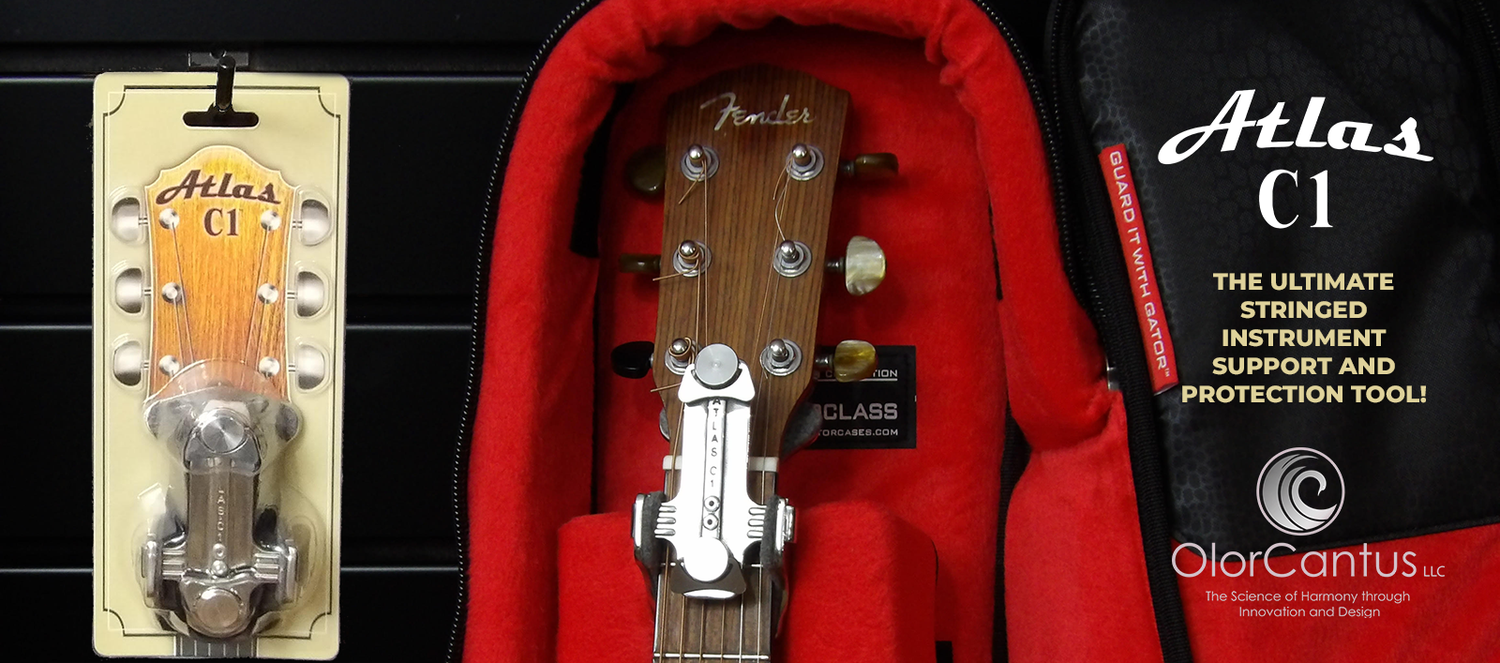
Beyond padding and case selection, dedicated headstock support tools provide the most reliable protection during travel.
The Atlas C1 is engineered specifically for this purpose. It provides unparalleled support to the vulnerable headstock-neck junction, counteracting the 130+ pounds of string pressure tension that stresses this connection. The universal design accommodates straight and angled headstocks, making it effective for virtually any guitar. Beyond travel protection, it functions as a pre-aligned repair jig, allowing you to align and repair breaks yourself without professional service. When you purchase protective equipment like the Atlas C1, a 10% product discount is available to help you invest in your instrument's safety.
No matter the mode of transportation you use when traveling with a stringed instrument, follow best practices that ensure your instrument arrives as safely as you do. The Atlas C1 provides you with peace of mind against accidents and mishandling. With proper preparation, loosening strings, using quality cases, creating immobile internal padding, and employing the Atlas C1 for dedicated headstock support, you can confidently travel with your guitar knowing that your instrument is protected. The Atlas C1 transforms headstock protection from a constant worry into a solved problem, allowing you to focus on your music rather than equipment anxiety.
Frequently Asked Questions
Q: Should I loosen my guitar strings before flying with my guitar?
A: Yes, loosening strings by a half-step to full step reduces string tension on the headstock during travel. Pressure changes in the aircraft cabin and temperature fluctuations can increase stress on the neck joint. Loosening strings takes 30 seconds and significantly reduces break risk during flight. Retune when you land and let the guitar acclimate to the new environment for 15-20 minutes before playing.
Q: What is the best way to ship guitars safely?
A: Use a hard case with internal padding designed for the guitar's body shape and neck support. Wrap the headstock and neck with additional protective layers like foam or bubble wrap. Secure loose items and use strap locks to prevent movement. Ship via a carrier that offers instrument insurance. Consider using a headstock support tool to provide extra reinforcement at the vulnerable neck junction where most breaks occur.
Q: Can I bring my guitar as a carry-on or must I gate check it?
A: Most airlines allow guitars as carry-on if the hard case fits overhead bin dimensions (typically 22x14x9 inches). Check your specific airline's policy before booking. Carry-on provides better control and reduces handling risk. If the case is oversized, gate checking is safer than checked baggage since it boards last and handles less. Always inform gate agents you're carrying an instrument so they can note it in the system.
Q: How do I protect my guitar headstock from TSA inspection damage?
A: TSA agents may open your case for inspection. Pack your guitar so the headstock is easily visible and accessible without requiring the agent to move protective padding. Use gaffer tape to secure padding so it doesn't shift during inspection. Remove the guitar from the case only if TSA requests it. A headstock support tool keeps the neck stable during inspection and prevents accidental stress on the joint while the case is open.
This article was written using GrandRanker