
Table of Contents
- Why Standard Guitar Shipping Fails
- Step 1: Loosening Guitar Strings for Shipping and Case Prep
- Step 2: Guitar Headstock Protection During Transit
- Step 3: The Double-Box Method with Proper Cradle Support
- Step 4: Choosing a Carrier and Understanding Shipping Insurance for Musical Instruments
- Step 5: Preparing Customs Documents for International Shipments
- What to Do If Your Guitar Arrives Damaged: The Claims Process
- Atlas C1: The Missing Link in Guitar Transit Safety
- Frequently Asked Questions
Last Updated: September 8, 2026
Shipping a high-value acoustic guitar is one of the most stressful tasks an owner faces. The best way to ship expensive acoustic guitars is a complete system: proper string loosening, Firm but gentle internal support, the double-box method, and carrier insurance that covers the instrument's full value. Skipping any one of these steps can turn a simple shipment into an expensive repair.
The headstock-neck junction is the weakest point on any guitar, and it is where a majority of transit breaks occur. Below, we break down the full process step by step, from case prep to the claims process, so you can ship with confidence.
Why Standard Guitar Shipping Fails
The standard approach of putting a guitar in its case and dropping it into a single cardboard box fails because it does not address the physics of impact. When a package is dropped, the guitar's momentum continues even as the case stops. The headstock, being the heaviest unsupported part, whips forward and snaps at the neck joint, a headstock break, the most common catastrophic damage in transit.
Standard packing also ignores temperature and humidity changes. A guitar in a non-climate-controlled truck can experience thermal shock, leading to finish checking and wood cracks. Instrument safety requires a layered approach that addresses both impact and environment.
Step 1: Loosening Guitar Strings for Shipping and Case Prep
Loosening guitar strings for shipping is a critical first step that many owners skip. The tension from a tuned set of strings, which can exceed 130 pounds of pressure across the neck, pulls the neck into a slight bow. During transit, temperature and humidity changes make the wood move, increasing the risk of neck damage.
Reduce the tension on all six strings by about a half-step to a full step, enough to relieve pressure while keeping the bridge in place. This practice, called reducing neck relief, protects the truss rod. Then place a soft cloth between the strings and the fretboard near the soundhole to prevent rattling and finish scratches.
Step 2: Guitar Headstock Protection During Transit
Guitar headstock protection during transit is where most packing jobs fall short. The headstock and neck joint need rigid support to prevent the whiplash effect that causes breaks. A soft cloth or foam does not provide enough resistance; the headstock needs to be immobilized against the case.
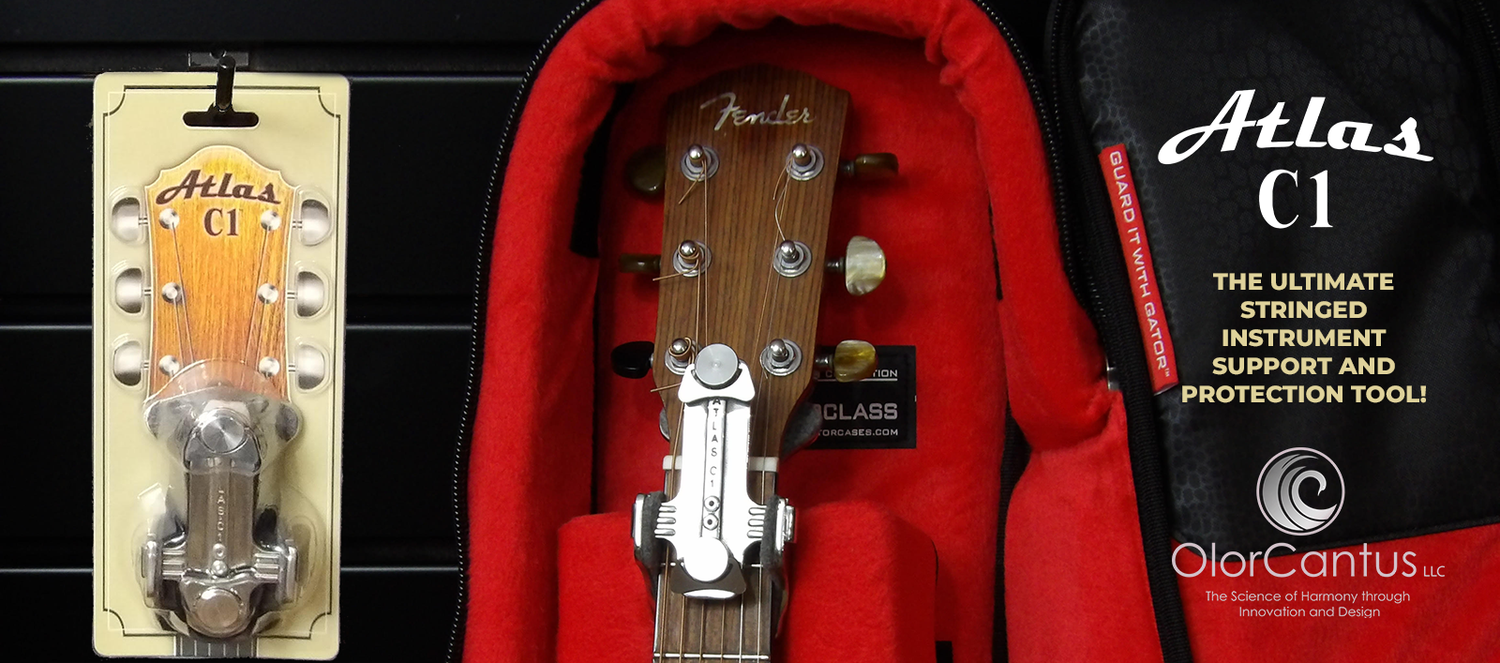
The most effective solution is a dedicated headstock support tool that braces the neck joint against the case interior. The Atlas C1 counteracts the string pressure and supports the vulnerable headstock-neck junction, preventing the forward snap that causes breaks. By locking the headstock in a neutral position, it also maintains proper neck relief. For any guitar with an angled headstock, such as a Gibson-style instrument, this support is essential.
Step 3: The Double-Box Method with Proper Cradle Support
The double-box method is the industry standard for shipping fragile, high-value items. It creates a buffer zone of crushable material between the inner case and the outer box, absorbing impacts that would otherwise transfer directly to the instrument.
Start with your guitar secured in a hard-shell case with the headstock support in place. Place the case inside a large cardboard box with at least three inches of space on every side. Fill the bottom with crumpled paper or foam to create a soft cradle, set the case in, and fill all remaining voids so the case cannot shift. Close the box and tape all seams with heavy-duty packing tape, not masking or duct tape, which do not hold under stress.

Measuring and Sourcing the Right Shipping Boxes
The outer box must be significantly larger than the guitar case. A typical acoustic case measures around 42 x 18 x 6 inches, so the outer box should be at least 48 x 24 x 12 inches to allow for the padding buffer. Use double-wall cardboard from shipping supply stores or moving companies; it provides greater crush resistance than single-wall.
Do not reuse a box that shows signs of damage or crushing, a compromised box will fail under pressure. For multiple guitars or custom sizes, purchase boxes specifically designed for guitar shipping, which are pre-sized and reinforced.
Step 4: Choosing a Carrier and Understanding Shipping Insurance for Musical Instruments
Selecting the right carrier is not about finding the cheapest label; it is about understanding the liability programs and service tiers each major carrier offers. For an instrument worth several thousand dollars, the difference between a small claim payout and a full replacement comes down to which program you choose and how you document the shipment.
Carrier Service Tiers: What Actually Matters
The three major carriers are UPS, FedEx, and USPS. Each offers standard ground and premium expedited service, but handling protocols differ significantly.
- UPS Ground vs. UPS Next Day Air: UPS Ground packages travel in trailers that may sit in unheated or uncooled hubs for hours. Next Day Air packages move through a dedicated air network with faster transfer times, reducing the window of exposure to temperature extremes. For a vintage instrument, the extra cost of air service is a form of environmental insurance.
- FedEx Home Delivery vs. FedEx Express Saver: FedEx Home Delivery often uses contract drivers and smaller vehicles, which can mean more handling events. Express Saver (3-day) uses the Express network, which has stricter package handling standards and more frequent scan points, providing better chain-of-custody documentation.
- USPS Priority Mail Express: USPS offers a flat-rate option that is often the cheapest, but the USPS claims process for damaged musical instruments is notoriously slow, and their liability is capped at the declared value you pay for, with a maximum of $5,000 for most items. For instruments above that threshold, USPS is not a viable option.
Professional luthiers and vintage dealers commonly use ground service for instruments valued under $2,000 and switch to air or white-glove freight above that. The reason is not speed; it is the reduced number of sortation events, since every sorting facility visit carries a statistical chance of damage.
Declared Value vs. Third-Party Freight Insurance: The Real Trade-Offs
Carrier declared value coverage is the default option, but it has structural limitations many shippers discover only after a loss.
Carrier Declared Value (UPS, FedEx):
- Coverage Cap: UPS and FedEx cap declared value liability at $50,000, but the claims process requires the carrier to inspect the damaged goods, often at a carrier facility, meaning you must ship the instrument back, risking further damage.
- Packing Requirement: Both carriers require that packing meet their published guidelines. If the carrier determines the packing was insufficient, for example, less than two inches of padding on all sides, they can deny the claim entirely. Photographing your packing process is your only defense against a packing-denial ruling.
- Depreciation Risk: For vintage or collectible instruments, carrier declared value typically covers actual cash value, not replacement value. The carrier may settle for depreciated book value rather than fair market value.
Third-Party Freight Insurance (e.g., specialized instrument insurers):
- Broader Coverage: Third-party policies often cover "mysterious disappearance" and temperature or humidity damage, which standard carrier liability excludes. They also typically cover the full agreed-upon value, not a depreciated amount.
- Faster Claims: Third-party providers usually allow you to take the instrument to a local authorized repair luthier for an estimate, avoiding the need to ship it back to the carrier's facility. This reduces secondary damage risk and speeds up settlement.
- Cost Structure: Third-party insurance is typically priced as a percentage of the declared value, often around 1-2%.
The Claims Process: What to Do Before You Ship
The most common reason claims are denied is a lack of documented evidence. Before you seal the outer box, create a digital evidence file that includes:
- Serial number and condition photos: Photograph the serial number, body, headstock, and neck joint from multiple angles. Use a dated newspaper or timestamped app to prove the photos were taken before shipment.
- Packing process photos: Photograph the case inside the box, the padding depth on all sides, and the sealed box with the tracking label visible. This proves you met the carrier's packing guidelines.
- Receipt of value: Keep a copy of the original purchase receipt, a recent appraisal, or a sales listing for a comparable instrument. This establishes the value you are claiming.
Signature Required and Delivery Confirmation
Always require an adult signature on delivery. This establishes a clean chain of custody. If the package is left on a porch and disappears, the carrier will deny the claim because delivery was completed without a signature. A signature forces the recipient to note any visible damage on the delivery record before accepting the package.
For high-value shipments, consider a carrier service with "delivery confirmation with photo." This provides a timestamped image of the package at delivery, useful if the recipient claims it was not delivered or was left in an unsafe location.
The Unique Angle: Why Carrier Choice Is an Environmental Decision
Carrier choice determines the environmental exposure your guitar faces. A guitar shipped via ground in January from Nashville to Chicago will sit in an unheated trailer overnight; when brought into a warm delivery truck the next day, the rapid temperature change can cause the finish to check. This thermal shock is not covered by standard carrier insurance.
To mitigate this, choose a service that minimizes transit time and avoids overnight holds at regional hubs, often air service or expedited ground with a guaranteed delivery window. The extra cost is a direct investment in preventing thermal damage that no insurance policy will cover.
Before purchasing a label, call the carrier and ask: (1) What is the maximum declared value liability for a musical instrument packed by the shipper? and (2) Does the claims process require an inspection at a carrier facility, or can I use a local repair shop? The answers will tell you whether you need third-party insurance.
Step 5: Preparing Customs Documents for International Shipments
International shipping is where the highest-stakes failures occur. Beyond the basic customs declaration form, there is a regulatory layer that can result in your guitar being seized, fined, or permanently confiscated: the Convention on International Trade in Endangered Species of Wild Fauna and Flora, commonly known as CITES. This is the single most important document to understand before shipping any acoustic guitar across a border.
CITES and Rosewood: The Rule That Changed Guitar Shipping
In January 2017, CITES placed all species of the genus Dalbergia, including Brazilian, Indian, and Honduran rosewood, under Appendix II protection. This applies to unfinished wood, veneer, and finished musical instruments containing any amount of this wood. The rule was amended in November 2019 to create a limited exemption for finished instruments, but the exemption is not universal.
What the 2019 Exemption Means for You:
- Traveler's Exemption: If you are personally carrying the guitar as accompanied baggage, you do not need a CITES permit for most rosewood-containing instruments, provided it is for personal use and not for sale.
- Unaccompanied Shipment: If you are shipping the guitar via freight without accompanying it, the exemption does not automatically apply. In practice, customs officials may require a CITES certificate even for finished instruments shipped unaccompanied.
- Brazilian Rosewood (Dalbergia nigra): Listed under Appendix I, the highest level of protection, commercial trade in Brazilian rosewood is strictly prohibited. If your guitar contains it, you cannot ship it internationally for commercial purposes under any circumstances.
The CITES Permit Process: What You Need to Do
If your guitar contains any protected wood species and you are shipping it internationally for repair, sale, or exhibition, you must obtain a CITES permit from the U.S. Fish and Wildlife Service (USFWS) before the shipment leaves the country:
- Identify the wood species: If unsure whether your guitar contains rosewood, ebony, or another protected species, consult the manufacturer or a luthier. Many modern guitars use alternative woods, but vintage instruments almost certainly contain protected species.
- Apply for a CITES permit: Submit an application to the USFWS Division of Management Authority with a detailed description of the instrument, including serial number, wood species, and shipment purpose.
- Allow processing time: Standard processing is 60-90 days. For a tour or time-sensitive repair, plan months in advance.
- Use a designated port: CITES shipments must enter and exit the U.S. through designated ports. For musical instruments, the primary ports are New York (JFK), Los Angeles (LAX), Miami, and San Francisco (SFO).
The Harmonized System (HS) Code and Accurate Valuation
Beyond CITES, standard customs documentation requires a Harmonized System (HS) code. For acoustic guitars, the correct U.S. code is 9202.90.2000, classifying the instrument as a "stringed musical instrument, played with a bow or by plucking." The correct code determines the duty rate and flags the package for special inspections.
Accurate valuation is equally critical. Under-declaring value to reduce import duties is a federal offense in most countries and can result in seizure and fines. Over-declaring creates unnecessary duty costs. Declare the actual purchase price or fair market value; for vintage instruments, attach a recent appraisal to justify the declared value.
The ATA Carnet: The Solution for Temporary Exports
If you are shipping a guitar out of the country temporarily, for a tour, trade show, or repair, the standard customs process requires paying import duties on entry and applying for a refund when it returns.
The solution is an ATA Carnet (Admission Temporaire/Temporary Admission), an international customs document that allows temporary export without paying duties or posting a bond. Valid for up to one year, it covers the instrument for multiple entries and exits across multiple countries.
How to obtain an ATA Carnet:
- In the United States, the ATA Carnet is issued by the U.S. Council for International Business (USCIB).
- The application requires a detailed inventory of the items being shipped, including serial numbers and values.
- The carnet must be validated by customs at the port of departure and again at the port of entry.
The Unique Angle: Why Most International Guitar Shipments Fail
The most common reason international guitar shipments fail is not transit damage; it is customs seizure due to missing CITES documentation. A guitar containing rosewood that arrives without a valid CITES permit is subject to confiscation, and the shipper may face fines. This is a permanent loss that no insurance policy will cover.
Before booking any international shipment, verify the wood species, check its CITES Appendix status, and confirm whether the destination country has stricter domestic regulations than the international baseline. The European Union, for example, has stricter rules for certain species. A quick consultation with the USFWS or a customs broker can save you from losing an irreplaceable instrument.
What to Do If Your Guitar Arrives Damaged: The Claims Process
If your guitar arrives damaged, do not accept the package without noting the damage on the delivery record. If the box shows visible signs of crushing, photograph it before opening, these photos are your primary evidence. Then inspect the headstock joint, neck, and body for cracks.
File a claim with the carrier immediately, most require claims within a few days to a few weeks after delivery. You will need the original shipping receipt, declared value documentation, and photos of the damage. The carrier may require you to ship the instrument to an inspection facility, so keep the original packing materials.
If you purchased third-party freight insurance, contact that provider instead. Their process is often more straightforward, and they may offer repair or replacement rather than a cash settlement. Act quickly and keep all documentation organized.
Atlas C1: The Missing Link in Guitar Transit Safety
The most common point of failure in guitar shipping is not the box or the padding; it is the lack of rigid support for the headstock. The Atlas C1 fills that gap. It is a U.S. patent-protected, universal tool that supports the headstock-neck junction, counteracting string tension and preventing the whiplash that causes breaks.
For touring musicians, collectors, and anyone shipping a high-value instrument, the Atlas C1 provides the protection that standard packing cannot. When you combine the Atlas C1 with the double-box method and proper insurance, you have the best way to ship expensive acoustic guitars. The peace of mind it provides is worth far more than the cost of a single repair. And when you're ready to secure your next instrument or upgrade your current one, remember that Atlas C1 offers a 10% product discount and free shipping on qualifying orders, making it easier to invest in the gear you love.
Frequently Asked Questions
Should I loosen the strings before shipping an acoustic guitar?
Yes. Loosening guitar strings for shipping is critical because the constant tension of tuned strings (over 130 pounds on some models) can warp the neck or cause the bridge to pull up during transit, especially with temperature and humidity changes. Loosen each string by about two full turns to reduce tension while keeping enough slack so the bridge doesn't shift. Never fully detune, as this can alter the neck relief and put the instrument out of adjustment when it arrives.
Is it safer to ship a guitar in a hard case or a gig bag?
A rigid, hard-shell case is non-negotiable for shipping expensive acoustic guitars. Gig bags offer zero protection against crushing or impact damage. Your hard case should fit the guitar snugly to prevent movement inside. For added guitar headstock protection during transit, use a device like the Atlas C1 to support the vulnerable headstock-neck junction, then pad the case's interior with soft cloths or bubble wrap to immobilize the instrument completely.
Do I need to buy extra insurance when shipping a high-value guitar?
Absolutely. Standard carrier liability is limited and will not cover the full replacement value of a high-end acoustic guitar. Shipping insurance for musical instruments is essential. Purchase declared value coverage through your carrier for the guitar's full insured value, or use a third-party freight insurance provider for better rates and more comprehensive coverage. Document the instrument's condition with dated photos before shipping to support any future claim.
What is the best packing material for shipping a guitar?
Use a layered approach. Inside the case, use soft padding like bubble wrap or foam to immobilize the guitar. In the outer box, create a 3-4 inch cushion on all sides using packing peanuts, crumpled paper, or foam sheets. The inner case must not touch the outer box walls at any point. This double-box method with proper cradle support absorbs shock and prevents transit damage from impacts or crushing.
How do I properly box an acoustic guitar for transit?
Place the guitar in its hard case and secure it. Use the Atlas C1 to protect the headstock area. Wrap the case in a layer of bubble wrap. Place it inside a cardboard box that is at least 6 inches larger than the case on all sides. Fill the bottom with packing material, insert the case, then surround it completely with more padding. Seal the box with heavy-duty tape and reinforce all edges. Write 'FRAGILE' on multiple sides, though carriers do not guarantee special handling based on labels alone.
Is it cheaper to ship a guitar with UPS, FedEx, or USPS?
Costs vary by weight, dimensions, and distance, so compare rates for your specific shipment. UPS and FedEx are generally recommended for expensive guitars because of their reliable tracking and declared value options. USPS Ground Advantage is often more economical but provides limited coverage for very high-value items. Consider using a shipping platform like Pirate Ship or ShipNerd to access discounted commercial rates from major carriers without paying retail prices.
What information do I need for the customs declaration when shipping a guitar internationally?
When shipping internationally, you must complete a customs declaration form accurately. Describe the item as an 'acoustic guitar' with its material composition (wood) and the country of manufacture. State the guitar's declared value for customs purposes. Be aware that the recipient may be responsible for import duties and taxes. Include a commercial invoice if you are a business. Check the destination country's import restrictions on wood products, as some require phytosanitary certificates.