
Table of Contents
- Why Airline Musical Instrument Policy Confuses Travelers
- The U.S. Rules That Govern Musical Instruments on Flights
- Musical Instrument Carry-On Rules: What Fits and What Doesn't
- Airline Rules for Guitars: A Carrier-by-Carrier Comparison
- Buying an Extra Seat for a Musical Instrument
- When You Must Check an Instrument: Fees, Risk, and Alternatives
- Packing a Guitar for Air Travel: Step-by-Step Protection
- What to Do When Staff or Cabin Space Blocks Your Instrument
- Frequently Asked Questions
Last Updated: October 21, 2026
Why Airline Musical Instrument Policy Confuses Travelers
Airline musical instrument policy is the set of carrier rules and federal protections that decide whether your guitar flies in the cabin, rides in the hold, or needs its own seat. The confusion comes from two rulebooks running at once. Federal law sets a floor for carry-on access, and each airline builds its own rules on top of it.
Here's the part most guides get wrong: the law and the airline's contract of carriage are different documents. One protects your right to try. The other controls what actually happens at the gate.
That gap is where instruments get damaged and players get stranded. Below, we'll walk through the federal baseline, the carrier-by-carrier differences, and the packing steps that keep a headstock intact.
The U.S. Rules That Govern Musical Instruments on Flights
Federal rules give you a legal right to bring a small instrument aboard, but they don't guarantee overhead space. The FAA Modernization and Reform Act of 2012 instructed carriers to allow instruments that fit in the cabin, and the U.S. Department of Transportation's aviation consumer guidance spells out how that works in practice.
The core protections:
- A carrier must let you bring a guitar or violin aboard if it fits in an overhead bin or under the seat
- You can buy a seat for a larger instrument and keep it in the cabin
- The instrument counts as your carry-on, so plan your other bags accordingly
- Gate agents cannot force a legally sized instrument into checked baggage without your consent
Small instruments like violins, ukuleles, and mandolins usually clear this bar. Full-size guitars sit right on the line.
Musical Instrument Carry-On Rules: What Fits and What Doesn't
The short answer: a standard guitar case rarely fits a mainline overhead bin, and almost never fits a regional jet. Musical instrument carry-on rules hinge on the case's linear dimensions, not the guitar inside it.
Here's how the categories break down:
| Instrument | Typical Case Type | Cabin Fit | Practical Outcome |
|---|---|---|---|
| Violin, viola | Shaped hard case | Usually fits | Carry on, overhead bin |
| Ukulele, mandolin | Padded gig bag | Fits easily | Carry on, under seat |
| Acoustic guitar | Hard-shell case | Sometimes fits | Mainline widebody only |
| Electric guitar | Gig bag or hard case | Often fits | Overhead on larger jets |
| Bass guitar | Long hard case | Rarely fits | Extra seat or checked |
| Cello | Hard case | Never fits | Extra seat or cargo |
Measure your case before you book. Add the length, width, and height together. Compare that number to the carrier's published carry-on limit, which most airlines list on their baggage page.
Soft gig bags bend. Hard cases don't. A gig bag can sometimes squeeze into a closet or between seats where a hard case cannot go.
Airline Rules for Guitars: A Carrier-by-Carrier Comparison
Airline rules for guitars differ most in three areas: whether the instrument counts as a carry-on, how gate agents handle a full cabin, and what the carrier charges for an extra seat. Policies change often, so confirm on the carrier's own site before you fly.
| Carrier | Carry-On Stance | Extra Seat Available | Notes |
|---|---|---|---|
| Delta | Allowed if it fits | Yes | Counts as carry-on; confirm dimensions on the baggage page |
| American | Allowed if it fits | Yes | Agent discretion at gate; call ahead for extra seat |
| United | Allowed if it fits | Yes | Confirm at booking; regional partners may differ |
| Southwest | Allowed if it fits | Yes | No assigned seats, board early |
| JetBlue | Allowed if it fits | Yes | Check case dimensions against published limits |
| Alaska | Allowed if it fits | Yes | Strong reputation for instruments; confirm regional jets |
The pattern is consistent: mainline carriers follow the federal floor. Regional partners flying under a mainline brand often have smaller cabins and tighter bins.
That's the gap nobody warns you about. You book a mainline ticket, then a regional jet shows up at the gate.
How to Verify Any Carrier's Policy in Under Five Minutes
Because policies change, the table above is a starting point, not a guarantee. Here is a repeatable process to confirm the rules for your specific flight:
- Open the carrier's contract of carriage. Search the carrier's site for "contract of carriage" and find the section on musical instruments. This is the legally binding document, not the marketing page.
- Check the aircraft type. Your booking confirmation shows the aircraft. Cross-reference the seat map to see whether you are on a mainline jet or a regional partner.
- Measure your case. Add length, width, and height. Compare that linear total to the carrier's published carry-on limit, which most airlines list on their baggage page.
- Call the carrier's accessibility or special items desk. Ask two questions: whether the instrument can be carried on for your specific aircraft, and whether an extra seat can be reserved for it.
- Save the confirmation. Note the agent's name, the date, and any reference number. If a gate agent later disagrees, you have a record.
The Regional Jet Trap
Mainline carriers often sell tickets that include a regional segment operated by a partner. The partner's aircraft may have overhead bins that are too small for a standard guitar case even when the mainline carrier's policy allows carry-on. Before you book, check whether any segment is operated by a regional partner. If it is, plan to gate-check or buy an extra seat for that segment, and confirm the arrangement with the operating carrier, not just the ticketing carrier.
What the Law Does and Does Not Require
The federal rule requires carriers to allow instruments that fit in the cabin, but it does not require them to guarantee bin space. A carrier can still ask you to gate-check if the cabin is full. The practical difference between carriers is how they handle that moment: some train gate agents to look for closet space first, while others default to gate-checking. Asking the carrier's special items desk about this before you fly is the best way to know what to expect.
Buying an Extra Seat for a Musical Instrument
Buying an extra seat for a musical instrument is the cleanest way to keep a large guitar in the cabin. You pay a second fare, and the instrument flies beside you instead of in the hold. The process is simple, but the details matter, and most carriers do not let you complete it online.
Step-by-Step Booking Process
- Call the airline before booking online. Most carriers cannot sell an instrument seat through the website. Call the reservations line and tell the agent you need to book a seat for a musical instrument.
- Ask the agent to flag the reservation as an instrument seat, not a passenger seat. This matters for boarding and for the gate agent's records.
- Confirm the seat is window-side and that the instrument will be secured. Some carriers require the instrument to be in a window seat so it does not block aisle access.
- Arrive early. Gate staff need time to verify the arrangement and to coordinate with the cabin crew.
What You Will Pay
Expect to pay a full fare, not a reduced one. Some carriers offer a child fare for instrument seats, but most charge the adult rate. The exact amount depends on the route, fare class, and carrier, so confirm the total with the agent before you commit. Ask whether taxes and fees apply to the instrument seat, because some carriers waive certain charges for non-passenger seats.
Restrictions and Coordination
- The instrument must stay in its case and be secured for taxi, takeoff, and landing. You cannot hold it on your lap.
- Some carriers require the instrument to be in a hard case. Confirm the case requirement when you book.
- The instrument seat may not be eligible for certain fare classes or upgrades. Ask the agent to confirm the fare rules.
- If your flight involves a connection, confirm that the instrument seat is booked on every segment. A single unbooked segment can force the instrument into the hold.
When an Extra Seat Is the Better Choice
An extra seat is safer than checking a valuable instrument. It is the best option for full-size guitars, basses, and cellos that exceed carry-on dimensions. For smaller instruments that fit in the overhead bin, an extra seat is unnecessary. Measure your case first, then decide.
When You Must Check an Instrument: Fees, Risk, and Alternatives
Checking an instrument is the last resort, and the risk is real. Baggage handlers move fast, and a headstock takes the worst of it. Angled headstocks, like those on Gibson-style guitars, are the most vulnerable.
Fees vary by carrier, route, and bag weight. Confirm the checked baggage fee on your carrier's site before you fly, since rates change by route and fare class.
Alternatives worth considering:
- Ship ahead. Use a specialist instrument courier or a carrier's fragile service with full insurance.
- Buy the extra seat. Cheaper than a headstock repair in most cases.
- Fly a carrier with a strong instrument reputation. Some airlines handle instruments better than others.
- Use a hard case with internal bracing. A case that holds the neck steady prevents the most common break.
Packing a Guitar for Air Travel: Step-by-Step Protection
Packing a guitar for air travel comes down to one job: stop the headstock from moving. The neck-headstock junction is the weakest point on the instrument, and it's where most travel breaks happen.

Follow these steps:
- Detune the strings. Slack them a half step to full step. This reduces tension on the neck.
- Support the headstock. Fill the gap under the neck with foam or a purpose-built support so the headstock can't drop.
- Cushion the body. Pack foam around the body so it can't shift inside the case.
- Lock the case. Use the latches and add a strap or tape around the case for flights.
- Label it fragile. Mark the case clearly and tell the gate agent what's inside.
Here's where most players lose the fight. They pad the body and leave the headstock floating. A single drop is enough to snap the neck junction.
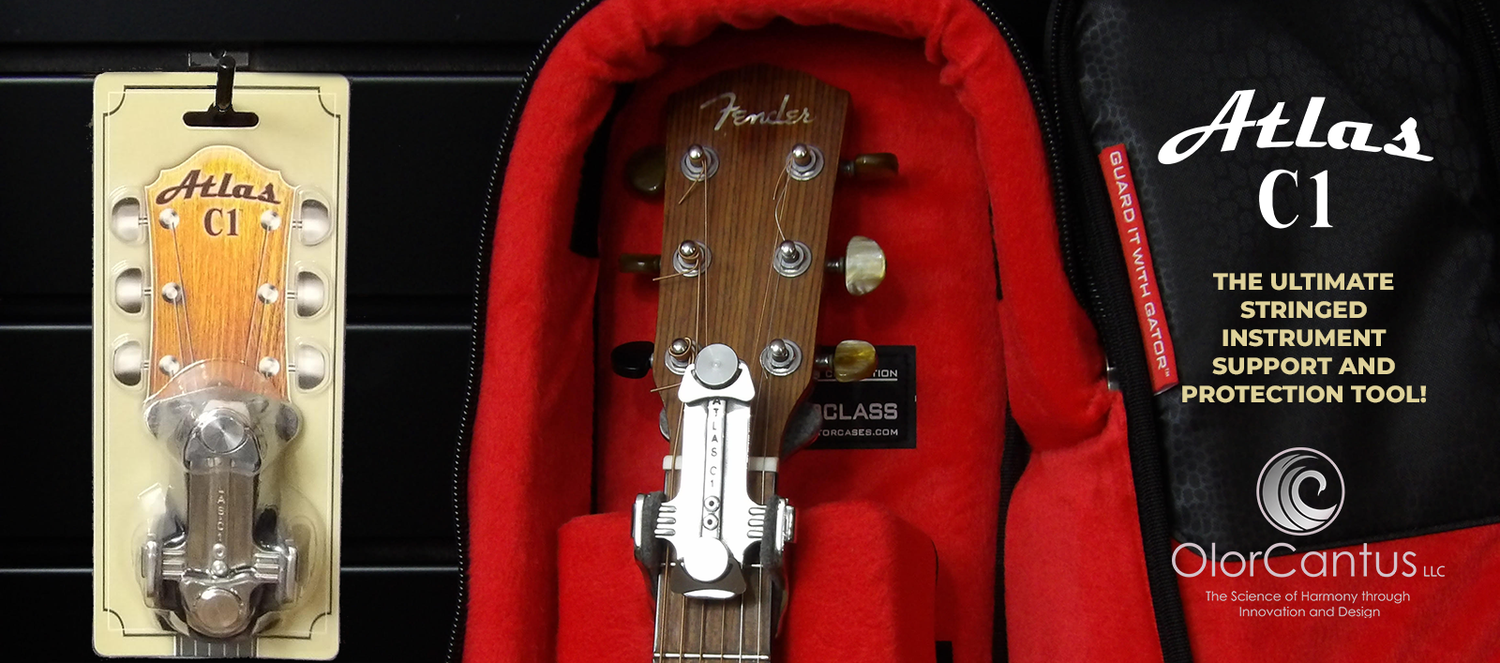
That's the exact problem the Atlas C1 was built to solve. The Atlas-C1 is a universal headstock support tool that braces the neck junction and counteracts the string tension pulling on the headstock. It fits in the case during travel and doubles as a pre-aligned repair jig if a break happens anyway.
What to Do When Staff or Cabin Space Blocks Your Instrument
Gate staff have the final say in the moment, even when the law is on your side. Stay calm and work the problem in order.
Your options, in sequence:
- Ask for the closet. Many aircraft have a coat closet near the door. Ask politely before boarding.
- Request a seat change. A window seat with an empty neighbor gives you room to stow.
- Offer to buy a seat. If space allows, ask the agent to sell you one on the spot.
- Ask for gate-check with a receipt. If you must surrender the instrument, get a written tag and confirm it goes to the jet bridge, not the hold.
- Escalate. If staff force a legally sized instrument into checked baggage against your wishes, note the flight and file a complaint with the carrier and the Department of Transportation.
Flying with a guitar asks you to plan ahead, know the rules, and protect the weakest point on the instrument. Airlines will always have their own policies, and cabin space will always be tight. What you can control is how well your guitar is braced before it ever leaves your hands.
At Atlas C1, we built the Atlas-C1 for exactly this moment. It supports the headstock-neck junction during travel, counteracts the string tension that causes breaks, and doubles as a repair jig if damage happens anyway. It's U.S. patent-protected, used by professional touring musicians, and available at Guitar Center, and if you order directly, you can take advantage of a 10 % product discount with free shipping.
Get started with Atlas C1 and give your guitar the protection it needs before your next flight.
Frequently Asked Questions
Can a guitar count as a carry-on item?
Yes, a guitar can count as your carry-on if it fits within the airline's size limits, typically 22 x 14 x 9 inches. Most standard guitars exceed these dimensions, so many airlines require you to purchase an extra seat or check the instrument. Always check your specific airline's musical instrument carry-on rules before booking. If the guitar fits, it must be stowed in the overhead bin or under the seat, and you cannot bring a separate carry-on bag.
How do you find an airline's rules for musical instruments?
Visit the airline's official website and search for 'musical instruments' or 'special baggage.' Look for a dedicated page outlining carry-on and checked baggage policies, including size and weight limits. If the information is unclear, call customer service and ask for written confirmation. For international flights, also review the destination country's customs regulations. Always verify policies close to your travel date, as airlines update their rules frequently.
What should you do if your instrument does not fit in the overhead bin?
If your instrument does not fit in the overhead bin, you may need to gate-check it or purchase an extra seat. Gate-checking carries damage risk, so pack the instrument in a hard case with padding. Alternatively, ask the gate agent about buying a seat for the instrument if space is available. Some airlines allow instruments to be stowed in the coat closet. Always arrive early and communicate with staff to explore all options before resorting to checked baggage.
Is it safer to check a musical instrument or bring it into the cabin?
Bringing an instrument into the cabin is generally safer because you maintain control and reduce handling risk. However, if the instrument exceeds carry-on limits, checking it in a hard case with proper padding is the next best option. Use a protective case and consider additional insurance. The Atlas C1 headstock protector can be used inside the case to safeguard the neck junction during travel, whether in the cabin or checked.