
Table of Contents
- D'Addario vs StewMac: A Direct Tool Comparison
- Best Guitar Setup Tools From Each Brand
- Guitar Repair Tools for Beginners: Where to Start
- Guitar Fretwork Tools: Accuracy and Precision Compared
- How to Fix a Broken Guitar Headstock: Tool Requirements
- Tool Quality and Durability: What Lasts
- Neck Relief Measurement and Setup Accuracy
- Value for Money: Total Cost of Ownership
- Which Brand Should You Choose?
- Frequently Asked Questions
Last Updated: October 20, 2026
D'Addario vs StewMac: A Direct Tool Comparison
When it comes to guitar setup tools, musicians face a fundamental choice: invest in specialized equipment designed by luthiers, or go with general-purpose alternatives that cost less upfront. D'Addario and StewMac represent two very different philosophies in this space. D'Addario offers affordable, entry-level guitar repair tools and accessories through their broader product lineup. StewMac, by contrast, builds its entire reputation on precision setup and repair equipment engineered specifically for professional luthiers and serious hobbyists.
The question isn't which brand is "better" in absolute terms. It's which approach matches your actual needs, your budget reality, and whether you plan to repair guitars once or repeatedly over years. At Atlas C1, we've spent considerable time understanding what separates a tool that works from one that frustrates you halfway through a repair. This comparison cuts through the marketing and shows you exactly what each brand delivers, and where a third option might serve you better.
Best Guitar Setup Tools From Each Brand
D'Addario's guitar setup tools focus on affordability and accessibility. Their offerings include string action gauges, basic repair kits, and maintenance products. These tools appeal to musicians who want to tinker with their own instruments without committing serious money to the hobby. You'll find D'Addario tools at most guitar retailers and online marketplaces, which means availability is rarely an issue.
StewMac specializes in professional-grade setup equipment: precision neck relief gauges, fret crowning files, fret leveling bars, and specialized workholding solutions. Their tools are engineered to tolerances that matter when you're correcting fret height or diagnosing neck issues. A StewMac neck relief gauge, for instance, gives you measurable feedback about what's actually happening in your instrument's neck, not just a visual guess. This precision costs more, but it translates directly to better repair outcomes.
The real difference emerges when you're mid-repair. A basic gauge tells you "something's wrong." A precision gauge tells you exactly how much is wrong and where. For beginners doing occasional maintenance, D'Addario suffices. For anyone fixing structural problems or working on valuable instruments, StewMac's accuracy becomes essential.
Guitar Repair Tools for Beginners: Where to Start
If you're new to guitar repair, start with measurement tools before buying anything else. You need to understand what you're actually working with, neck relief, string action height, fret levelness. Guessing leads to worse problems.
A basic fret height gauge and neck relief gauge should be your first purchases. These tell you what needs fixing. Only after you've diagnosed the problem should you buy the tool to fix it. This prevents the common mistake of investing in specialized equipment for a problem that doesn't actually exist on your guitar.
D'Addario's entry-level gauges work adequately for this diagnostic phase. They're inexpensive enough that you won't feel wasteful if you discover your guitar doesn't need the repair you thought it did. StewMac's gauges cost more but provide feedback you can trust completely, which matters if you're working on an instrument worth real money.
Many beginners skip the measurement phase entirely and jump straight to buying fret files or leveling bars. This almost always ends badly. Measure first, buy tools second.
Guitar Fretwork Tools: Accuracy and Precision Compared
Fretwork is where the two brands diverge most sharply, and it is also where generic advice falls apart. Leveling, crowning, and dressing frets are subtractive processes: every stroke removes material you cannot put back. The tool has to be flat, the file has to hold its profile, and the result has to be repeatable across all six strings and every fret.
A useful way to compare the brands is tool by tool, because the categories are not equivalent.
Fret leveling bars. A leveling bar or beam must stay flat along its working face. StewMac sells machined leveling beams in several lengths and profiles, including radiused versions that match common fretboard radii so you are not fighting the neck curve while you work. D'Addario does not market a dedicated fret leveling beam as a core category. If you need to level frets, the StewMac-style beam is the reference design; a generic hardware-store straightedge is not a substitute because it is not machined for this purpose and can rock or flex.
Fret crowning files. After leveling, each fret has a flat top that must be returned to a rounded crown. StewMac offers crowning files in different profiles, including diamond-coated and traditional cut versions, and the profile shape controls whether you create a smooth crown or a faceted one. D'Addario's lineup does not center on crowning files. A dull or wrong-profile file is the most common cause of a scratchy, uneven crown, which is why practitioners treat this as a precision purchase rather than a commodity one.
Fret end dressing and nut files. Fret end files and nut slotting files are another category where StewMac publishes specific thicknesses and cut profiles. D'Addario's strength is in accessories and maintenance rather than these specialized cutting tools. For a beginner, this is fine: fret sprout can often be handled with a fine file and patience. For anyone leveling a full neck, the specialized file is what prevents a re-fret.
Measured accuracy and repeatability. The gap competitors miss is evidence rather than anecdote. A controlled comparison would measure flatness of a leveling beam, consistency of a crowning file's cut across repeated strokes, and whether a gauge returns the same reading when removed and replaced. Most practitioners find that the practical difference shows up in repeatability: a tool that reads the same way twice lets you diagnose and verify, while a tool that drifts forces you to guess. That is the real distinction between a consumer-grade fret tool and a professional one, and it matters more than the marketing label.
Compatibility and workflow. Fretwork tools are not universal. Radiused beams must match the fretboard radius, crowning files must suit the fret size, and nut files must match string gauge. Before buying, confirm the radius and fret size of the instruments you actually own. A complete fretwork workflow runs: measure relief, level frets, re-crown, polish, then re-check relief and action. Tools that fit that sequence are worth more than a single impressive-looking file.
If you are only addressing minor fret sprout or doing cosmetic work, basic tools suffice. If you are correcting serious fret wear or leveling a neck that has been abused, you need equipment that will not introduce new problems while solving the old one. This is where precision becomes non-negotiable, and where the tool-by-tool match to your actual fretboard matters more than the brand on the handle.
How to Fix a Broken Guitar Headstock: Tool Requirements

A broken headstock is among the most serious damage a guitar can suffer. The headstock-neck junction concentrates enormous tension from string pressure, over 130 pounds of force pulling constantly on that vulnerable joint. When it breaks, repair requires absolute precision in alignment. Any deviation from perfect alignment creates stress points that will break again.
This is where generic tools fail completely. You cannot fix a headstock break with clamps and hope. You need a jig that holds the headstock in exact alignment while glue cures. StewMac offers headstock repair jigs designed for different headstock angles. These jigs cost significantly more than basic clamps, but they eliminate the primary cause of failed repairs: misalignment during glue-up.
D'Addario doesn't manufacture headstock repair jigs. Neither do most general tool suppliers. This repair requires specialized equipment, which is precisely why so many musicians pay luthiers to handle it professionally rather than attempting it themselves.
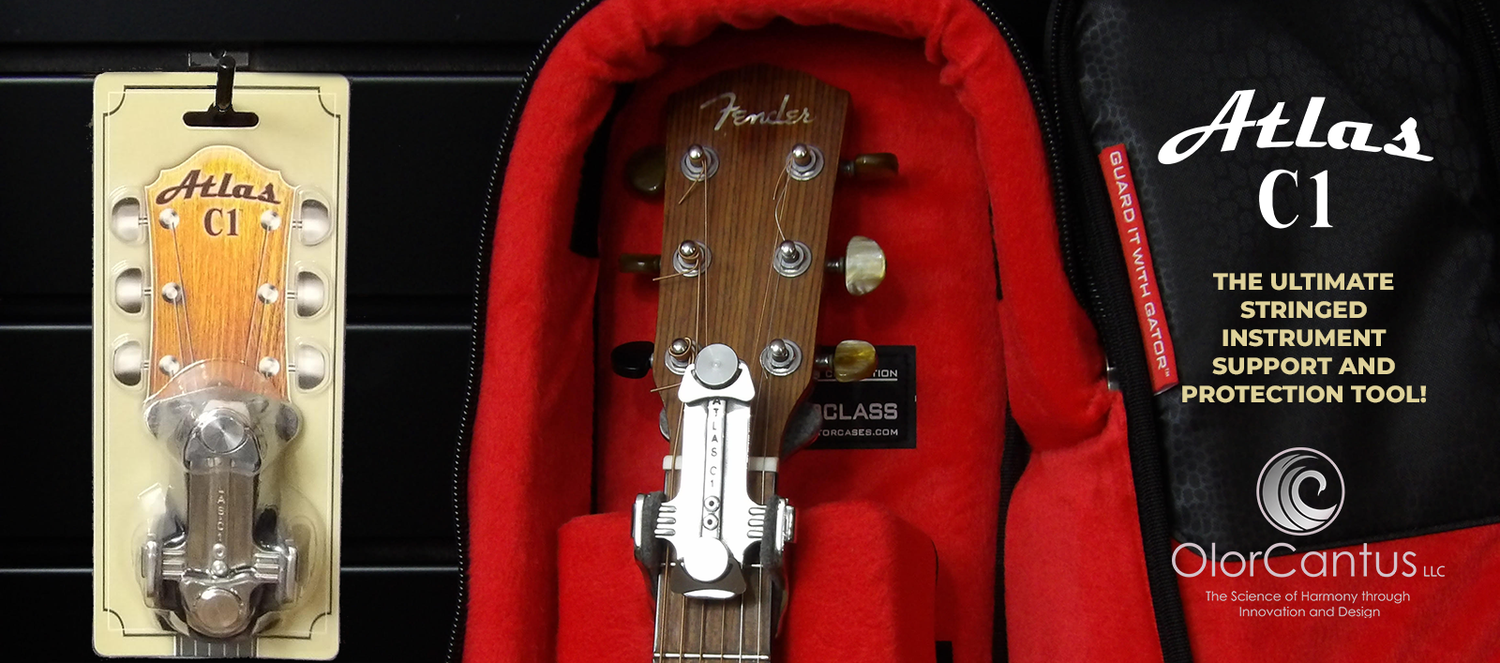
The Atlas C1 headstock repair tool takes a different approach entirely. It's engineered as a universal multi-function device that works with Gibson-style angled headstocks and straight headstocks alike. It doubles as a pre-aligned repair jig while also serving as protective support during travel and storage. This dual functionality means you're not buying a one-time repair tool, you're investing in something that protects your instruments for life.
Tool Quality and Durability: What Lasts
StewMac tools are built to last decades. Their precision equipment is manufactured to withstand repeated use in professional shops. This durability comes with a price premium that many hobbyists never recover through use, but professionals depend on it.
D'Addario tools are consumer-grade. They work adequately for occasional use but show wear faster. Gauges lose accuracy, files dull quickly, and plastic components crack. This isn't a criticism, it matches the price point. You get what you pay for.
The durability question becomes critical only if you plan to repair guitars regularly. Occasional users won't notice the difference. Regular tinkerers will replace D'Addario tools every few years. Professional luthiers buy StewMac once and use it for a career.
Consider your actual usage pattern. If you're fixing your own guitars twice yearly, consumer-grade tools make economic sense. If you're working on guitars weekly, professional equipment pays for itself through reduced replacement costs and better results that don't create callbacks.
Neck Relief Measurement and Setup Accuracy
Neck relief, the slight forward bow in a guitar neck, is the foundation of proper setup. Measure it wrong and everything downstream fails. String action won't be consistent, frets will buzz unpredictably, and the instrument will feel wrong to play.
A neck relief gauge measures this bow precisely. StewMac's gauges are engineered to eliminate guesswork. You place the gauge on the frets, sight along it, and see exactly how much relief exists. This measurable feedback is what separates diagnosis from guessing.
D'Addario's approach to neck measurement is less developed. They focus on other aspects of setup rather than specializing in the precision measurement tools that luthiers depend on.
Accurate neck relief measurement prevents cascading problems. Many setup issues trace back to misdiagnosed neck relief. Fix the neck first, and string action, fret buzz, and playability often improve without additional work. Ignore neck relief and you'll spend hours chasing problems that stem from a misaligned neck.
Value for Money: Total Cost of Ownership
The sticker price is the least useful number in this comparison. Total cost of ownership means purchase price plus replacement frequency plus the cost of redoing a repair that failed because a tool was not accurate enough. Competitors rarely break this down, so here is a structured way to think about it.
Purchase price and what is included. A StewMac precision gauge typically costs more upfront than a D'Addario entry-level gauge, but the comparison is not like for like. Check what ships in the box: a gauge that includes a feeler set, a storage case, or a calibration reference is a different value than a bare tool. A budget alternative that arrives without the accessories you need can end up costing more once you buy the missing pieces separately.
Replacement frequency. Consumer-grade gauges and files wear. Gauges can lose accuracy after repeated handling, and files dull with use. Professional-grade tools are built to hold their specification across years of shop use. The break-even math is simple: if a budget tool is replaced every couple of years and a professional tool lasts a decade or more, the annualized cost narrows considerably. For occasional users, the budget tool still wins on annualized cost; for weekly users, the professional tool usually does.
Shipping and marketplace alternatives. Amazon and marketplace listings often undercut specialist retailers on price, but factor in shipping, return shipping if the tool arrives out of spec, and the risk of counterfeit or mislabeled measurement tools. A gauge that is not what it claims to be is worse than no gauge, because it gives you false confidence. When comparing marketplace options, verify the seller and the stated specification rather than trusting the listing title. Many specialist retailers offer free shipping on orders, which can offset the upfront price difference when you factor in total cost.
The cost of modifying budget alternatives. A common pattern is buying a budget tool and then spending time and money truing it, shimming it, or building a jig to make it usable. That labor is real cost. If the modification is simple and you enjoy it, fine; if it requires machining or repeated trial and error, the savings evaporate.
The cost of a failed repair. This is the number competitors ignore. A botched fret level or a misaligned headstock repair on a valuable instrument can cost more to correct professionally than the tool investment would have been. For hobbyists working on guitars worth under $500, D'Addario tools make financial sense. For anyone working on instruments worth $1,000 or more, or doing regular repairs, professional equipment becomes cost-justified through better outcomes and fewer redos.
For occasional maintenance, the budget path is rational. For repeated or high-stakes work, the professional path pays for itself. The mistake is choosing on sticker price alone and discovering the real cost mid-repair.
Which Brand Should You Choose?
D'Addario works for casual maintenance and light repairs on guitars you don't mind risking. StewMac works for serious repair work and professional use. Neither is the complete answer for every guitarist.
The missing piece in this comparison is specialized protection and repair solutions designed for specific problems. A broken headstock requires a repair jig that works. A guitar traveling 200 days yearly requires protection that prevents breaks from happening at all. Generic tools address the symptom; specialized solutions prevent the problem.
The Atlas C1 headstock tool represents this third category: precision engineering that solves a specific, high-stakes problem. It protects instruments during travel and shipping, and it doubles as a pre-aligned repair jig when breaks do occur. This dual functionality means you're not choosing between protection and repair capability, you get both.
Your choice depends on your actual situation. Are you doing occasional maintenance on guitars you own? D'Addario tools suffice. Are you doing serious repair work or working on valuable instruments? StewMac precision justifies the investment. Are you traveling frequently with guitars or working on instruments worth protecting? The Atlas C1 tool serves a different purpose entirely, it prevents the damage that would require either brand's tools to fix.
Protecting your guitar from headstock damage doesn't require choosing between expensive repairs and risky DIY attempts. The Atlas C1 headstock tool prevents costly breaks while simplifying repairs when damage does occur. Its U.S. patent-protected design supports the vulnerable headstock-neck junction against 130+ pounds of string pressure, and it works as a pre-aligned repair jig for when professional-level precision matters. Whether you're a touring musician, a collector protecting valuable instruments, or a luthier needing reliable equipment, the Atlas C1 delivers the precision and durability that setup work demands. Get started with Atlas C1 today and enjoy a 10% product discount on your first order, plus free shipping to protect your instruments for a lifetime.
Frequently Asked Questions
Are D'Addario or StewMac tools better for guitar setup?
Both brands excel at different tasks. D'Addario focuses on string-related tools and basic setup measurements, while StewMac specializes in advanced fretwork and repair equipment. For beginners, D'Addario offers simpler entry points. For professional-grade work, StewMac provides specialized precision tools. Your choice depends on whether you need general maintenance or advanced repair capabilities. Consider the Atlas C1 as a complementary investment for headstock protection and repair alignment during any setup work.
What tools do I need for basic guitar maintenance?
Start with a neck relief gauge to measure straightness, a string action gauge for height measurement, a fret rocker to check fret levelness, and basic hex keys for truss rod adjustments. D'Addario offers beginner-friendly versions of these tools. For headstock-heavy guitars or travel protection, add a dedicated headstock support tool to your kit. Most hobbyists find these five core items sufficient for routine maintenance and minor adjustments.
Which guitar tools are best for repairing a broken headstock?
Headstock repair requires alignment precision, clamping stability, and support for the vulnerable neck junction. Specialized repair jigs that double as travel protection eliminate guesswork during alignment. StewMac offers traditional repair clamps, but tools designed specifically for headstock support provide better control during glue-up. The Atlas C1 functions as a pre-aligned repair jig, simplifying the process for musicians without luthier experience by handling the critical alignment phase automatically.
Are StewMac tools worth it for a beginner?
StewMac tools carry premium pricing but deliver professional-grade accuracy and durability. Beginners benefit more from D'Addario's entry-level offerings or budget alternatives for initial learning. However, if you own high-value instruments or plan serious repair work, StewMac's precision pays dividends through repeatability and results. For occasional players, consider whether the investment matches your repair frequency and instrument value before committing to premium tool sets.