
Table of Contents
- The Real Cost of a Broken Headstock on Tour
- Guitar Flight Case vs Gig Bag: What Actually Protects Your Instrument?
- How to Prevent Guitar Headstock Damage During Transit
- Climate Control: Humidity and Temperature Swings
- Securing Gear in the Tour Van
- Theft Prevention at Venues and Hotels
- The Best Way to Ship Guitars Safely
- Build Your Pre-Tour Safety Checklist
- Frequently Asked Questions
Last Updated: September 6, 2026
The moment a headstock snaps, the tour doesn't stop. You still have load-in in four hours, and your main guitar is now a no- go and also repair bill waiting on a luthier's bench. Guitar safety on the road is about building a system that survives travel, climate swings, and the inevitable bump in a dark loading dock.
Nearly every common travel mishap is preventable with the right combination of gear, habits, and pre-trip planning. Below are the touring musician guitar safety tips that professional players use, starting with the most expensive failure mode you will ever face.
The Real Cost of a Broken Headstock on Tour
A broken headstock is the most common damage a guitar can suffer on the road. Unlike a scratched finish, a headstock break often means the instrument is unplayable for weeks, and the repair can cost more than many gigs pay. Factor in lost income from cancelled sessions and the cost of a rental replacement, and the true price is substantial.
The vulnerability is structural. Guitars with angled headstocks, particularly Gibson-style designs, place enormous tension on the headstock-neck junction. A sudden impact releases kinetic energy exactly where the wood is thinnest, which is why a drop from waist height can snap a neck clean through while the case shows only a scuff.
Your best defense is to prevent the impact from reaching the junction in the first place. A protective support tool that braces the headstock against the case interior distributes force across a wider area, reducing the risk of a catastrophic break.
Guitar Flight Case vs Gig Bag: What Actually Protects Your Instrument?
The choice comes down to how your guitar travels. For local shows where your instrument stays in your control, a quality gig bag offers adequate protection. For air travel, tour buses, or any situation where your guitar is handled by strangers, a hard-shell case is the only sensible option.
Flight cases with rigid exteriors and custom-fit interiors provide impact resistance that soft bags cannot match. The key is the interior fit: a guitar that rattles inside a hard case is still vulnerable. The headstock needs firm support that prevents movement in every direction.
TSA guidelines on musical instruments permit guitars in overhead bins when they fit, but the reality of regional jets and full flights means your instrument often ends up gate-checked. A hard-shell case is the minimum requirement for that scenario. For the highest level of protection, pair your hard case with a dedicated headstock support tool that keeps the neck stable regardless of how the case is tossed.
How to Prevent Guitar Headstock Damage During Transit
Preventing headstock damage requires addressing both impact protection and internal stress. A case shields your guitar from external forces, but the instrument needs internal bracing to handle sudden deceleration.

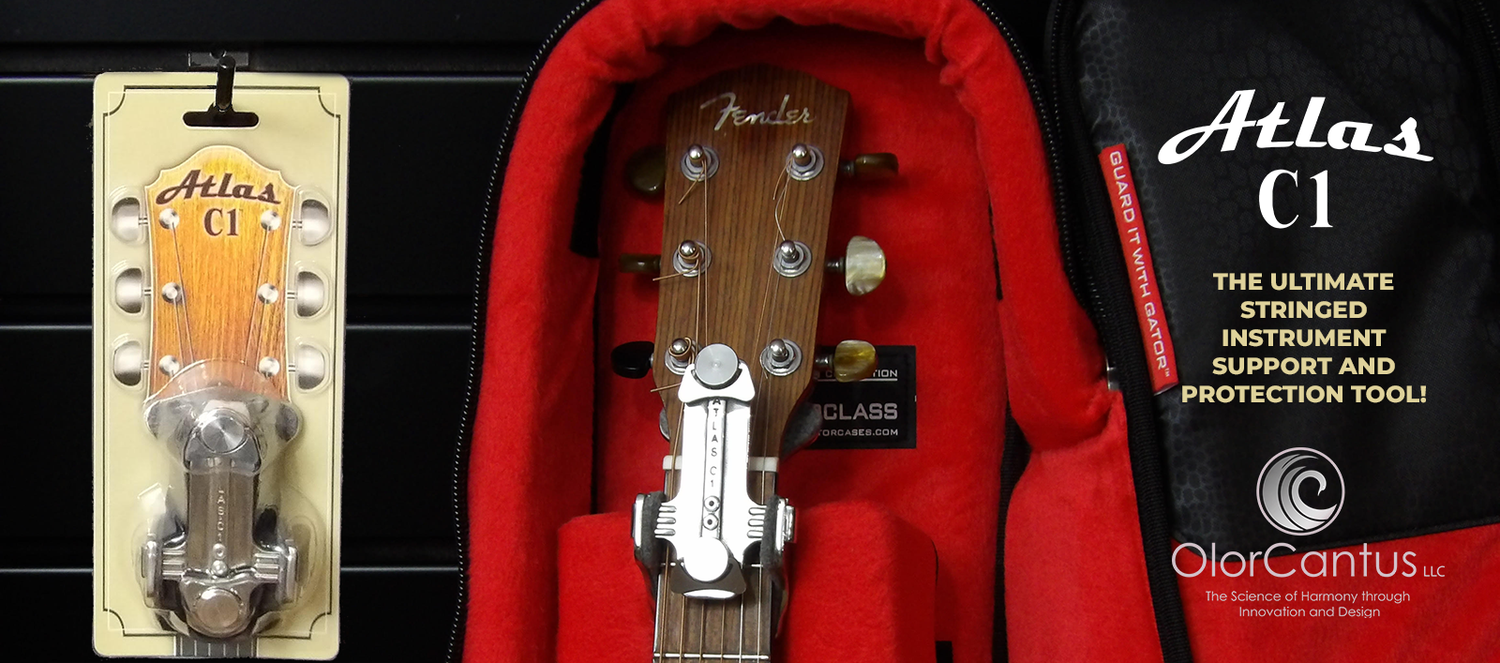
The most effective approach combines three layers: a rigid case, a snug interior fit, and a support device that transfers impact energy away from the neck joint. The Atlas C1 counteracts the string tension that pulls at the headstock-neck junction and provides a stable brace point inside your case.

Detune Strings to Reduce Tension
String tension is your enemy during transit. A guitar tuned to pitch exerts continuous pull on the headstock, and when the case is dropped, that tension amplifies the force on the neck joint. Detuning your strings by a full step or more relieves this pressure.
The practice takes thirty seconds and costs nothing. Loosen each string until it is noticeably slack, then place the guitar in its case. When you arrive, retune and check the setup, as temperature and humidity changes can affect neck relief.
Support the Headstock-Neck Junction
The headstock-neck junction is the weakest point on most guitars and needs direct support during transport. A support tool that fits snugly against the junction and the case interior prevents the headstock from flexing during impact.
The Atlas C1's U.S. patent-protected design locks around the headstock area, providing a stable brace that keeps the neck aligned and absorbs shock. It functions as both a travel protector and a pre-aligned repair jig.
Climate Control: Humidity and Temperature Swings
Wood is hygroscopic; it constantly exchanges moisture with the air around it. On tour, your guitar faces a gauntlet of microclimates, from the arid air of a plane's cargo hold to the oppressive humidity of an outdoor summer festival. Each swing forces the wood to expand or contract, manifesting as cracks, finish checking, and fret sprout. The goal is not to stop this movement but to slow it down and keep changes gradual.
The most dangerous moment is the transition. A guitar sitting in a cold van brought into a warm, humid venue forms condensation not just on the finish, but inside the soundhole and in the truss rod cavity. This moisture can seep into finish cracks, corrode electronics, and cause uneven swelling. Let the guitar acclimate in its closed case for at least 30 to 60 minutes after a significant temperature change. Do not open the case early; every time you do, you introduce warm, humid air that accelerates condensation.
The Dry Climate Problem
Arid environments (below 30% relative humidity) pull moisture out of the wood, causing the top to sink, the fretboard to shrink, and in severe cases, cracks along the grain. For touring in the American Southwest or winter in the Northeast, use a soundhole humidifier filled with distilled water, never tap water, which leaves mineral deposits. Check them daily, as they can dry out or leak if overfilled.
For a more passive solution, two-way humidity control packs release or absorb moisture to maintain a target relative humidity (usually 45-50%) inside the case. A common mistake is using one pack for an acoustic and none for an electric; solid-body guitars are less sensitive, but their necks still move. Use one pack near the headstock and one near the body.
The Humid Climate Problem
High humidity (above 60% RH) causes the wood to swell, the action to rise, and can lead to finish clouding or mold growth. For tours through the Gulf Coast or Pacific Northwest in summer, use silica gel desiccant packs. You can buy them in bulk and recharge them by baking at 200°F, making them a reusable investment. Place one or two in the case's accessory compartment, ensuring they do not touch the guitar's finish.
The Temperature Trap: The Van
The tour van is the worst climate offender. A closed vehicle in direct summer sun can reach 140°F, softening glue joints and making the finish tacky. In winter, freezing temperatures make the finish brittle. Never leave a guitar in a parked vehicle for extended periods. If you must, park in the shade, crack a window, and cover the case with a reflective sunshade or thick moving blanket.
The Post-Arrival Setup Check
Your guitar's setup is the most accurate humidity gauge you have. If the action is higher than at soundcheck, the wood has absorbed moisture. If there is fret buzz, the wood has dried out. A quick check with a tuner and visual inspection of neck relief will tell you if the truss rod needs adjustment. Do not adjust the truss rod immediately after a climate change; wait until the guitar has acclimated, typically 24 hours.
Securing Gear in the Tour Van
The tour van is where most gear damage and theft occurs. Physical packing discipline is the first line of defense, but the van is also a mobile data center. Your laptop, hard drives, and pedalboard presets are as valuable as your main guitar, arguably more so, because they contain the work product of your entire tour. A comprehensive security plan addresses both the physical and the digital.
Physical Packing: The Non-Negotiable Rules
Guitars must be in a hard-shell case, period. Load the case flat on its back or on its side with the headstock pointing toward the center of the van, never outward where a sudden stop can drive it into the van wall. Never stack cases without a layer of padding, a moving blanket or spare jacket, between them.
Use ratchet straps or cam-buckle straps to secure cases against the van's interior walls, creating a single, immovable mass. Anchor straps to the van's tie-down points. Do not rely on bungee cords, which stretch and can release under load.
The Digital Security Blind Spot
Your laptop contains your backing tracks, setlists, financial documents, and master files. Your phone has your two-factor authentication codes for your bank. If the laptop is stolen, you lose not just the hardware but irreplaceable intellectual property.
Treat the laptop bag with the same rigor as a guitar case. Secure it with a steel cable lock to a fixed point in the van. But physical locking is only half the battle, the data must be encrypted. Both Windows (BitLocker) and macOS (FileVault) offer free, built-in full-disk encryption. Enable it before you leave.
The 3-2-1 Backup Rule for Touring
The industry standard for data safety is the 3-2-1 rule: three copies of your data, on two different types of media, with one copy stored off-site. For a touring musician, this means:
- Primary Copy: Your laptop's internal drive.
- Local Backup: A ruggedized external SSD (solid-state drive, not a spinning hard drive, which is vulnerable to vibration) that you keep in a separate bag from your laptop.
- Off-Site Backup: A cloud backup service that runs automatically when you have Wi-Fi. Services like Backblaze or iDrive are designed for continuous, unattended backup.
Before you leave, do a full backup to the external drive and confirm the cloud backup is current. Every night at the hotel, plug in the external drive and let the cloud sync run. This ensures that even a stolen van with both laptop and backup drive leaves your data intact in the cloud.
The Venue Wi-Fi Trap
Public Wi-Fi at venues and coffee shops is a security risk. Never log into your bank, email, or streaming distributor's dashboard on an unsecured network. Use a Virtual Private Network (VPN) on your laptop and phone to encrypt all your traffic, making it unreadable to anyone else on the network.
The Pre-Show Digital Checklist
Just as you check your guitar's tuning before you go on stage, you should run a quick digital security check:
Checkpoint |
Action |
Time Needed |
|---|---|---|
Laptop encryption |
Confirm FileVault or BitLocker is active |
1 minute |
External backup |
Plug in the SSD and run a manual backup |
5 minutes |
Cloud sync |
Confirm the cloud client shows 'Up to Date' |
1 minute |
VPN status |
Verify the VPN is connected before using Wi-Fi |
30 seconds |
Physical lock |
Secure the laptop bag to a fixed point in the van |
1 minute |
By treating your digital assets with the same protection as your physical instruments, you ensure a single theft does not wipe out your entire tour's work.
Theft Prevention at Venues and Hotels
Theft is a touring reality. Vans get broken into, gear disappears from stages during load-out, and hotels are not immune. Guitar safety includes protecting your instrument from people, not just physics.
Your first line of defense is visibility. Keep guitars in your sight whenever possible, and never leave cases open and unattended during load-in. Mark your cases with distinctive paint or stickers for easy identification.
Record serial numbers and photograph your instruments before tour. An inventory list with serial numbers, descriptions, and photos is essential for insurance claims and police reports. FBI statistics on property crime consistently show that recovered stolen property often cannot be returned because owners lack serial numbers. For hotels, use the room safe for small valuables and never leave guitars in a hallway or luggage cart unattended.
The Best Way to Ship Guitars Safely
When you cannot travel with your guitar, shipping is the alternative. The best way to ship guitars safely combines a rigid case, careful packing, and a carrier that handles instruments with care. The guitar must not move inside its case, and the case must not be crushed.
Start with a hard-shell case and a headstock support tool. Loosen the strings, brace the neck, and ensure a snug fit. Wrap the case in bubble wrap or foam, then place it in a double-walled cardboard box with at least two inches of padding on every side. Insurance is non-negotiable; declare the full replacement value.
For international tours, U.S. Customs and Border Protection guidance on ATA Carnets explains how an ATA Carnet simplifies temporary imports. This document allows your instruments to cross borders without paying duties, provided you have a complete inventory with serial numbers. Without it, customs officials may delay your gear or demand payment.
Build Your Pre-Tour Safety Checklist
A pre-tour checklist turns scattered precautions into a reliable routine. Run through this list before every departure to catch problems before they become emergencies.
Checkpoint |
Action |
Time Needed |
|---|---|---|
Case inspection |
Check latches, hinges, and interior padding |
5 minutes |
Headstock support |
Install Atlas C1 or equivalent brace |
1 minute |
String tension |
Detune strings a full step |
2 minutes |
Humidity pack |
Verify case humidifier or desiccant is fresh |
1 minute |
Documentation |
Photograph guitar and record serial number |
3 minutes |
Climate check |
Confirm case will not sit in extreme temperatures |
1 minute |
Document your gear before you leave. A complete inventory with photos and serial numbers supports insurance claims, aids recovery if gear is stolen, and is required for customs documentation on international trips.
The difference between a guitar that survives a tour and one that does not comes down to preparation. Every tip in this guide is simple to execute, but they only work if you do them consistently.
Protecting your guitar on the road means protecting your livelihood, and no single piece of gear matters more than the support your headstock receives in transit. The Atlas C1 is the only headstock support and protection tool of its kind, designed to brace the vulnerable neck junction against impact and string tension. Its patented design doubles as a pre-aligned repair jig, so the same tool that prevents damage can guide a precise repair if a break ever happens. Get started with the Atlas C1 and give your guitar the protection it deserves on every mile of the tour.
Frequently Asked Questions
What is the best way to protect a guitar headstock during transit?
Use a hard-shell case and ensure the headstock-neck junction is supported. A gig bag offers minimal protection against impact. Tools like the Atlas-C1 counteract string tension and provide a physical barrier against knocks. Detune your strings to reduce tension, and avoid placing heavy gear on top of the case.
Should I loosen my guitar strings before flying or long-distance travel?
Yes, detune your strings by about a whole step to reduce tension on the neck and headstock. This is especially important during air travel or long van rides where temperature and pressure changes occur. However, do not fully remove string tension, as this can alter the neck's relief. A tool like the Atlas-C1 can help maintain stability.
What are the TSA regulations for bringing a guitar on a plane?
The TSA allows guitars as carry-on items, but space is not guaranteed. You may need to gate-check the instrument if the overhead bins are full. A hard-shell case is required for gate-checking. For larger instruments, purchasing a seat for the guitar is an option. Always check the airline's specific policy before you book.
How do temperature and humidity changes affect touring guitars?
Wood expands and contracts with changes in humidity and temperature. This can cause cracks, finish checking, and shifts in the neck or truss rod. Use a humidifier in your case during dry conditions and avoid leaving guitars in a hot van. Let the instrument acclimate to room temperature before opening its case.