
Last Updated: November 20, 2026
Quick Summary
No, you should not use original Gorilla Glue for a gorilla glue guitar repair, because its polyurethane formula foams and expands as it cures, pushing cracks wider and lifting finish. Choose Titebond Original or hide glue instead, since those reversible adhesives release cleanly when a technician needs to undo the joint later.
- Original Gorilla Glue is polyurethane and foams during cure, while Gorilla Wood Glue is a PVA adhesive.
- Reversibility is the most important principle in instrument repair, so pick glue a professional can undo.
- Use Titebond Original or hide glue for neck joints, bridge reglues, structural cracks, and loose braces.
- Cyanoacrylate suits binding and small cosmetic fills because it fills gaps and reverses with debonder.
- After a bad glue job, stop applying glue, identify the product, and seek a luthier early.
Table of Contents
- The Short Answer: When Gorilla Glue and Guitars Don't Mix
- Polyurethane Glue vs Wood Glue: What the Foaming Actually Does
- Gorilla Wood Glue: The One Formulation Worth a Second Look
- Gorilla Wood Glue vs Titebond: Which Belongs on a Guitar
- Titebond Original Wood Glue and the Reversible Repair Rule
- Matching the Adhesive to the Repair: Necks, Bridges, Cracks, and Binding
- Step-by-Step: Dry Fit, Surface Prep, and Clamping Before Any Glue
- Broken Guitar Headstock Repair: Why Alignment Decides the Outcome
- Safety Warnings: Finish Damage, Toxic Fumes, and What to Do After a Bad Glue Job
- Protect the Headstock Before It Breaks
- Frequently Asked Questions
The Short Answer: When Gorilla Glue and Guitars Don't Mix
No, you should not use a gorilla glue guitar approach with the original formula. That polyurethane formula expands as it cures, and expansion is the enemy of every tight joint on a stringed instrument. This guide from Atlas C1 explains which adhesives actually belong in a guitar repair, and why the wrong one can turn a small crack into a permanent problem.
Here is the core tension nobody explains well: glue choice is not about strength. Most modern adhesives are stronger than the wood around them. It is about fit, reversibility, and what happens to the joint ten years from now when the instrument needs service again.
Below, we break down the formulations, match each one to a specific repair, and show you where the real risks sit.
Which Gorilla Glue Product You Actually Have
The name on the bottle matters more than most players realize. Gorilla makes several distinct products, and they behave differently.
- Original Gorilla Glue: a polyurethane adhesive that foams and expands during cure
- Gorilla Wood Glue: a PVA-type wood adhesive, closer to a traditional cabinet glue
- Gorilla Super Glue: a cyanoacrylate, useful in narrow, controlled applications
- Gorilla Epoxy: a two-part structural adhesive for non-porous bonds
Most warnings you read online refer to the original polyurethane bottle. Players often lump all four together, then either avoid the whole brand or, worse, grab the foaming one because it says "strongest."
Check the label before anything else. The rest of this article assumes you know which bottle is in your hand.
Polyurethane Glue vs Wood Glue: What the Foaming Actually Does
Polyurethane glue reacts with moisture in the wood and air, then releases gas as it sets. That gas creates foam, and the foam pushes outward. In a loose joint, this gap-filling behavior looks helpful. On a guitar, it is a liability.
Here is what that expansion does in practice:
- It can push a crack wider instead of closing it
- It creeps into finish channels and lifts lacquer
- It leaves foam residue that is difficult to clean out of grain
- It cures hard and slightly rubbery, which resists later disassembly
Traditional wood glue, by contrast, sets by losing water to the wood and air. It pulls joints tighter as it dries, forms a thin and rigid glue line, and softens with heat and moisture when a luthier needs to take the joint apart again.
That last point is the whole ballgame. A guitar is a serviceable object. Every joint you glue may need to come apart someday.
Gorilla Wood Glue: The One Formulation Worth a Second Look
Gorilla Wood Glue is a different product from the original polyurethane bottle.
For general woodworking, it performs well. For guitar work, it lands in a middle zone.
Where it works: cosmetic repairs on internal braces, temporary fixturing, and non-structural shop tasks where reversibility is not critical.
Where we would not use it: neck joints, bridge reglues, and headstock breaks. PVA glues have a reputation for creeping under sustained load, and a guitar puts constant tension on those joints. A glue line that shifts over time changes neck angle and action.
Watch out: some Gorilla Wood Glue versions are labeled for exterior use and carry water resistance. Water-resistant glue is harder to reverse later, which is the opposite of what a repair technician wants.
Gorilla Wood Glue vs Titebond: Which Belongs on a Guitar
| Adhesive | Base | Gap Filling | Reversible | Best Use on a Guitar |
|---|---|---|---|---|
| Original Gorilla Glue | Polyurethane | Yes, by foaming | Poor | Not recommended |
| Gorilla Wood Glue | PVA | Limited | Moderate | Shop tasks, non-structural |
| Titebond Original | Aliphatic resin | Minimal | Yes | Necks, braces, cracks |
| Titebond II or III | Cross-linking PVA | Minimal | Difficult | Not recommended |
| Cyanoacrylate | Acrylic | Yes | With debonder | Filler, binding, small fixes |
| Hide glue | Animal protein | Minimal | Yes, with heat | Vintage-correct repairs |
The pattern is clear. The glues that reverse cleanly are the ones that belong on an instrument. The glues engineered for weather resistance and gap filling are the ones that fight you later.
One insider note:
Titebond Original Wood Glue and the Reversible Repair Rule
Reversibility is the single most important principle in instrument repair, and it is the one most DIY players never hear. A reversible repair is one a trained technician can undo without damaging the instrument. Every adhesive choice should be judged against that standard.
A gorilla glue guitar repair fails this test. Once cured, polyurethane is stubborn. Removing it often means cutting it out, and cutting means removing wood.
If you take one rule from this article, take this one: choose the adhesive a professional can undo.
Matching the Adhesive to the Repair: Necks, Bridges, Cracks, and Binding
Different repairs demand different adhesives, and the reason is mechanical, not brand loyalty. Each joint on a guitar sees a different load pattern, a different fit tolerance, and a different likelihood of needing service later. Treating them as one category is where most DIY damage starts.
Here is the decision guide most articles skip. Use it to match the adhesive to the repair before you open a bottle.
| Repair | Load Type | Fit Tolerance | Recommended Adhesive | Why |
|---|---|---|---|---|
| Neck joint (dovetail or bolt-on) | Constant tension at an angle | Tight; no gap filling | Titebond Original or hide glue | Must hold under string tension and release cleanly for a future reset |
| Bridge reglue | Shear and peel across the top | Tight; thin glue line required | Titebond Original or hide glue | Transfers string energy into the top; a thick or creeping glue line kills tone and lift resistance |
| Structural cracks (top, back, sides) | Tension and humidity cycling | Tight; crack must close | Titebond Original or hide glue | Thin glue line and closed crack; flexible filler holds halves apart |
| Loose braces | Tension and vibration | Tight; brace must seat | Titebond Original or hide glue | Rigid bond preserves top stiffness and tone |
| Binding | Peel and impact | Moderate; small gaps possible | Cyanoacrylate or binding cement | Fast set, fills small gaps, can be trimmed and scraped |
| Cosmetic fills and small chips | Minimal load | Gap filling acceptable | Cyanoacrylate with filler | Reversible with debonder; color-matched fills possible |
| Headstock break | Tension at an angle plus impact | Tight; alignment critical | Titebond Original or hide glue | Rigid bond and reversible; alignment matters more than adhesive |
Neck joint. The joint must hold under constant string tension and release cleanly if a reset is ever needed. Fit must be tight, so gap filling is irrelevant. A glue that creeps under load changes neck angle and action over time. Titebond Original or hide glue are the only sensible choices here.
Bridge reglue. The bridge transfers string energy into the top, so the glue line must be thin and rigid. Clamping and surface prep matter more than the brand. Old glue must come off both surfaces, the fit must be checked dry, and the clamp layout must hold the bridge flat while the glue sets. A creeping or rubbery glue line here dulls tone and invites a future lift.
Cracks and joints. For structural cracks, use Titebond Original or hide glue. The challenge is getting adhesive into the crack and then closing it. Flexible, gap-filling glue sounds appealing here. It is not. You want a thin glue line and a closed crack, not a rubbery filler holding the halves apart. Cyanoacrylate is for filling small cosmetic gaps and stabilizing binding, not for structural crack repair.
Binding. Cyanoacrylate or a compatible binding cement, applied carefully to avoid finish damage. Binding sees peel and impact loads, and small gaps are common, so a gap-filling adhesive is appropriate here in a way it is not on a neck or bridge.
Loose braces. A loose brace changes top stiffness and tone. The brace must seat tightly, so use Titebond Original or hide glue. Gap-filling adhesive here adds mass and flexibility where you want rigidity.
Watch out: the most common matching error is using a gap-filling adhesive on a tight joint because the fit looks imperfect. On a guitar, a poor dry fit is a preparation problem, not a glue problem. Fix the fit before you choose the adhesive.
Bridge Reglue and Crack Repair
A bridge reglue is a clamping problem disguised as a glue problem. Old glue must come off both surfaces, the fit must be checked dry, and the clamp layout must hold the bridge flat while the glue sets. Use Titebond Original or hide glue, apply a thin even coat to both surfaces, and confirm the bridge has not shifted under pressure before the glue sets.
For cracks, the challenge is getting adhesive into the crack and then closing it. Flexible, gap-filling glue sounds appealing here. It is not. You want a thin glue line and a closed crack, not a rubbery filler holding the halves apart. Work adhesive into the crack, clamp the crack closed, and check alignment before the glue grabs.
Step-by-Step: Dry Fit, Surface Prep, and Clamping Before Any Glue
Preparation decides the outcome. Follow this sequence every time, and do not skip ahead to glue.
- Dry fit the joint. Assemble with no adhesive and check alignment, gaps, and clamp access. If it does not close dry, it will not close glued.
- Remove old adhesive. Scrape and sand carefully. Old polyurethane or epoxy must be fully removed for a new bond to hold.
- Clean the surfaces. Wipe with a solvent appropriate to the finish, and let it flash off completely.
- Test your clamps. Set the full clamp layout before glue touches wood. Practice the sequence.
- Apply a thin, even coat. Both surfaces, no pooling.
- Clamp and check alignment. Confirm the joint has not shifted under pressure.
- Leave it alone. Respect the cure time on the label, then add a day before stringing up to tension.
For a deeper walkthrough on clamp placement and pressure, see our guide on how to safely clamp a guitar bridge before you start.
Broken Guitar Headstock Repair: Why Alignment Decides the Outcome
A broken guitar headstock repair lives or dies on alignment, not adhesive strength. The headstock-neck junction carries string tension at an angle, so a repair that is even slightly rotated will show up as tuning instability, string spacing problems, or a visible crack line.
The sequence that works:
- Dry-fit the break and mark the correct position before any glue
- Clean both faces of old adhesive and loose fibers
- Apply Titebond Original or hide glue thinly
- Clamp in the pre-marked position and verify alignment twice
- Leave the joint undisturbed for the full cure window
A common mistake is clamping too hard and squeezing the glue line dry. Another is trusting feel instead of a marked reference. For a full walkthrough, read our guide on how to fix a broken guitar headstock, and for the alignment specifics, see the best methods for perfect alignment when gluing a broken headstock.
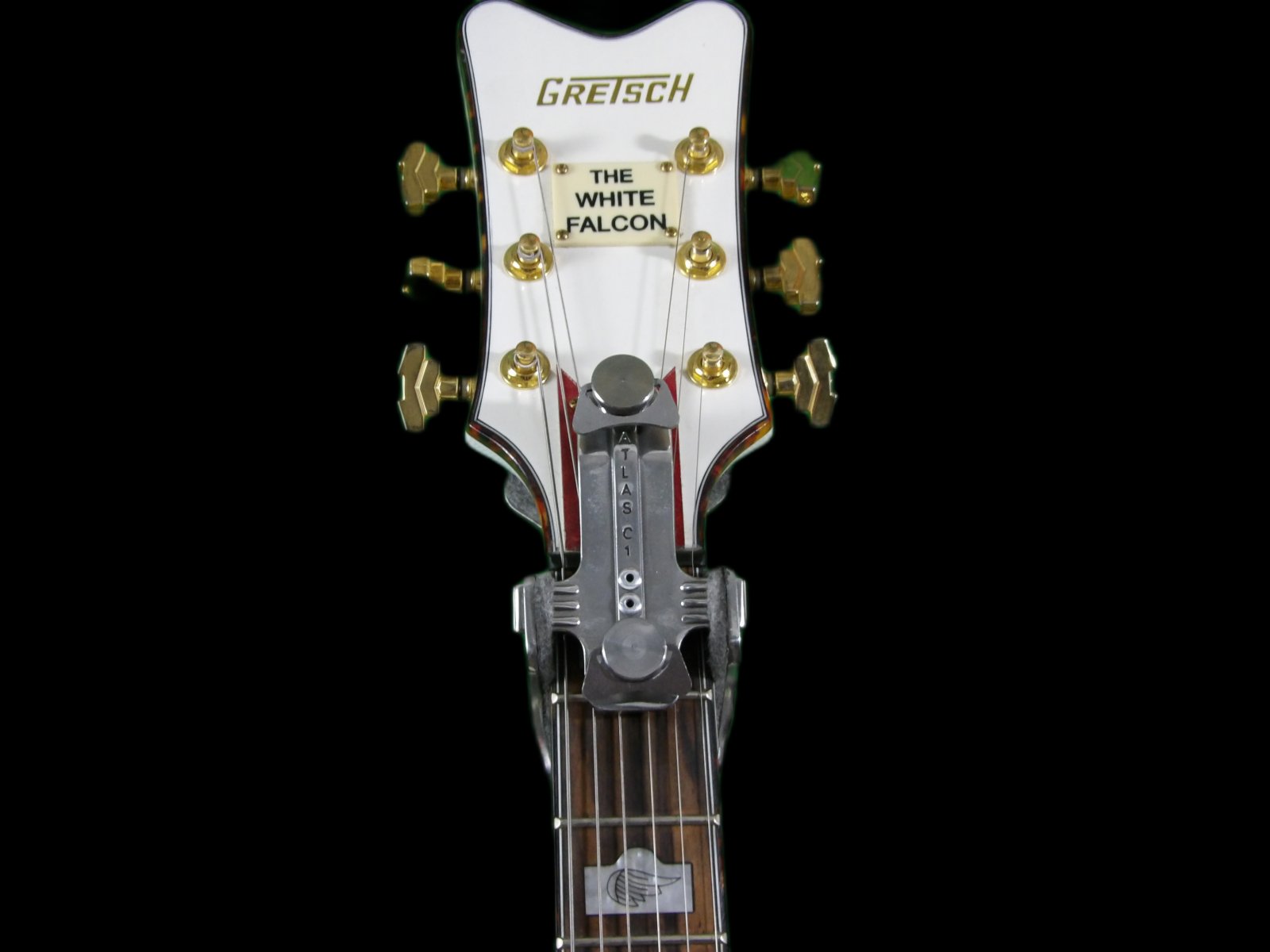
The Atlas-C1 doubles as a pre-aligned repair jig for headstock breaks.
Safety Warnings: Finish Damage, Toxic Fumes, and What to Do After a Bad Glue Job
Two real hazards come with polyurethane glue, and neither gets enough attention. Then there is the situation most articles avoid: what to do after the wrong glue is already on the instrument.
Finish damage. Squeeze-out and foam can bond to lacquer and pull finish away when removed. Mask surrounding areas and clean squeeze-out while it is still soft. Once cured, polyurethane foam is difficult to remove without lifting finish, and the repair to the finish can cost more than the original repair.
Fumes. Polyurethane adhesives give off vapors during cure and carry a strong odor. Work in a ventilated space, away from open flame, and follow the manufacturer's safety guidance on the label. PVA glues are far milder. Cyanoacrylate produces strong vapors and bonds skin instantly, so keep debonder on hand and avoid eye contact.
What to Do After an Incorrect Glue Repair
This is the part competitors leave unresolved. If you have already used the wrong glue, the goal shifts from fixing the guitar to preventing further damage. Work through this triage in order.
- Stop applying glue. More adhesive rarely fixes a bad bond and often makes removal harder.
- Do not force the joint apart while the glue is hard. Forcing a cured polyurethane or epoxy joint can tear wood fibers and turn a repairable joint into a structural failure.
- Identify exactly what you used. Note the product name, formulation, and cure state. A technician needs this to choose a removal strategy.
- Test any solvent on scrap finish first. Solvents that remove glue can also remove lacquer, and finish damage is often irreversible.
- Photograph the joint and the surrounding area. Document alignment, squeeze-out, and any finish damage before you touch it again.
- Seek a luthier early. A technician can often reverse a bad PVA job. A bad polyurethane job is harder, and the earlier it is seen, the better the outcome.
When to stop and call a professional. Stop immediately if the joint has expanded, if alignment has shifted, if finish is lifting, or if the repair involves a neck joint, bridge, or headstock. These are the repairs where a bad glue choice causes the most expensive downstream damage. A technician can assess whether the joint can be reversed with heat and moisture, cut out, or splinted, and can advise on whether the instrument should be stabilized before any further work.
Watch out: the most common mistake after a bad glue job is adding a second adhesive on top of the first. Adhesives do not reliably bond to cured polyurethane or epoxy, and the result is a weak joint with two incompatible glue lines that is harder to reverse than either one alone.
Prevention is the real safety rule. Check the label before you open the bottle, dry-fit before you glue, and choose the adhesive a professional can undo. That single habit prevents most of the situations this section describes.
Protect the Headstock Before It Breaks
The best repair is the one you never need. Headstock breaks usually happen in transit, when a case takes a knock and the angled neck junction absorbs the energy. String tension, well over a hundred pounds on a typical set, keeps that junction loaded even at rest.
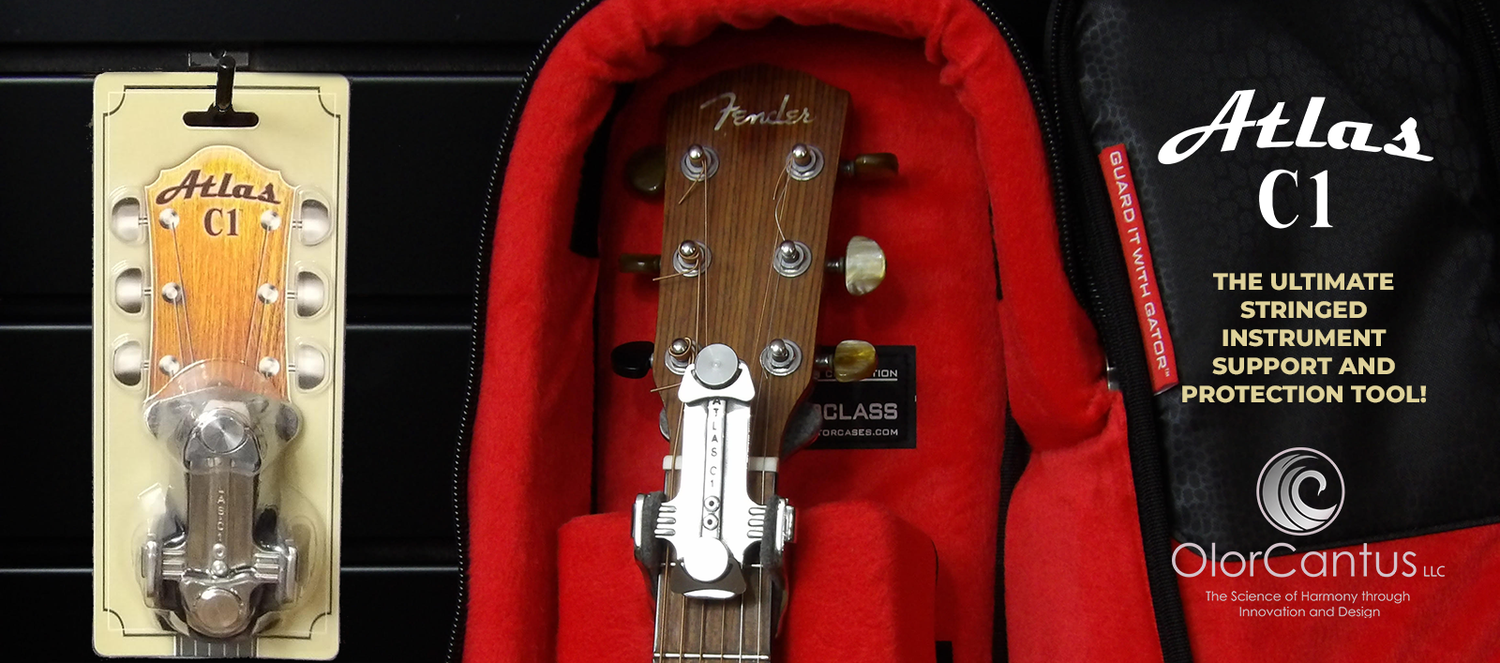
That is the problem the Atlas-C1 was designed for. It is a patent-protected headstock support, protection, and repair tool designed to protect the vulnerable neck junction during travel, shipping, and storage. It also doubles as a pre-aligned repair jig for headstocks awaiting repair. Before buying, check that your guitar has a 3-on-3 tuning machine headstock design. If you want to see how it handles angled headstocks, read how to use an Atlas C1 for angled headstock support.
At Olor Cantus LLC, we designed the Atlas-C1 to be affordable for stringed instrument owners anywhere in the world, and it comes with an unlimited transferable lifetime warranty. Before you buy, check that your guitar has a 3-on-3 tuning machine headstock design. Free shipping is available.
So here is the challenge: look at your glue shelf and your guitar case tonight. One of them probably needs a change. Get started with Atlas C1 and give your headstock the support it deserves.
The Science of Harmony through innovation and design
Long Live the Six String TM
Frequently Asked Questions
Can I use Gorilla Glue on my guitar?
For most structural guitar repairs, no. The original Gorilla Glue is a polyurethane adhesive that expands and foams as it cures, which can push apart tight-fitting joints, seep into finish and binding, and make future repairs harder. Gorilla Wood Glue is a different product and behaves more like traditional wood glue, but even then, a reversible aliphatic resin glue such as Titebond Original is the safer default for joints a luthier may need to open again.
Can Gorilla Glue repair a broken guitar headstock?
A headstock break is a structural repair where alignment matters as much as the adhesive. Polyurethane glue's expansion can shift the two halves out of line while it cures, and cleanup is difficult once foam reaches the finish. A wood glue with a controlled cure and a proper clamping setup gives a cleaner result. At Olor Cantus LLC, we designed the Atlas-C1 as a pre-aligned repair jig for headstock breaks.
Is Gorilla Wood Glue different from Gorilla Glue polyurethane adhesive?
Yes, and the distinction matters. Gorilla Wood Glue is a water-based PVA-type wood adhesive intended for wood-to-wood joints. The original Gorilla Glue is a polyurethane formula that foams and expands during cure and works on mixed materials. Reading the label before you buy is the single most useful step, because the two products behave very differently on a guitar joint.
What glue is best for repairing a guitar?
For many wood-to-wood joints, a reversible aliphatic resin glue such as Titebond Original Wood Glue is a common choice. Polyurethane adhesives have their place on mixed materials, but their expansion and removal difficulty make them a poor first choice for necks, bridges, and cracks.