
Table of Contents
- Quick Comparison: Top Guitar Travel Gear for 2026
- Best Travel Guitars for Professional Musicians
- The Best Way to Ship Guitars Safely
- Protecting Guitar Headstock During Travel
- Hard Cases vs. Gig Bags: Which Protects Your Investment?
- Essential Accessories for Touring Musicians
- Insurance and Liability for Professional Gear
- Conclusion
- Frequently Asked Questions
Last Updated: September 14, 2026
Quick Comparison: Top Guitar Travel Gear for 2026
Choosing the right guitar travel gear for professional musicians starts with one question: what actually survives a loading dock, a cargo hold, and a tour bus without a repair bill? This guide from Atlas C1 breaks down the instruments, cases, and accessories that hold up to real touring conditions, plus the logistics most gear lists ignore.
The short answer: a compact travel guitar plus a hard case plus a headstock support tool covers most touring scenarios. Everything else is refinement.
Gear Category |
Top Pick |
Best For |
Why It Wins |
|---|---|---|---|
Headstock protection |
Atlas C1 |
All traveling guitarists |
Prevents the most common touring break |
Compact acoustic |
Taylor GS Mini-e Koa |
Singer-songwriters |
Full tone in a carry-on footprint |
Folding acoustic |
Voyage-Air |
Full-scale feel |
Folds into a backpack case |
Minimalist electric |
Traveler Guitar Mark III |
Silent practice |
Headphone amp built in |
Climate-resistant |
Journey Instruments Carbon Fiber |
Extreme touring |
Resists humidity swings |
Warm-tone acoustic |
Taylor GS Mini-e Rosewood |
Performers |
Rich low end, pro electronics |
What most guides miss is that the case is only half the equation. The headstock-neck junction is where guitars break, and no amount of padding can compensate for the effects of inertia and the release of kinetic energy from an accidental drop or intentional careless mishandling .
Best Travel Guitars for Professional Musicians
The best travel guitar for a working musician balances three things: tone you can perform with, a footprint that clears airline carry-on rules, and construction that survives temperature swings. Compact doesn't have to mean compromise, but each model makes a different trade.
Taylor GS Mini-e Koa and Rosewood
Taylor's GS Mini line is the default recommendation for a reason. The Koa version delivers a bright, balanced projection from a scaled-down Grand Symphony body, while the Rosewood model trades some sparkle for a warmer, bass-rich voice. Both include the ES-B pickup system with an onboard tuner, so you can plug straight into a house PA.
The 23.5-inch scale keeps string tension comfortable for long sessions. Neither is a full-scale instrument, and players who bend heavily will notice it.
Voyage-Air and Journey Instruments
Voyage-Air solves portability differently: a patented folding neck hinge that lets a full 25.5-inch scale guitar collapse into a backpack-style case. You get full-size feel and tension, but you pay for it in setup time before every show.
Journey Instruments takes the opposite approach with carbon fiber construction that shrugs off humidity and temperature changes. The detachable neck system breaks down fast, and the included backpack is built to TSA-compliant carry-on dimensions. Traditionalists may not love the carbon aesthetic.
Traveler Guitar Mark III
For electric players, the Mark III packs a full 25.5-inch scale into a frame that fits most overhead bins. The built-in headphone amplifier makes silent practice possible in a hotel room or on a bus, and a standard 1/4-inch output means it works on stage too. The unconventional body shape takes adjustment.
The Best Way to Ship Guitars Safely
The best way to ship guitars safely is to immobilize the headstock, pad the neck junction, and use a hard shell case inside a double-walled box. Loose movement inside the case causes more breaks than impact itself.
A workable shipping sequence:
- Detune the strings roughly a half step to reduce tension on the neck
- Support the headstock so it cannot flex forward
- Fill all void space around the body with padding
- Place the hard case inside a box with 2 inches of cushioning on every side
- Mark the box clearly and use a carrier that offers declared-value coverage
The detuning step gets debated constantly. The goal isn't zero tension, it's less tension. Slack strings relieve 130 plus pounds of constant tension , reducing the effects of inertia related damage when a case is dropped.
Protecting Guitar Headstock During Travel
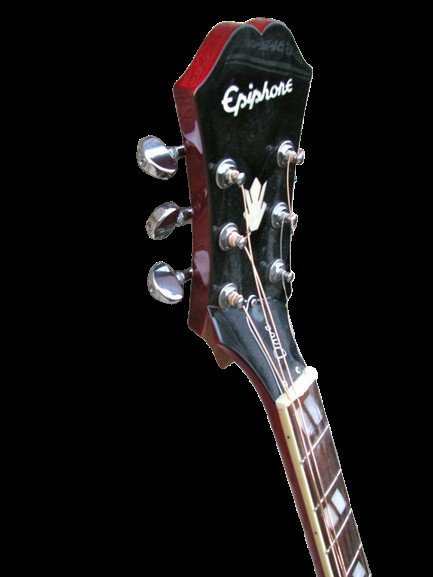
Protecting a guitar headstock during travel means addressing the single weakest point on the instrument. Angled headstocks, common on Gibson-style guitars, create a lever arm that concentrates stress right at the neck junction. A drop that would dent a straight-headstock Fender can snap an angled neck clean off.
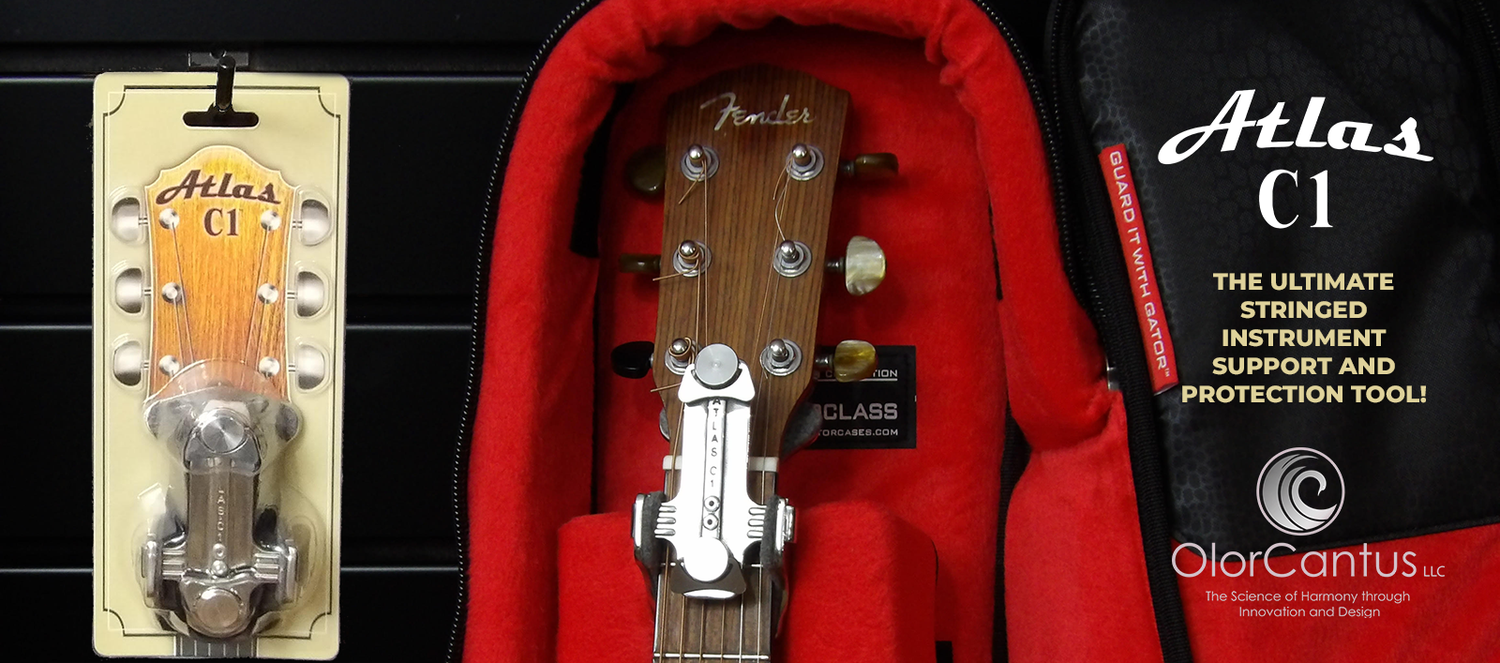
This is where Atlas C1 earns its place in a touring rig. The Atlas-C1 is a precision-engineered, universal multi-function tool that supports the headstock-neck junction and counteracts 130+ pounds of string pressure tension. It works on angled and straight headstocks alike, which matters if your collection mixes Les Pauls and Teles.
The same tool doubles as a pre-aligned repair jig, so a break that does happen becomes a fixable job instead of a repair bill or, write-off. The Atlas- C1 is a U.S. patented design, and the tool is built for a lifetime of use.

Hard Cases vs. Gig Bags: Which Protects Your Investment?
Hard cases win for air travel and shipping; padded gig bags win for local gigs and rehearsal. The choice comes down to how much abuse the guitar will absorb between venues, and whether the instrument will ever leave your hands.
Factor |
Hard Shell Case |
Padded Gig Bag |
|---|---|---|
Impact protection |
High |
Low to moderate |
Weight |
Heavy |
Light |
Carry-on friendly |
Rarely |
Often |
Backpack straps |
Sometimes |
Usually |
Best for |
Flights, shipping, bus travel |
Local gigs, rehearsals |
Cost |
Higher |
Lower |
A common mistake is treating a premium gig bag as flight protection. It isn't. Flight cases and hard shells exist because cargo handling is unpredictable, and a bag with foam padding won't stop a headstock from flexing when a suitcase lands on it. The mechanism is simple: a gig bag transfers impact directly to the neck joint, while a hard shell distributes force across the entire rim and interior padding.
What most guides skip is the airline liability layer. Under U.S. Department of Transportation rules, airlines are required to compensate for lost, damaged, or delayed baggage on domestic flights, but the liability cap is adjusted periodically and often falls far short of a professional instrument's value. For international itineraries, the Montreal Convention governs liability and sets a higher limit than most domestic caps, but you still need to document the instrument's value before check-in. A gate-checked guitar in a gig bag is treated as a checked bag, not a carry-on, and the liability rules follow the checked-bag framework.
The practical rule: if the guitar flies in the hold, it goes in a hard shell or a custom flight case. If it stays in the cabin, a high-quality gig bag with rigid foam and a reinforced headstock area is acceptable. For high-end instruments, custom flight cases built to ATA 300 Category I standards offer the highest level of protection, but they add significant weight and cost. Off-the-shelf hard shells from major manufacturers are sufficient for most touring pros, provided the headstock is immobilized.
Weight management matters here too. A hard shell can add 10 to 15 pounds to your load, which matters when you're also carrying a pedalboard and a backpack. Some touring pros use a hybrid approach: a hard shell for the primary instrument and a lightweight gig bag for a backup that stays in the bus or venue. The key is matching the case to the actual risk, not the other way around.
Essential Accessories for Touring Musicians
Touring accessories should solve problems you'll actually hit on the road: power, cables, and quick repairs. Weight matters, so every item has to justify its place in the bag. The gap most guides leave open is the power layer, especially when your pedalboard and digital gear cross regions with different voltages.
- Portable pedalboard: a compact board with a built-in power supply beats daisy-chaining at the venue. Look for a board that accepts a universal power input so you can swap cables instead of carrying a separate converter.
- Patch cables and spares: carry at least two extra instrument cables and a handful of patch cables. Coil them properly and label both ends.
- Power supply with international support: check the input voltage range on your power supply before flying. Many modern pedalboard power supplies accept 100-240V at 50/60Hz, which means you only need a plug adapter, not a voltage converter. If your supply is fixed at 120V, you'll need a step-up transformer for 230V regions, and those add weight and heat.
- Maintenance kit: truss rod wrench, string winder, spare strings, and a small multi-tool. A headstock support tool belongs here too, because it prevents the most common touring break and doubles as a repair jig.
- Pick holder and thumb drive: picks vanish, and a thumb drive with backing tracks or set files saves a rehearsal.
- Backup instrument: for long tours, a second guitar prevents a single break from ending a run.
Gear organization is its own discipline. Label cables, coil them properly, and keep the maintenance kit in one pouch so you're not digging through a case at soundcheck.
The digital-vs-analog decision affects what you pack. A modeling unit replaces a pedalboard and several cables, saving weight and setup time, but it needs reliable power and a backup if the unit fails. A traditional pedalboard is heavier and more cable-intensive, but individual pedals can be swapped or bypassed if one fails. For international dates, the modeling unit is often the lighter choice because it accepts a universal power supply and eliminates the need for multiple pedal power cables. The trade-off is that a failed modeling unit can take your entire rig down, while a failed pedal on a traditional board leaves the rest of the chain intact.
Weight management is a running calculation. A compact pedalboard, a universal power supply, and a headstock support tool add less than five pounds combined, but they prevent the two most common touring failures: a snapped headstock and a dead rig at soundcheck. That's the standard every accessory has to meet.
Insurance and Liability for Professional Gear
Instrument insurance is the gap most touring musicians leave open until something breaks. Standard homeowner or renter policies often cap coverage for musical instruments used professionally, and some exclude them outright once money changes hands.
What to check before you buy a policy:
- Whether the policy covers professional use, not just personal possession
- Whether it covers the instrument in transit, in a venue, and in a vehicle
- What the deductible looks like against the value of your most expensive guitar
- Whether depreciation applies, or if you get agreed-value coverage
- Whether a rider is needed for vintage or high-value instruments
Document everything. Photos, serial numbers, purchase receipts, and appraisal records make claims dramatically easier. For vintage owners, an appraisal from a qualified luthier is worth the cost.
Conclusion
The hard part of touring isn't the playing, it's getting the instrument to the stage in one piece, night after night. Atlas C1 exists for exactly that problem: a U.S. patent-protected, universal multi-function tool that supports the headstock-neck junction, counteracts 130+ pounds of string tension, and doubles as a pre-aligned repair jig when a break does happen. It's a lifetime-use investment that pays for itself the first time it prevents a repair bill. Ordering direct also comes with a 10% product discount and free shipping, which makes it easy to equip every guitar in the stable.
Get started with Atlas C1 and give your guitars the protection they need before the next tour leaves the driveway.
Frequently Asked Questions
How do professional musicians travel with guitars safely?
Professional musicians use a combination of strategies. They often carry instruments in TSA-compliant carry-on cases when possible, use padded gig bags with additional headstock support for checked luggage, and always loosen string tension slightly before flying. Many also use a device like the Atlas C1 to protect the vulnerable headstock-neck junction, which counteracts over 130 pounds of string pressure. Always check airline regulations before booking.
What is the best way to protect a guitar headstock during air travel?
The best protection combines a hard-shell case or a padded gig bag with a dedicated headstock support tool. The Atlas C1 is a U.S. patent-protected device that supports the headstock-neck junction, preventing the most common break. Additionally, detune strings by a half-step to reduce tension, pack the case tightly to prevent movement, and consider a backup instrument for critical gigs.
Should I use a hard case or a gig bag for touring?
Hard cases offer superior impact protection for checked luggage, while gig bags are lighter and easier to carry on. For air travel, a TSA-compliant hard case is safer if you must check your guitar. For local gigging, a well-padded gig bag with backpack straps is more convenient. Many touring pros use a hybrid approach: a hard case for flights and a gig bag for rehearsals.
What are the essential accessories for a touring guitarist?
Essential accessories include a maintenance kit (strings, winder, truss rod tool), a portable pedalboard with patch cables, a power supply with international voltage converter, spare cables, a pick holder, a thumb drive for backing tracks, and a headstock protection device like the Atlas C1. A padded gig bag or flight case and instrument insurance are also critical for professional touring.
Is a travel guitar worth it for professional musicians?
Yes, for musicians who fly frequently. Travel guitars like the Taylor GS Mini-e or Voyage-Air offer full-scale playability in a compact size that fits overhead bins, reducing the risk of damage from checked luggage. They also serve as a backup instrument. However, if you primarily play locally, a standard guitar with a quality case may suffice. The Atlas C1 can protect any guitar, travel or not.