
Table of Contents
- Why Gibson Headstocks Break: Structural Vulnerability
- How to Protect Angled Guitar Headstocks During Daily Use
- Preventing Guitar Neck Damage During Travel
- Environmental Factors: Temperature, Humidity, and Storage
- Using a Guitar Headstock Repair Jig for Structural Reinforcement
- Materials and Reinforcement: The Volute and Glue Joint
- Insurance, Valuation, and Long-Term Protection Investment
- Frequently Asked Questions
Last Updated: September 1, 2026
Why Gibson Headstocks Break: Structural Vulnerability
Gibson guitars are prized by musicians worldwide, but their iconic angled headstock design creates a structural weak point. The angle concentrates stress at the neck-headstock junction, making them vulnerable to catastrophic failure. Understanding why Gibson headstocks break is the first step toward preventing damage during travel, storage, and daily use.
The headstock-neck joint experiences enormous forces during normal playing. String tension alone exerts 130+ pounds of pressure on this junction (peer-reviewed research). When a guitar is dropped or subjected to sudden impact, the inertia and kinetic energy released create shear forces that can snap the neck cleanly away from the body.
According to Fender's guitar construction guide, angled headstock designs are inherently more fragile than straight designs because the grain orientation of the wood runs perpendicular to the stress line. The pattern is consistent: the break occurs at the narrowest point of the neck, where the headstock angle is most severe.
The anatomy of the headstock break
A Gibson headstock break typically initiates at the volute, the curved transition where the headstock meets the neck. This is the thinnest cross-section of wood in the entire instrument, where all string tension and impact forces converge. The break usually propagates upward through the truss rod cavity, which further weakens the structure.
Most breaks are clean shears that separate the headstock from the neck at a 45-degree angle, the path of least resistance through the wood grain. Micro-fractures can develop from repeated thermal stress or minor impacts, remaining invisible until one small bump causes catastrophic failure.
Headstock angle and structural integrity
Gibson's classic 17-degree angle creates a mechanical disadvantage. The wood grain meets the headstock at an oblique angle rather than straight on, reducing the effective cross-sectional strength at the joint. Straight-headstock designs have a major structural advantage: the grain runs parallel to the stress line, allowing wood fibers to resist tension and compression more effectively.
The volute, that curved reinforcement at the base of the headstock, was Gibson's attempt to address this weakness. By adding extra wood at the transition point, the volute increases the cross-sectional area and distributes stress over a larger area. Guitars with larger volutes are measurably more resistant to headstock breaks than those with minimal volutes.
How to Protect Angled Guitar Headstocks During Daily Use
Daily protection starts with how you position and support your guitar when it's not in your hands. Most headstock breaks occur at home, in studios, or during rehearsals when the guitar is set down carelessly or knocked over. Proper stand selection and neck support techniques can eliminate most of this risk.

Stand selection and neck support
A quality stand should cradle the neck at multiple points, distributing the weight of the headstock across a wide area rather than concentrating pressure at a single point. Avoid stands that grip the headstock or rest the neck on a narrow edge.
The best stands for angled headstocks use a wide, padded cradle that supports the neck from below. Look for stands with at least two contact points on the neck, ideally positioned near the headstock base and at the upper fret area. When positioning a guitar on a stand, always angle it so the headstock is supported from underneath. The headstock should rest in a gentle V-shaped cradle, not balanced on an edge.
In-case protection and support techniques
When your guitar is in a case, the headstock still needs active support. Use a headstock pillow or support block inside your case to ensure the headstock rests on a soft, padded surface rather than against the hard case shell.
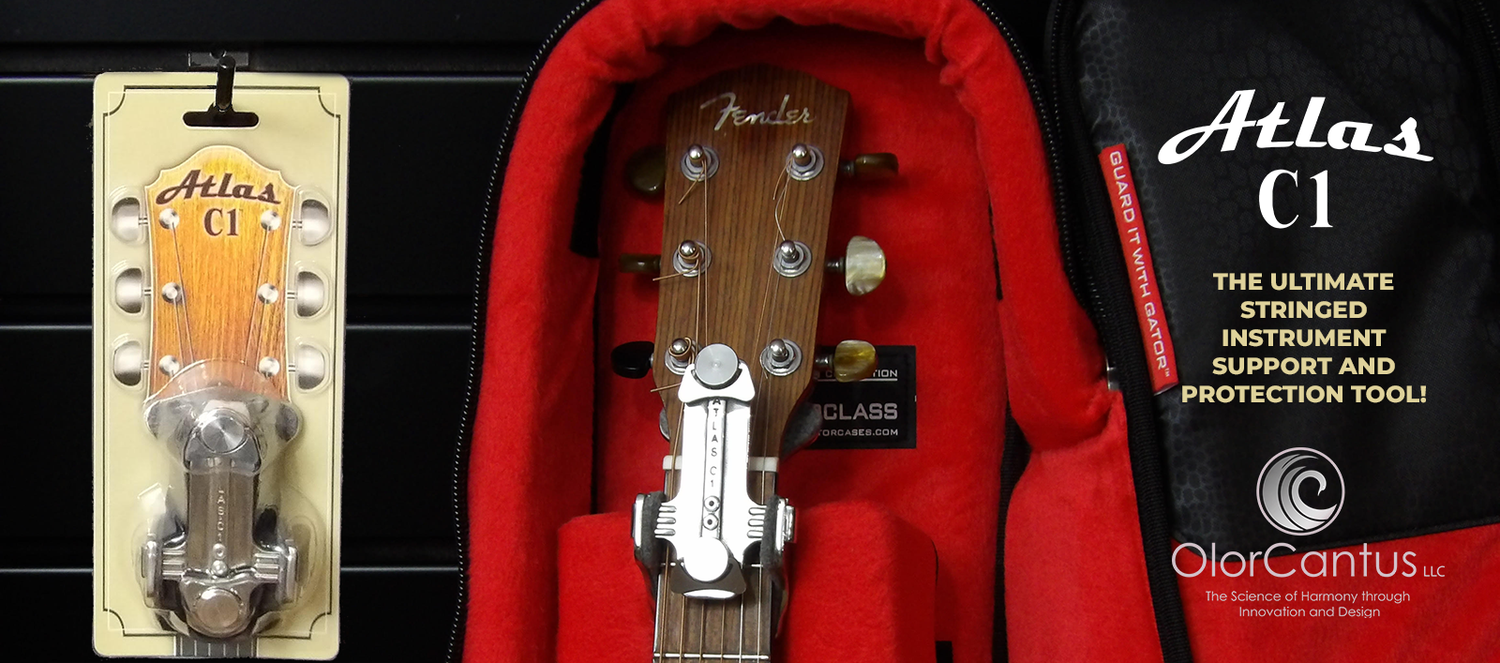
For traveling musicians, the Atlas C1 headstock support tool is engineered to protect the vulnerable headstock-neck junction by providing precise support during transport and storage. It doubles as a pre-aligned repair jig, useful for both prevention and addressing damage if it occurs. When packing your guitar in a case, ensure the headstock doesn't shift during transport. Use soft padding around the headstock area, and consider additional support blocks if you're flying or shipping.

Preventing Guitar Neck Damage During Travel
Travel is where most serious headstock breaks occur. Air travel, bus transport, and car travel expose guitars to vibration, temperature changes, and the risk of impact.
Hard-shell case requirements and padding
A hard-shell case is non-negotiable for protecting angled headstocks during travel. Soft cases provide almost no protection against impact. The interior padding should be at least 2 inches thick on all sides, with extra protection for the headstock area.
When packing a guitar in a hard case, position it so the headstock doesn't contact the case shell directly. Use soft padding to create a barrier between the headstock and the case. Inspect your case regularly for damage and replace it if necessary.
Travel-specific safety protocols for air and ground transport
Air travel is the highest-risk scenario for headstock damage. Consider purchasing an additional seat for the instrument rather than checking it as baggage. If you must check your guitar, use a flight case rather than a standard guitar case, with custom foam padding that holds your guitar securely in place.
For ground transport, keep your guitar in the passenger compartment of your vehicle rather than in the trunk. Position the case so it won't slide or shift during acceleration, braking, or turns. For bus travel, consider shipping your guitar ahead to your destination instead of traveling with it.
Environmental Factors: Temperature, Humidity, and Storage
Wood is hygroscopic, meaning it absorbs and releases moisture based on surrounding humidity. Changes in humidity cause wood to expand and contract, creating internal stress concentrated at the weakest point, the neck-headstock junction.
Acclimation and thermal shock prevention
When a guitar is moved between environments, the wood needs time to acclimate to new humidity and temperature. Sudden changes create stress as outer layers expand or contract faster than inner layers. Allow your guitar to acclimate gradually when moving between environments. Don't immediately remove it from its case; let it sit for 30-60 minutes so the wood can adjust.
Thermal shock is a specific risk when traveling. A guitar stored in a cold car or airplane cargo hold will be extremely cold. Bringing it into a warm room causes rapid expansion, creating internal stress. Use a case that provides insulation and allow your guitar to acclimate before removing it.
Long-term storage best practices
Maintain consistent humidity levels between 40-50% for long-term storage (fender.com). Fluctuating humidity is worse than consistently high or low humidity. Store your guitar in its case in a climate-controlled environment, not in attics, basements, or garages where temperature and humidity fluctuate seasonally.
If storing a guitar for more than a few months, consider loosening the strings slightly to reduce constant tension on the neck. String tension pulls the headstock downward continuously, and over time, this can contribute to headstock failure.
Using a Guitar Headstock Repair Jig for Structural Reinforcement
If your Gibson headstock does break, the repair process is critical. A poorly executed repair can result in a weak joint that fails again, while a properly executed repair can restore the guitar to its original strength.

Pre-aligned repair jig setup and alignment
A repair jig is essential for ensuring the headstock is properly aligned during glue-up. Without a jig, aligning a broken headstock by hand is nearly impossible. A quality repair jig like the Atlas C1 is pre-aligned for the specific headstock angle of your guitar model, so you don't have to calculate the correct angle.
First, clean the broken surfaces thoroughly to remove any old glue, dirt, or debris. Position the headstock in the jig so the break surfaces are properly aligned. Double-check the alignment before applying glue.
Wood glue selection and clamping pressure
Use a glue specifically designed for guitar repairs, typically an aliphatic resin like Titebond or a two-part epoxy. Apply glue evenly to both surfaces of the break, just enough to coat them completely without over-applying.
Clamping pressure is critical. Apply moderate pressure, enough to hold the joint firmly but not so much that you're crushing the wood. Allow the glue to cure fully before removing the jig. Most aliphatic resins require 24 hours of curing time.
Materials and Reinforcement: The Volute and Glue Joint
The structural materials of your guitar, the wood species, the glue joint, and reinforcement features like the volute, all affect how resistant your headstock is to breaking.
The volute as structural reinforcement
The volute is Gibson's primary defense against headstock breaks. This curved reinforcement at the base of the headstock adds material where stress is greatest, increasing the cross-sectional area and distributing stress over a larger volume of wood. Guitars with larger, more pronounced volutes are measurably more resistant to headstock breaks.
A well-designed volute extends 2-3 inches up the headstock, creating a smooth transition from the thin neck to the thicker headstock. If you're considering a Gibson guitar purchase and want to minimize headstock break risk, prioritize models with pronounced volutes. Modern Gibson models typically have larger volutes that provide better structural integrity than vintage models.
Modern material alternatives and adhesive selection
Modern adhesives have improved significantly. Older guitars were often glued with hide glue, which is brittle and can fail under thermal shock or humidity changes. Modern aliphatic resins and epoxies are more flexible and more resistant to environmental stress.
If you're repairing a headstock break, use a modern adhesive rather than traditional hide glue. Titebond III is a popular choice because it's waterproof, flexible, and creates a strong joint. Some luthiers use reinforcement materials like carbon fiber strips along with glue to strengthen a repaired headstock.
Insurance, Valuation, and Long-Term Protection Investment
A headstock break can be expensive to repair. Professional luthier repairs range from basic work to complex repairs involving reinforcement or cosmetic restoration. For valuable or vintage guitars, a headstock break can reduce the instrument's value significantly.
Insurance is worth considering if you own expensive guitars. Many homeowners' insurance policies cover musical instruments, but coverage limits are often low. If you own guitars worth more than your policy covers, consider adding a rider for musical instruments.
Beyond insurance, the best long-term protection is prevention. Investing in proper cases, stands, and support tools prevents damage before it occurs. The Atlas C1 headstock support tool is a one-time investment that provides lifetime protection. For a touring musician or collector with valuable guitars, this tool pays for itself by preventing a single headstock break. Plus, when you order the Atlas C1, you'll receive a 10% product discount and free shipping, making it an even smarter investment in your guitar's safety.
Protecting your Gibson from headstock damage requires a combination of proper handling, environmental control, and the right tools. The most vulnerable point on your guitar deserves the most attention. The Atlas C1 headstock support tool is specifically engineered to protect this critical area, whether you're traveling, storing your guitar long-term, or addressing a break that's already occurred. With its pre-aligned design and universal compatibility with angled headstocks, it's the most reliable solution for preventing Gibson guitar headstock breaks and simplifying repairs when needed. Get started with Atlas C1 and keep your guitar safe for years to come.
Frequently Asked Questions
Q: What causes Gibson guitar headstocks to break so easily?
A: Gibson's angled headstock design creates a structural weak point at the neck-headstock junction. The volute (the curved reinforcement area) provides some support, but the angle concentrates stress from string tension and impact forces at this junction. When a guitar is dropped or knocked over, the headstock experiences shear stress that can snap the wood grain. The grain orientation in the mahogany neck runs along the length of the instrument, making the joint vulnerable to breaks perpendicular to that grain direction.
Q: How do I safely store my guitar to prevent headstock damage?
A: Store your guitar in a hard-shell case with proper neck support. Position the guitar so the headstock rests on padded support, not suspended by the strings. Keep the case in a climate-controlled environment between 45-55% humidity and 65-75°F to prevent wood movement that stresses the glue joint. Avoid storing guitars upright against walls or leaning at angles. For long-term storage, use a guitar stand with a padded neck cradle that distributes support across the back of the neck rather than concentrating pressure at one point.
Q: Can a guitar headstock repair jig really help me fix a break myself?
A: A pre-aligned repair jig simplifies the repair process by holding the broken headstock in correct alignment while the wood glue cures. The jig counteracts string tension and provides consistent clamping pressure across the glue joint, which is critical for shear strength in the repair. However, success depends on using the correct wood glue (Titebond or equivalent), allowing proper cure time (24 hours minimum), and following the jig's alignment specifications. If you're uncomfortable with the process, a professional luthier can handle the repair, but a quality jig makes DIY repair accessible for musicians with basic tool experience.
Q: How much does a Gibson headstock repair typically cost if it breaks?
A: Professional headstock repairs typically range from $200-400 depending on break severity, location, and your luthier's rates. A clean break at the volute costs less than a complex multi-piece fracture. Some breaks require reinforcement with internal bracing or epoxy, which increases cost. A quality protection tool that prevents the break entirely eliminates this expense and protects your instrument's resale value and structural integrity.
This article was written using GrandRanker