
Table of Contents
- Why Safe Guitar Storage Matters for Valuable Instruments
- Ideal Temperature and Humidity for Guitar Storage
- Case Storage vs. Display Stands: Which Protects Better?
- Preventing Headstock Damage During Long-Term Storage
- The Best Way to Ship Guitars Safely
- Cleaning, Maintenance, and Pest Prevention Before Storage
- Smart Monitoring and Insurance Documentation for Collections
- Space-Saving Storage for Small Collections
- Frequently Asked Questions
Last Updated: September 16, 2026
Why Safe Guitar Storage Matters for Valuable Instruments
Safe guitar storage for collectors is the practice of controlling temperature, humidity, and physical support so that wood, glue joints, and finishes stay stable over years or decades. It matters because most catastrophic damage to valuable instruments does not happen on stage. It happens in a closet, a garage, or a case that sat unopened through a season change.

At Atlas C1, we build headstock protection hardware, so we spend a lot of time talking to touring players and collectors about what actually goes wrong. The pattern is consistent: the instrument survives the tour and then suffers at home.
Three forces do the damage. Wood absorbs and releases moisture, which makes it swell and shrink. Glue joints and the headstock-neck junction are the weakest points in that cycle. And gravity, applied through string tension, keeps pulling on an angled headstock whether the guitar is played or not.
Below, we break down the storage setup that protects a collection, from climate targets to shipping and documentation.
Ideal Temperature and Humidity for Guitar Storage
The target for most guitars is 45-55% relative humidity at 65-75°F, held steady year-round. Stability matters more than the exact number. An instrument that lives at 50% humidity consistently fares better than one that swings between 30% and 70% every month.
Relative humidity is the percentage of moisture the air currently holds versus what it could hold at that temperature. When heated air dries out in winter, indoor humidity can drop into the 20s, which pulls moisture out of a fretboard and top.
Watch for these failure modes:
- Below 40%: fret ends sprout past the binding, tops sink, and glue seams open
- Above 60%: wood swells, action rises, and mold becomes a real risk in closed cases
- Rapid swings: finish checking on nitrocellulose, the lacquer used on many vintage instruments
Keep instruments away from exterior walls, floor vents, radiators, and unfinished basements. A finished, insulated interior closet beats a garage every time.
Using a Hygrometer and Dehumidifier
A hygrometer is a device that measures relative humidity in the air around your instrument. Buy two: one for the room and one that lives inside the case. Inexpensive digital units drift, so calibrate them against each other and replace them every couple of years.
Pair the hygrometer with the right corrective tool:
- Room too dry: a room humidifier, or case humidifiers for individual instruments
- Room too wet: a dehumidifier sized to the square footage, not a desktop unit in a large room
- Case-level control: desiccant packs for short-term stabilization, refreshed on a schedule
Case Storage vs. Display Stands: Which Protects Better?
Hard-shell cases win on protection. Display stands win on access and display aesthetics. For a collection with real value, the answer is usually both: cases for storage, a rotating display for the two or three instruments you play most.
| Storage Method | Protection Level | Airflow | Best For |
|---|---|---|---|
| Hard-shell case | Highest | Sealed | Vintage and high-value instruments |
| Gig bag | Low | Open | Local transport, short trips |
| Wall mount | Moderate | Open | Daily players in a climate-controlled room |
| Display stand | Low | Open | Showpieces in a stable room |
Hard-Shell Cases, Gig Bags, and Wall Mounts Compared
Hard-shell cases provide structural integrity and a sealed environment. Fit matters: a case that lets the neck move inside it can cause as much damage as no case at all. Check that the neck cradle contacts the instrument properly and the lid closes without pressure on the bridge.
Preventing Headstock Damage During Long-Term Storage
Headstock damage during storage comes from one source: an unsupported headstock absorbing the pull of string tension while the neck is held rigid. Angled-headstock designs are most exposed because the break angle concentrates stress at the neck junction.
For long-term storage, reduce the load and support what remains:
- Detune roughly a half step to a full step. Do not remove all tension, since the truss rod needs some counter-load.
- Support the headstock so it cannot cant forward or back inside the case
- Never stack cases so weight rests on the neck area
- Check the case lid for contact with the headstock before closing it
Truss Rod Tension and String Pressure
The truss rod is a metal rod inside the neck that counteracts string pull and controls neck relief, which is the slight forward bow a neck needs to play cleanly. String tension and truss rod tension are a matched pair. Change one without the other and the neck moves.
For storage, the goal is a neutral, supported neck:
- Leave the truss rod at its current setting unless you are doing a full setup
- Detune moderately, not completely
- Check neck relief before and after any long storage period
- If the instrument will sit for a year or more, have a technician check relief when it comes out
The Best Way to Ship Guitars Safely
The best way to ship guitars safely is to detune slightly, support the headstock so it cannot move inside the case, cushion the case inside a rigid outer box, and label the box clearly. Most shipping damage traces back to the instrument shifting inside its own case, not to the outer packaging.
Work through it in order:
- Detune the strings about a half step and secure the headstock so it cannot cant in any direction.
- Pad the case interior so the body cannot slide, using non-reactive foam or clean cloth. Avoid newspaper, which can transfer ink to a nitrocellulose finish.
- Place the hard-shell case in a box with at least two inches of padding on all six sides.
- Seal the box, mark it "Fragile" and "This Side Up," and add a second address label inside the case.
- Photograph the packed instrument and the sealed box before it leaves.
Cleaning, Maintenance, and Pest Prevention Before Storage
Clean and condition before anything goes into long-term storage. Dirt and skin oils cure onto a finish over time, and a dirty instrument gives pests and mold something to work with.
The pre-storage routine:
- Wipe the body and neck with a soft microfiber cloth
- Condition the fretboard with a product made for the wood species, sparingly
- Clean and lightly lubricate the tuners and bridge
- Change strings or at least remove grime from the current set
- Let the instrument acclimate to the storage room for a day before closing the case
Smart Monitoring and Insurance Documentation for Collections
Two things separate a well-managed collection from a pile of guitars: data and paperwork. Both are cheap to set up and both matter enormously when something goes wrong.
Insurance and valuation documentation is the part collectors skip. Build a collection inventory with:
- Make, model, year, and serial number for each instrument
- Purchase date, purchase price, and current replacement value
- Dated photographs of the front, back, headstock, and any existing wear
- Receipts, appraisals, and any provenance documentation
- A note of which instruments are stored where
Space-Saving Storage for Small Collections
Not every collector has a dedicated room. If you are working with a closet, a corner, or a shared apartment, the constraint is space, and the temptation is to stack cases or lean instruments against walls. Both cause damage.
A few approaches that work in tight spaces:
- Vertical case racks hold hard-shell cases upright and keep weight off the necks
- Under-bed case storage works if the space is climate-stable and not against an exterior wall
- A single climate-controlled cabinet can hold several instruments and replaces multiple cases
- Rotate display: keep two instruments out, store the rest
Frequently Asked Questions
Should guitars be stored flat or upright?
Store guitars upright in a hard-shell case whenever possible. Upright storage keeps the neck supported and reduces the chance of the headstock bearing weight, which matters most for Gibson-style angled headstocks. If you must lay a guitar flat, place it on its back with the neck supported along its full length. Never lean an uncased guitar against a wall, because the headstock can slip and crack at the neck junction.
What are the ideal humidity levels for guitar storage?
Most builders recommend keeping relative humidity between 45% and 55% and ambient temperature near 70°F. Below 40% humidity, wood shrinks and fret ends protrude; above 60%, glue joints soften and mold can grow. Use a hygrometer to monitor the room and a dehumidifier or humidifier to correct swings. Stable conditions matter more than a perfect single number, since rapid changes cause warping.
How do I prevent headstock damage during long-term storage?
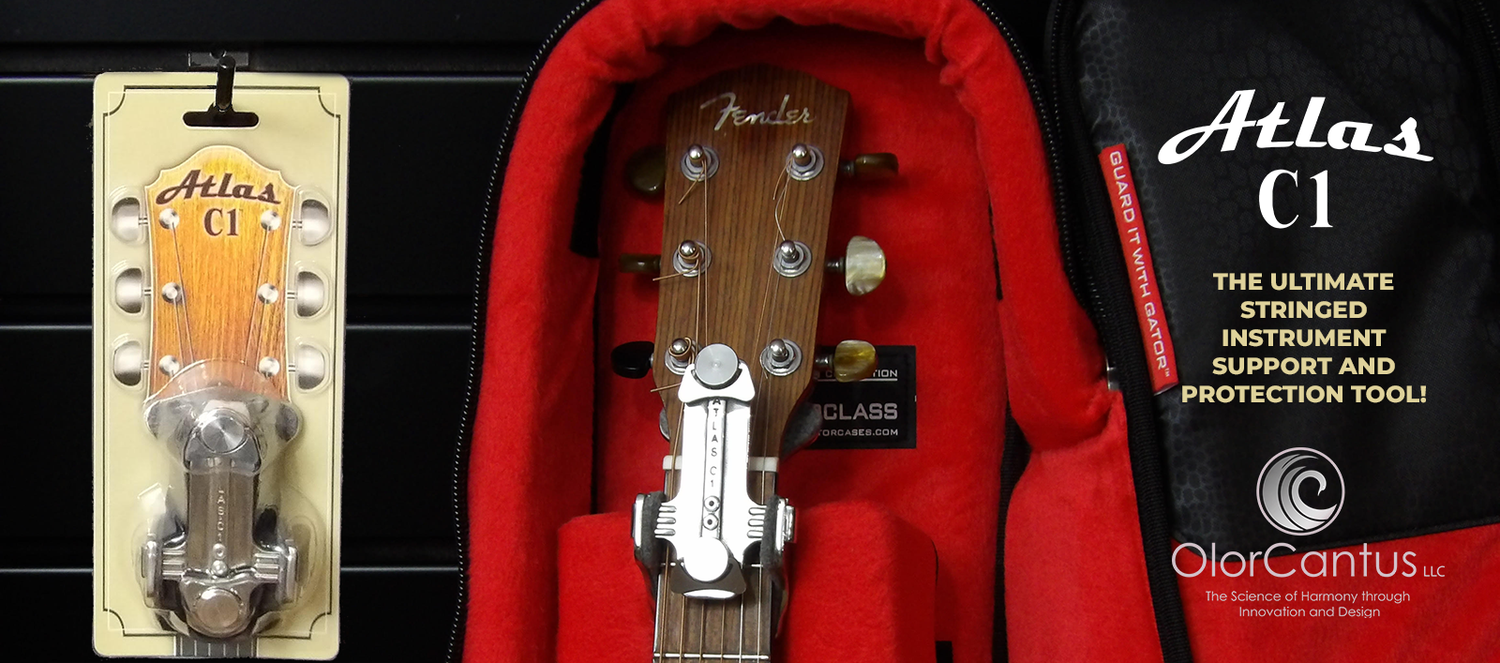
Support the headstock-neck junction so string tension does not pull the headstock forward. A tool like the Atlas C1 braces that vulnerable point and counteracts the 130+ pounds of string pressure that acts on an angled headstock. Keep the guitar in a hard-shell case, avoid stacking cases, and check tuning tension every few months. For vintage instruments, this step alone can prevent the costly repairs that plague Les Paul-style guitars.
Is it better to keep guitars in their cases or on wall hangers?
For collectors with high-value or vintage instruments, cases win. A hard-shell case buffers humidity swings, blocks dust and pests, and protects against accidental knocks. Wall hangers work for daily players in a climate-controlled room, but they expose the guitar to light, dust, and temperature shifts. If you display guitars, rotate them and keep the room between 45% and 55% relative humidity.