
Table of Contents
- Why Vintage Guitars Need Special Shipping Care
- Step 1: Prepare Your Guitar Before Packing
- Step 2: How to Secure a Guitar Headstock for Shipping
- Step 3: Choose the Right Shipping Box and Padding Materials
- Step 4: Hard Shell Case vs. Gig Bag for Shipping
- Step 5: Best Shipping Insurance for Musical Instruments
- Step 6: Is Professional Guitar Packing Service Worth the Cost
- Step 7: Choosing a Reliable Carrier and Tracking Your Shipment
- Climate Control and Humidity Considerations During Transit
- Protect Your Vintage Guitar Investment with the Right Tools
- Frequently Asked Questions
Last Updated: October 6, 2026
Why Vintage Guitars Need Special Shipping Care
Vintage guitars are investments, heirlooms, and irreplaceable pieces of musical history. Shipping one exposes it to risks standard packing methods don't address.
The headstock-neck junction is where most transit damage occurs. It bears roughly 130 pounds of combined string tension, making it the structural weak point on nearly every guitar design, and it's the first place to fail under rough handling or pressure changes. A headstock break can compromise playability, reduce resale value, and require specialized repair work.
Climate fluctuations are another serious concern. Vintage instruments were built in different humidity environments than where they'll be shipped, and rapid temperature and humidity changes cause wood to expand and contract unevenly, leading to soundboard cracks, brace separation, and neck warping. Proper shipping protection isn't optional, it's essential insurance for instruments that may never be replaceable.
Step 1: Prepare Your Guitar Before Packing
Before your vintage guitar enters a box, preparation is critical. Stabilizing the instrument reduces movement inside the case and minimizes shock transfer during transit.
Loosening Guitar Strings for Transit
Loosening your guitar strings is one of the most important steps before shipping. Full tension creates constant pulling force on the headstock and bridge, and vibrations and impacts during transit multiply that effect, increasing the risk of headstock breaks or bridge failure.
Lower all strings to approximately half tension, roughly two to three turns on each tuning machine. Leave them loose enough to press down easily on any fret, but don't fully detune them, as this makes the instrument harder to inspect before packing.
Inspecting for Existing Damage
Before packing, document the guitar's condition with clear photos from multiple angles: headstock, neck joint, body edges, and any visible wear or previous repairs. This baseline protects you if damage occurs and a carrier disputes your claim.
Inspect the headstock for hairline cracks, especially around the tuning machine holes, and sight down the fretboard for warping. Check the body for cracks, loose braces (rattling means internal braces have separated), or lifting finish. Note any existing damage clearly so carriers can't claim it as transit damage.
Step 2: How to Secure a Guitar Headstock for Shipping
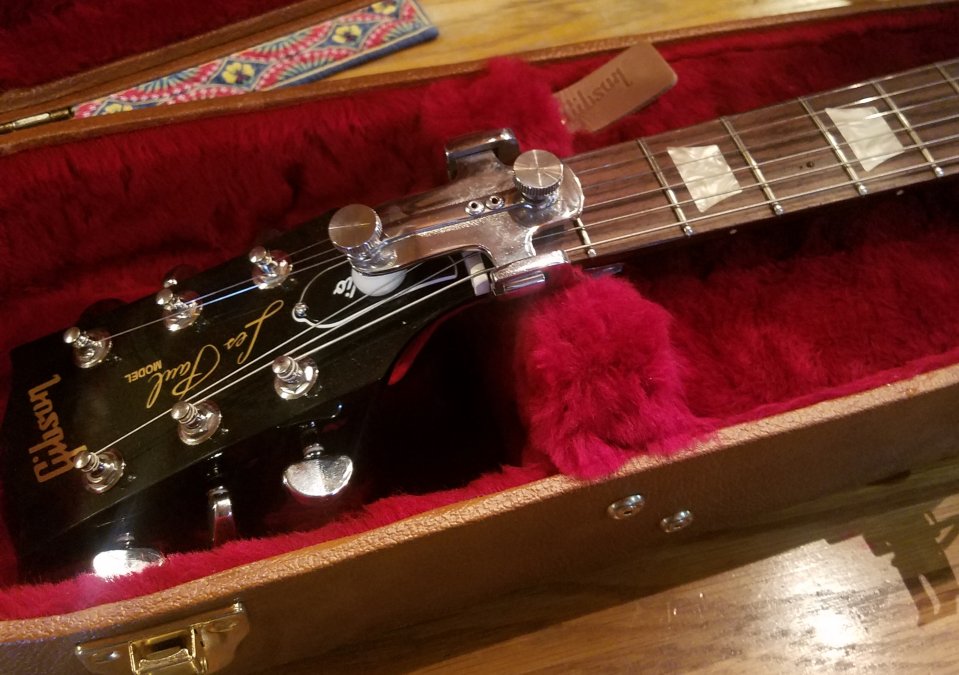
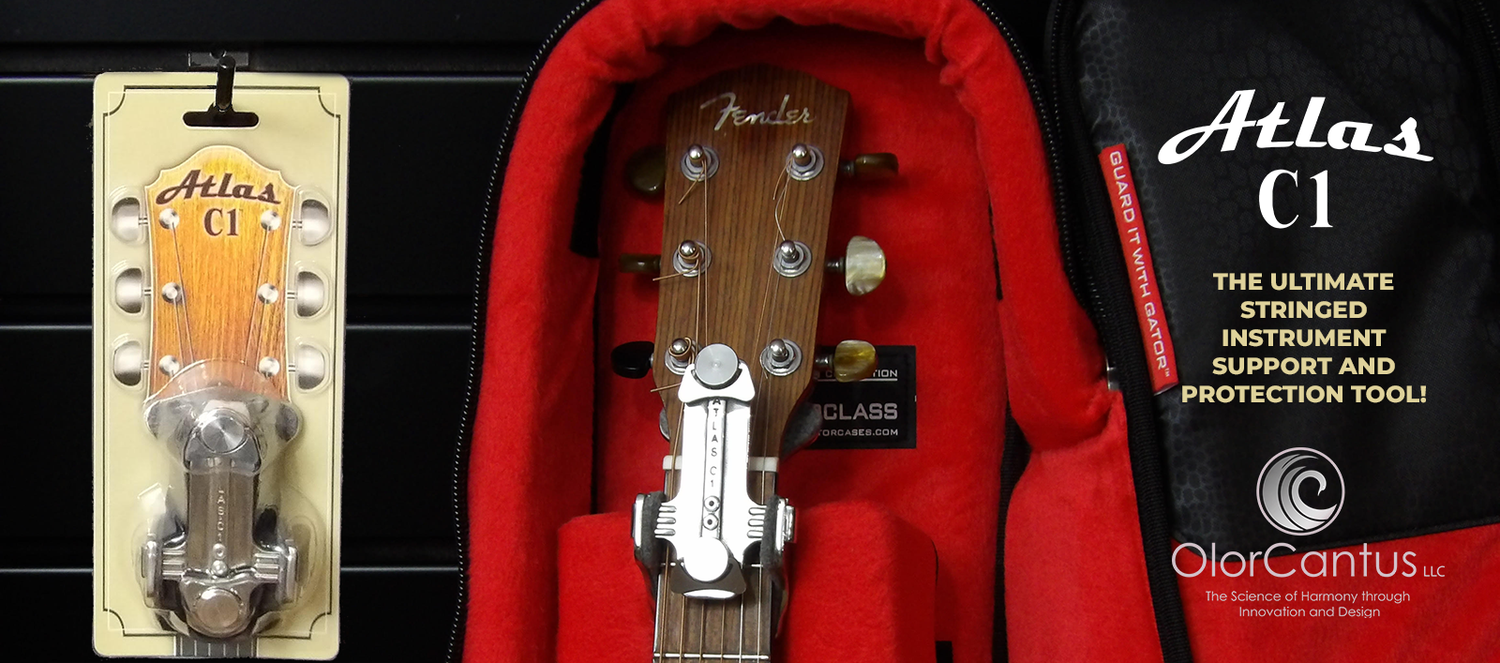
The headstock is the most vulnerable part of any guitar during shipping, and securing it properly is non-negotiable. The Atlas C1 is designed specifically to support the headstock-neck junction, counteracting string tension and providing rigid support that prevents angled or straight headstocks from flexing under impact.
Position the support tool before placing the guitar in its case. The Atlas C1 fits universally across solid body, acoustic, and semi-hollow designs, whether you're shipping a Gibson-style angled headstock or a Fender-style straight headstock. Install it per the tool's specifications, ensuring full contact with the underside of the headstock to prevent movement or flex at the weakest structural point.
After installing the support tool, wrap at least two layers of bubble wrap around the headstock, extending down the first 12 inches of the neck. Secure it with painter's tape, never duct tape, which can damage vintage finish. The goal is a protective cocoon that absorbs impact while the structural support prevents bending.
Step 3: Choose the Right Shipping Box and Padding Materials
Selecting appropriate materials makes the difference between a guitar arriving pristine and arriving damaged.
Double-Boxing Techniques for Maximum Protection
Double-boxing is the gold standard for vintage guitar shipping. Place the cased guitar in an inner box with at least 4 inches of void fill on all sides, using packing peanuts, crumpled kraft paper, or airbags. The guitar should not shift even slightly when you shake the inner box.
Seal the inner box completely with reinforced packing tape along all seams and edges, then place it inside a larger outer box with another 4-6 inches of void fill on all sides. This dual-layer system absorbs shock from multiple angles and keeps the inner package from contacting the outer box walls.
Use a double-wall corrugated outer box rated for shipping; single-wall boxes compress too easily under stacking pressure. Reinforce all seams with packing tape, including an "H" pattern on the bottom and top.
Selecting Bubble Wrap, Packing Peanuts, and Void Fill
Bubble wrap with 5/8-inch bubbles provides excellent shock absorption for the case. Wrap it in at least two full layers, overlapping each by 50%, and add a third layer around the headstock.
Packing peanuts fill the void between the case and box walls. Choose expanded polystyrene rather than biodegradable alternatives, which compress less under pressure. Fill every gap completely; empty space lets the case shift and defeats the purpose of the box.
For the void fill between inner and outer boxes, combine packing peanuts and crumpled kraft paper for shock absorption and to prevent sliding. Ensure the outer box is completely filled; a partially filled box offers almost no protection.
Step 4: Hard Shell Case vs. Gig Bag for Shipping
A hard shell case is mandatory for shipping vintage guitars. Hard cases provide rigid structure that protects against crushing, impacts, and pressure changes, keeping the guitar's shape intact and preventing the body from flexing or warping. For vintage instruments, a quality hard shell case is the minimum acceptable standard.
Gig bags are convenient between venues but offer insufficient protection for shipping. They provide minimal impact resistance and let the guitar shift inside, leaving it vulnerable to exactly the impacts that cause damage. Never ship a vintage guitar in a gig bag alone.
If you don't own a hard case, invest in one for shipping. A quality hard shell case costs considerably less than repairing a broken headstock. For vintage guitars worth more than a few thousand dollars, the case is essential equipment, not an optional expense.
Step 5: Best Shipping Insurance for Musical Instruments
Declared value and shipping insurance are separate protections, and both matter when shipping a vintage guitar.
Declared value tells the carrier what your package contains and establishes the maximum claim amount if damage occurs. Always declare the actual replacement value of your instrument; underestimating creates gaps in coverage.
Carrier insurance (UPS, FedEx, or USPS) typically covers declared value up to a limit. Review the carrier's terms before shipping, since some limit coverage for musical instruments. If coverage is insufficient, purchase additional third-party insurance.
Third-party shipping insurance fills gaps carrier coverage leaves open. Services specializing in instrument shipping often provide more comprehensive protection than standard carrier insurance, typically for 1-2% of the declared value.
Document everything before shipping: photos of the guitar's condition, the declared value amount, the insurance policy number, and the tracking number. This documentation is essential if you need to file a damage claim.
Step 6: Is Professional Guitar Packing Service Worth the Cost
Professional packing services handle the entire process, from preparation through final boxing, using techniques and materials designed specifically for guitars. They understand vintage instruments' unique vulnerabilities and apply best practices consistently.
Professional packing costs vary by provider and location, but weigh it against a single shipping incident that damages a valuable vintage guitar. Repairing headstock breaks, internal damage, or finish cracks can be costly, and professional packing reduces that risk significantly.
Professional packers use the same materials and techniques this guide covers, but with speed and consistency home packing rarely matches. They know how to work with the Atlas C1 headstock support tool, wrap and secure components properly, and build double-box systems that withstand rough handling. If you're shipping a particularly valuable instrument or lack confidence in your technique, professional services are worth the investment.
For occasional shippers with standard vintage guitars, careful home packing following this guide provides excellent protection. For frequent shippers or extremely valuable instruments, professional services offer insurance-like protection that justifies the cost.
Step 7: Choosing a Reliable Carrier and Tracking Your Shipment
Carrier choice determines whether a well-packed vintage guitar gets white-glove handling or gets treated like a box of paperback books. The three national carriers differ in service tiers, claim procedures, and oversize pricing, and those differences matter more for a $12,000 instrument than a $200 one.
Comparing Service Tiers That Matter for Instruments
Ground services. UPS Ground, FedEx Ground, and USPS Ground Advantage move packages by truck and are the default for domestic vintage guitar shipping. Ground is slower but involves fewer handoffs than air, and fewer handoffs means fewer impact events. For a double-boxed guitar in a hard case, ground is usually the right call.
Air services. UPS Next Day Air, FedEx Priority Overnight, and USPS Priority Mail Express move faster but expose the package to more automated sorting, conveyor drops, and pressure and temperature swings in the cargo hold. Faster is not automatically safer. Use air only when the recipient needs the guitar quickly or ground transit would cross extreme climate zones.
Signature and adult-signature options. UPS offers Signature Required and Adult Signature Required; FedEx offers Direct Signature and Adult Signature Required; USPS offers Signature Confirmation and, on some services, Adult Signature Required. For a vintage guitar, Adult Signature Required is standard: it prevents the package from being left on a porch and creates a named record of who accepted delivery, which is the first thing a claims adjuster asks for.
How Carriers Price Oversize Guitar Boxes
Guitar boxes almost always trigger dimensional weight pricing. Carriers bill by the greater of actual weight or dimensional weight, calculated as length times width times height in inches divided by a dim divisor (commonly 139 for daily UPS and FedEx rates, 166 for some USPS and retail rates). A double-boxed dreadnought measuring 50 x 22 x 10 inches yields a dimensional weight well above the actual 20- to 30-pound package, which is why guitar shipping quotes often surprise sellers.
A few practical levers:
- Keep the outer box as tight as the required void fill allows. Every extra inch of length or width can push the package into a higher dim-weight tier.
- Compare a single well-reinforced double-wall box against a true double-box system. Double-boxing is safer, but it costs more; for a vintage instrument, pay the difference.
- Ask about declared-value fees separately from base freight. Carriers charge for declared value above a threshold (often $100 for USPS and higher for UPS and FedEx), and that fee scales with the declared amount.
Claim Windows, Liability Limits, and Why They Matter
Each carrier publishes its own liability limits and claim filing windows, and they are not generous by default. USPS generally caps liability on many services unless extra insurance is purchased, and its claim window is measured in days from the mailing date. UPS and FedEx set default per-package limits and require additional declared value or third-party insurance to cover a vintage instrument's full replacement value. Filing deadlines are typically 60 to 180 days, so photograph and document the unopened box immediately on arrival.
Tracking, Interception, and Damage Documentation
Track the shipment actively. Watch for packages that stall in a sorting hub, get rerouted, or show repeated "in transit" scans without movement. A stalled package is a chance to call the carrier for a trace before the box spends another night on a conveyor.
If the outer box arrives crushed, punctured, or wet, don't open it in a way that destroys the evidence. Photograph all six sides, the label, and any carrier damage stickers before opening, then open slowly and photograph the packing materials layer by layer. This sequence supports a claim; a box that's been fully unpacked and discarded weakens the file.
UPS tariff and declared value terms FedEx service guide and liability limits USPS domestic mail manual and insurance
Climate Control and Humidity Considerations During Transit
Most shipping guides ignore climate entirely, which is a mistake for vintage instruments. Wood is hygroscopic: it absorbs and releases moisture unevenly across end grain, flat-sawn surfaces, and glue joints. A vintage guitar that has spent decades stabilizing at one humidity level can crack, buzz, or develop a twisted neck after a few days in a dry cargo hold or humid warehouse.
What Actually Happens to Wood in Transit
Relative humidity (RH) is the percentage of moisture the air can hold at a given temperature. When temperature drops, the same air holds less moisture, so RH rises; when temperature rises, RH falls. A guitar case that sits on a cold loading dock then moves into a heated truck can swing through a wide RH range in hours, and the wood, finish, braces, and glue joints respond at different rates.
For most vintage guitars, the safe range is roughly 45 to 55 percent RH at 65 to 75 degrees Fahrenheit. Acoustics are more sensitive than solid-body electrics because their thin soundboards and bracing move more. A dried-out vintage acoustic can develop a center-seam top crack or lifting bridge; too much moisture causes swelling and rising action.
Practical Mitigation Before and During Transit
- Acclimate before packing. If the guitar has been stored in a very dry or very humid room, give it a day or two in a moderate environment before sealing it in a case. Packing a guitar that is already at an extreme is asking for trouble.
- Use a calibrated hygrometer. A small digital hygrometer placed in the case for an hour before packing tells you the actual starting RH. Without a reading, you are guessing.
- Desiccant packs for humid routes. Silica gel packs absorb excess moisture and are most useful when the guitar is traveling through humid climates or sitting in a warehouse. Rechargeable packs can be dried out and reused.
- Humidification for dry routes. In winter or in arid regions, a case humidifier or a lightly dampened sponge in a perforated bag can keep RH from dropping too far. Do not overdo it; a soaked sponge can cause finish damage.
- Buffer with the case itself. A hard case with a plush interior slows the rate of humidity change, which is often more important than holding an exact RH. Rapid swings cause more damage than a steady but slightly off reading.
Seasonal and Route Planning
Shipping during moderate seasons reduces climate risk, but route matters as much as season. A guitar moving from a humid coastal area to a dry high-desert destination crosses a large RH gradient. If you know the destination climate, bias your packing: extra desiccant for humid destinations, a humidifier for dry ones.
For international shipments, customs delays are the wild card: a guitar can sit in a non-climate-controlled warehouse for days. Build in extra desiccant, use a hard case with a tight seal, and consider a case cover or outer plastic wrap to slow moisture exchange. If the destination is in a very different climate zone, tell the recipient to let the guitar acclimate in its case for several hours before opening it fully.
Monitoring and Post-Arrival Care
Ask the recipient to note the case temperature and RH on arrival, before opening. If the guitar traveled through extreme conditions, it should sit in its case in the destination room for several hours to a day before being played or tuned to pitch. Opening a cold case in a warm room can cause condensation on the finish and hardware.
After arrival, check the action, look for new cracks along the top and back seams, and sight down the neck. Most climate-related damage shows up within the first few days. Catching it early makes repair cheaper and preserves the instrument's value.
Protect Your Vintage Guitar Investment with the Right Tools
Shipping a vintage guitar safely requires proper preparation, appropriate materials, correct packing technique, and reliable carriers. Each step protects your instrument from different types of damage.
The most effective approach combines professional-grade materials with specialized protection tools. The Atlas C1 headstock support system addresses the single greatest vulnerability in guitar shipping, the headstock-neck junction. By providing rigid support that counteracts string tension and prevents flexing during impact, the Atlas C1 eliminates the most common failure point when you ship vintage guitars.
When you're ready to ship, consider taking advantage of free shipping on orders that include the Atlas C1 and other protective gear, which can help offset the cost of proper packing materials. Additionally, a 10% product discount is available, making it more affordable to assemble a complete, professional-grade shipping kit.
Protecting a valuable vintage guitar during shipping isn't optional, it's essential insurance for instruments that may be irreplaceable. By following these steps, using double-boxing techniques, selecting quality materials, and securing proper insurance, you ensure your vintage guitar arrives in the same condition it left when you ship vintage guitars. The Atlas C1 provides the specialized headstock protection professional shippers rely on, preventing costly damage before it happens. Invest in proper shipping protection today and preserve your guitar investment for years to come.
Frequently Asked Questions
Should I loosen the strings before shipping a vintage guitar?
Yes, loosening strings reduces tension on the neck and headstock during transit. Lower the tension gradually over several days before shipping, but don't remove strings entirely. This step significantly reduces the risk of headstock cracks and neck warping during shipping, especially for valuable vintage instruments with angled headstocks.
What is the best way to ship vintage guitars to prevent transit damage?
Use a hard-shell case inside a double-wall corrugated box with generous padding. Secure the headstock with additional support to counteract string pressure. Include desiccant packs to control humidity, use shock-absorbing materials like bubble wrap and packing peanuts, and declare full value with your carrier. This multi-layer approach addresses the primary risk points for vintage guitars.
How much shipping insurance should I declare for a vintage guitar?
Declare the full replacement value of your instrument. For vintage guitars, this may be significantly higher than the original purchase price. Review your carrier's declared-value limits and signature confirmation requirements. Some carriers cap coverage at standard rates unless you pay extra for declared-value insurance, so verify terms before shipping.
Is professional guitar packing service worth the cost?
Professional packing services can be worthwhile for high-value vintage instruments, especially for frequent shippers or international shipments. They handle customs documentation, use specialized materials, and provide expertise in headstock protection. For occasional domestic shipments of moderately valued guitars, careful DIY packing following this guide can provide adequate protection at lower cost.