
Last Updated: November 9, 2026
Quick Summary
To learn how to measure a guitar for a case, lay the guitar flat and record seven reference points in inches: overall length, body length, upper bout, lower bout, waist, body depth, and headstock width. Compare those readings to the case's interior dimensions, not its exterior shell, and leave a small even gap around the body.
- Measure in inches and record fractions down to 1/16 inch, since case interiors are listed in inches.
- Skipping the waist measurement is the most common reason a case that should fit doesn't.
- Case dimensions describe the inside cavity, so a 42-inch case has a 42-inch interior length.
- Aim for 1/8 to 1/4 inch total side-to-side gap at the lower bout in a hard case.
- Remove the strap, capo, and clip-on tuner before measuring the guitar.
Table of Contents
- What You'll Need Before You Measure
- How to Measure a Guitar for a Case: The Seven Reference Points
- How to Measure an Acoustic Guitar Without Guessing
- Guitar Case Dimensions: What the Interior Numbers Actually Tell You
- How to Measure a Guitar Case You Already Own
- How Much Clearance a Case Should Have
- Measuring Unusual Shapes, Protruding Hardware, and Accessories
- Guitar Size Chart: Matching Your Numbers to Case Categories
- Common Measuring Mistakes That Lead to a Bad Fit
- Ordering Your Atlas C1 and Locking In the Right Case Fit
- Frequently Asked Questions
What You'll Need Before You Measure
A guitar case only protects an instrument when the interior dimensions match the guitar's real shape. Learning how to measure a guitar for a case starts with four tools and one clean surface. Many players buy a case by body style alone, then discover the lid won't close over an angled headstock.
Gather these first:
- A soft measuring tape, 60 inches or longer
- A rigid ruler or straightedge for depth readings
- A framing square or two books with straight spines
- A pencil and a printed worksheet
- A flat, padded surface such as a table or workbench
Lay the guitar on its back. Remove the strap, capo, and any clip-on tuner. A padded surface protects the finish and keeps the instrument from rocking while you read the tape. The National Institute of Standards and Technology guidance on measuring devices explains why a soft tape plus a rigid straightedge gives more reliable readings than eyeballing.
One more thing: measure in inches and record fractions down to 1/16 inch. Case interiors are listed in inches, and a 1/8-inch error at the waist can mean a snug fit turns into a forced fit.
How to Measure a Guitar for a Case: The Seven Reference Points
Seven numbers decide whether a case fits: overall length, body length, upper bout, lower bout, waist, body depth, and headstock width. Record each one in the same order every time. Consistency matters more than speed.
Here is the sequence we recommend:
- Overall length - bottom of the body to the very top of the headstock
- Body length - bottom of the body to where the neck meets the body
- Upper bout - widest point of the body's upper half
- Lower bout - widest point of the body's lower half
- Waist - narrowest point between the bouts
- Body depth - top to back at the lower bout
- Headstock width - widest point across the headstock
Treat each number as a separate measurement. Skipping the waist is the most common reason a case that "should fit" doesn't.
Overall Length and Body Length
Overall length is the single most important number, because it tells you whether the case's interior cavity is long enough end to end. Run the tape from the bottom edge of the body to the tip of the headstock. Keep the tape parallel to the centerline of the neck.
Body length starts at the same bottom edge but stops where the neck heel meets the body. On acoustic guitars, that joint sits around the 14th fret on most models. On a Les Paul-style electric, the neck joins the body much earlier.
Write both numbers down. A case can be long enough overall yet too short in the body cavity, which pushes the neck toward the lid.
Upper Bout, Lower Bout, and Waist Width
These three widths describe the body's silhouette. The upper bout is the widest span of the body's upper half, near the shoulders. The lower bout is the widest span of the lower half, near the bridge. The waist is the narrowest point between them.
Measure each width at its widest or narrowest point, straight across the body, perpendicular to the centerline. Use a framing square or two books to project the edges onto the tape if you're working alone.
For a dreadnought, the lower bout is usually the widest reading. For a jumbo or a 12-string, expect a wider lower bout and a fuller waist. Record all three, because case interiors are shaped to cradle the waist, and a mismatch there shows up as pressure on the sides.
Body Depth, Neck, and Headstock
Body depth is where most players guess, and where most fit problems start. Stand the ruler vertically against the body at the lower bout and read from the top to the back. Do the same at the upper bout if the body tapers.
The neck and headstock need two more readings:
- Neck width at the nut, for cases with a fitted neck cradle
- Headstock width across its widest point, including any tuning pegs that stick out
- Headstock thickness, front to back, if the case has a shallow lid
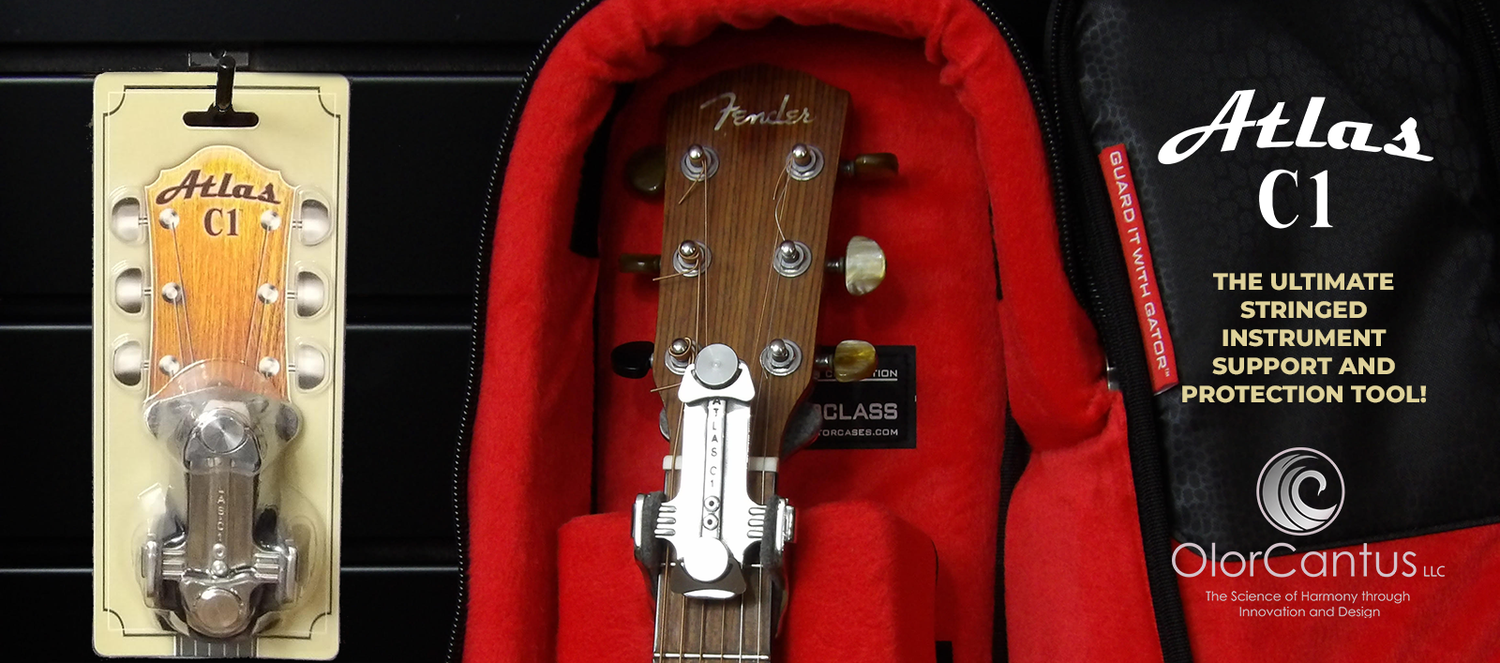
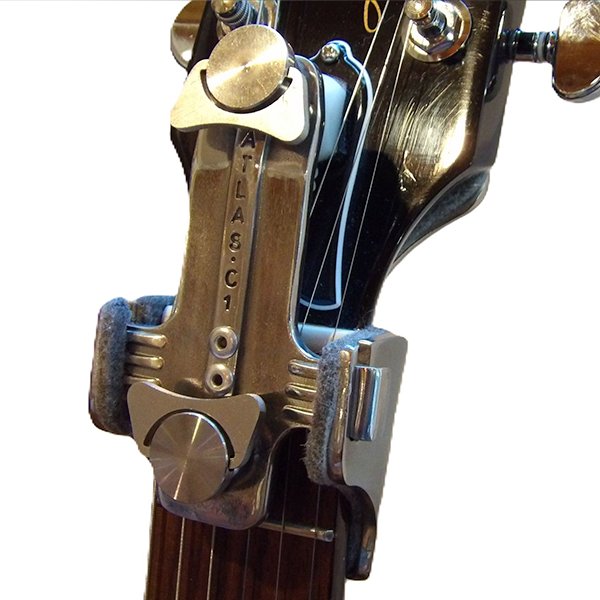
Angled headstocks, common on Gibson-style guitars, need extra room at the top of the case. That angle is exactly where headstock breaks happen, which is why the Atlas C1 headstock support tool exists: it cradles the headstock-neck junction so the vulnerable spot isn't taking the load.
How to Measure an Acoustic Guitar Without Guessing
Acoustic guitars are the hardest to measure because their bodies are curved in every direction. The trick is to measure at fixed reference points, not wherever the tape happens to land.
Follow this order:
- Place the guitar on its back on a flat surface
- Find the centerline by running a straightedge from the neck to the tail
- Measure widths perpendicular to that centerline
- Take each width reading twice and use the larger number
- Note the body shape: dreadnought, orchestra, jumbo, or parlor
Body shape matters because two guitars with the same lower bout can have very different waist curves. A case built for a dreadnought may not cradle an orchestra model's tighter waist.
If you're measuring a guitar with a pickup system, add the preamp or battery box to your depth reading. Those small protrusions count.
Guitar Case Dimensions: What the Interior Numbers Actually Tell You
Case dimensions describe the inside cavity, not the outside shell. A hard case listed as 42 inches long has a 42-inch interior, and that number must exceed your overall length reading.
Here's how to read a typical spec sheet:
| Spec Listed | What It Means | Compare To |
|---|---|---|
| Interior length | Cavity from end to end | Overall length |
| Upper bout | Widest upper cavity span | Upper bout width |
| Lower bout | Widest lower cavity span | Lower bout width |
| Waist | Narrowest cavity span | Waist width |
| Body depth | Cavity depth at the lower bout | Body depth |
| Headstock clearance | Space above the neck cradle | Headstock thickness plus angle |
If you're weighing case types, our breakdown of flight case vs gig bag protection differences explains how much structure each one actually adds.
A gig bag's listed dimensions are often generous, because soft sides flex. A hard case's numbers are firm, so they need to be closer to your readings.
How to Measure a Guitar Case You Already Own
Measuring a case you already have is the fastest way to know whether a new guitar will fit. Open the lid, remove any padding you can detach, and measure the bare interior.
Work through these steps:
- Run the tape along the interior from the bottom curve to the top of the headstock cavity
- Measure the interior width at the upper bout, lower bout, and waist
- Measure interior depth at the deepest point
- Measure the neck cradle width and the headstock cavity width
- Note any fixed blocks or supports inside
Write the numbers on masking tape and stick it inside the case lid. Next time you're guitar shopping, you'll have the answer in seconds.
How Much Clearance a Case Should Have
A good fit leaves a small, even gap around the body, not a tight squeeze and not a loose rattle. The problem is that most case spec sheets list interior dimensions but never tell you how much margin is acceptable. Here is a practical clearance guide you can apply to the numbers you just recorded.
Work in fractions of an inch, because that is the scale at which fit problems appear:
- Side-to-side at the lower bout: 1/8 to 1/4 inch total gap (roughly 1/16 to 1/8 inch per side) is the working target for a hard case with firm padding. Less than 1/16 inch total means you will be pressing the guitar into place.
- Side-to-side at the waist: the waist is where a case cradles the body, so light contact is normal. A gap wider than 1/4 inch at the waist lets the body rock.
- End-to-end at the headstock: 1/4 to 1/2 inch of space above the headstock is typical for a hard case, provided the headstock is supported from below. More than 1/2 inch of unsupported space is where an angled headstock can rock forward under impact.
- Depth at the lower bout: 1/8 to 1/4 inch of lid clearance over the deepest point of the body. Add the height of any pickup preamp, battery box, or tailpiece before you compare.
A hard case's numbers are firm, so your readings need to sit inside them with margin to spare.
Watch out: padding compresses over time, so a case that feels snug on day one can loosen after a season of travel. Structural support holds its shape where foam does not. Our article on guitar case padding versus structural support explains how each affects the clearance you just measured.
For the headstock, clearance matters most. An angled headstock that can rock forward under impact is the classic break scenario, and no amount of side padding fixes it. That is the gap the Atlas C1 is built to fill: it cradles the headstock-neck junction so the vulnerable spot is supported rather than left floating in the lid cavity.
Measuring Unusual Shapes, Protruding Hardware, and Accessories
Standard guitars follow the seven-point method. Odd shapes need extra readings, and the reference points shift. Use the procedure below for each family of nonstandard instrument.
Offset bodies (Jazzmaster, Jaguar, Mustang styles). The waist is not symmetric, so a single waist reading is misleading. Measure the treble-side waist and the bass-side waist separately, then record the longer of the two. Also measure the widest span across the offset horns, because some cases are cut for a symmetric body and will pinch one horn.
Flying V and Explorer styles. These bodies are widest at the tips, not at a bout. Measure the tip-to-tip span across the widest point, then measure from each tip to the neck joint. A case built for a V needs both numbers, because the tips sit at different distances from the neck on many models.
Archtops and carved-top acoustics. The top is domed, so a flat depth reading at the lower bout understates the true height. Stand the ruler at the highest point of the arch and read to the back, then add the height of the bridge and tailpiece if they protrude. Note whether the body has a floating pickup or pickguard that sits proud of the top.
Headless and extended-range instruments. Headless guitars have no headstock to measure, so overall length runs from the bottom of the body to the tip of the tuner hardware at the bridge end. For 7- and 8-string guitars, measure the full nut width and the full bridge width, and check the case's neck cradle width against the wider neck. A case sized for a 6-string will often close but press on the outer strings.
Semi-hollow and hollow-body electrics. Measure body depth at the lower bout and again at the upper bout, because the body often tapers. Note the height of any f-hole binding or raised center block.
Protruding hardware needs its own pass. Add these readings when they apply:
- Bigsby or tremolo units: add the tailpiece depth to your body depth, and measure how far the arm extends past the body edge when at rest.
- Strap buttons and output jacks: note anything that sticks out past the body outline, especially on the bottom edge where the case end-pad sits.
- 12-string headstocks: measure the full headstock width with all tuners in place, not the bare wood.
- Removable accessories: remove the strap, capo, and clip-on tuner before measuring, and measure only the accessories you will actually travel with.
Watch out: a clip-on tuner left on the headstock can add enough width to matter, and a tremolo arm left installed can press against the lid. Remove what comes off, and measure what stays on.
If you are shipping rather than carrying, our guide to protecting a guitar headstock during shipping covers the extra steps for angled and protruding headstocks.
Guitar Size Chart: Matching Your Numbers to Case Categories
Use your readings to sort guitars into broad case categories. The chart below is a starting point, not a substitute for the case maker's own interior specs.
| Category | Typical Overall Length | Typical Lower Bout | Common Models |
|---|---|---|---|
| Parlor | 36-38 in | 12-13 in | Small-body acoustics |
| Orchestra | 39-40 in | 14-15 in | OM and 000 styles |
| Dreadnought | 40-41 in | 15-16 in | Standard acoustics |
| Jumbo | 41-43 in | 16-17 in | Large acoustics, 12-strings |
| Solid-body electric | 38-39 in | 12-13 in | Strat and Tele styles |
| Single-cut electric | 39-40 in | 12-13 in | Les Paul styles |
Typical Lower Bout
Match on the tightest dimension first. If your lower bout sits at the top of a category, size up.
Common Measuring Mistakes That Lead to a Bad Fit
Most bad fits trace back to five repeatable errors. Watch for these before you order.
- Measuring the case exterior instead of the interior. The shell adds inches that tell you nothing about fit.
- Skipping the waist. A case can match on length and bouts yet pinch at the waist.
- Ignoring headstock angle. Flat measurements miss the forward lean of an angled headstock.
- Rounding fractions. A 1/16-inch difference at the neck cradle changes the fit.
- Measuring with accessories attached. Straps, tuners, and capos inflate readings.
A common mistake is trusting the body style name alone. Measure the individual guitar, every time.
Ordering Your Atlas C1 and Locking In the Right Case Fit
Once your seven numbers are on paper, the last step is protecting the spot those numbers can't fully describe: the headstock-neck junction. Even a perfectly sized case leaves an angled headstock unsupported at the top, and that's where breaks happen.
The Atlas C1 is a U.S. patent-protected, universal multi-function tool built for exactly this gap. It cradles the headstock-neck junction during travel, shipping, and storage, and it counteracts 130+ pounds of string tension on that joint. It doubles as a pre-aligned repair jig. Professional players including Pete Townshend and Greg Martin have given testimonials.
Ready to order? Visit the Atlas C1 product page to get yours, and check the Atlas C1 FAQs if you have questions about fit or setup before you buy.
The Science of Harmony through innovation and design
Long Live the Six String ™
Your measurements get the case right. The Atlas C1 keeps the most fragile part of the guitar safe inside it, whether you're flying to a gig or storing a vintage instrument at home. With its universal fit, patent-protected design, and dual role as a repair jig, it's a one-time investment that protects every guitar you own. Get started with Atlas C1 and give your headstock the support it was missing.
The Science of Harmony through innovation and design
Long Live the Six String ™
Frequently Asked Questions
How do I know what size guitar case to get?
Measure seven points on your guitar: overall length, body length, upper bout, lower bout, waist, body depth, and headstock width. Write each number down in inches to the nearest 1/16 inch, then compare them against the interior dimensions printed on the guitar case listing. The case should be equal to or slightly larger than every measurement, never smaller on any single one. If one number exceeds the case spec, that case will not fit, no matter how close the other six are.
Should a guitar fit tightly or have space inside its case?
It should sit snugly at the body without being forced. A small amount of clearance around the body, roughly 1/4 to 1/2 inch on each side, lets you lift the guitar in and out without scraping the finish, while foam or padding holds it in place. What you do not want is empty space at the headstock end. A guitar that can slide lengthwise inside its case will take impact on the neck junction during transit, which is exactly where angled headstocks tend to crack.
Can I use a tape measure to check whether a guitar fits a case?
Yes, a cloth or retractable tape measure works for every dimension except body depth, where a straightedge and ruler give a cleaner reading. Lay the guitar flat on a table, keep the tape parallel to the instrument, and record fractions rather than rounding down. Rounding a 15 3/4 inch lower bout to 15 inches can push you into a case that is too small. For depth, bridge a straightedge across the top and measure down to the back at the widest point.
How do I measure an acoustic guitar for a case if it has a pickup or a strap button?
Measure the guitar as it sits, with the hardware installed. An endpin jack or strap button adds length at the bottom of the body, and an onboard preamp can add a few sixteenths of an inch to the depth at the upper bout. Include those protrusions in your numbers, then check that the case has a cutout or enough padding relief at those points. A case that fits the wood but pinches the jack will stress the end block every time you close the lid.