
Last Updated: November 3, 2026
Quick Summary
Look for a guitar shipping box made of at least double-wall corrugated board with an ECT rating around 32-48, then size it so the cased instrument has about 2 inches of cushioning on every side. Check corners, seams, creases, and moisture damage before trusting any box, and always support the headstock inside.
- Double-wall corrugated board is the minimum for shipping anything valuable.
- BC double-wall combines B-flute and C-flute for strength plus cushioning.
- Add roughly 2 inches of cushioning per side, or 3 for heavy instruments.
- Reject any box with soft corners, split creases, moisture, or a loose seam.
- Double-boxing uses an inner box for fit and an outer box for handling damage.
Table of Contents
- Why the Wrong Guitar Shipping Box Costs More Than the Right One
- How to Assess Box Quality Before Buying or Reusing One
- Getting the Guitar Shipping Box Size Right
- Hard Case, Gig Bag, or Case-Free: Matching the Box to the Guitar
- How to Pack a Guitar for Shipping, Step by Step
- How to Protect a Guitar Headstock During Shipping
- Guitar Shipping Box DIY: Building a Box-Within-a-Box
- Acoustic, Electric, and Odd Shapes: Packaging Variances That Matter
- Carrier Handling, Dimensional Weight, and Insurance Coverage
- Packing Your Guitar for Its Next Trip
- Frequently Asked Questions
Why the Wrong Guitar Shipping Box Costs More Than the Right One
A guitar shipping box is a protective container built to carry a stringed instrument through a carrier network without damage to the neck, headstock, or body. The wrong box turns a routine shipment into a repair bill. The right one costs far less than the damage it prevents.
At Atlas C1, we build our whole business around the weakest point on a guitar: the headstock-neck junction. That focus shapes how we think about boxes. A box is not a container. It is the first layer of a protection system.
Here is the hard truth most guides skip. The box itself rarely fails. What fails is the fit, the cushioning, and the way the instrument sits inside. A flimsy box with perfect internal support usually beats a heavy box with a guitar rattling around inside it.
Below, we break down exactly what to look for in a guitar shipping box, from corrugated strength to internal clearance. We also cover how to pack a guitar for shipping so the box does its job.
How to Assess Box Quality Before Buying or Reusing One
Most guides tell you where to find a box. Fewer tell you how to judge one. That is the gap this section fills. Before you buy, salvage, or reuse a guitar shipping box, run it through an objective inspection so you are comparing board against board, not guessing from appearance.
Start with the corrugated board itself. A guitar shipping box should use at least double-wall corrugated construction for anything valuable. Single-wall board dents under stacking weight and punctures at corners. But "double-wall" on a label is not enough, you need to read the board.
Reading Corrugated Construction and Strength Ratings
Corrugated board is described by flute type and by strength ratings. The flute is the wavy layer between the flat liners. Flute size affects cushioning and stiffness:
- A-flute: roughly 1/4 inch thick, the thickest common flute, best cushioning, least stacking strength per inch
- B-flute: roughly 1/8 inch, stiffer and flatter, good for printing and die-cutting, less cushioning
- C-flute: roughly 5/32 inch, the most common shipping flute, a balance of cushioning and strength
- E-flute: roughly 1/16 inch, thin and stiff, common in retail cartons, poor for heavy instruments
- BC double-wall: a B-flute and C-flute combined, roughly 1/4 inch total, strong and cushioned, well suited to guitars
Two ratings matter most when comparing boxes. The bursting strength (often printed as a Mullen rating, in pounds per square inch) tells you how much pressure the board holds before it ruptures. The edge crush test (ECT) rating, usually printed as a number followed by "ECT" or "#," tells you how much stacking weight the board resists when crushed on its edge. For a guitar, look for a box rated for stacking and handling, not a light retail carton. A common pattern is that guitar-appropriate double-wall boxes carry an ECT in the 32-48 range; treat anything below that as light-duty unless the instrument is low-value and well-cushioned.
If the rating is missing or rubbed off, treat the box as light-duty. Do not ship a guitar in it.
The Box Inspection Checklist
Run every candidate box through these checks. Each is pass/fail; a single fail means reinforce or replace.
- Wall count: double-wall or heavy-duty board for guitars. Single-wall is a fail for anything valuable.
- Corner crush: press each corner firmly. Soft, split, or dented corners mean the board has lost structural integrity, fail.
- Creases and fold lines: worn or split fold lines will tear on a second trip, fail.
- Moisture damage: any soft spot, stain, or musty smell means the board has absorbed water and lost strength, fail. Corrugated loses a large share of its compression strength when wet, and it does not fully recover.
- Tape residue and delamination: old tape hides tears; peeling liner board means the plies are separating, fail.
- Seam integrity: the manufacturer's joint (the glued seam) should be tight. A loose seam will pop under load, fail.
- Interior cleanliness: grit, staples, or debris can scratch a finish, clean or reject.
Reusing a box is fine if it passes all seven checks. Most reused boxes fail at least one.
The Decision Tree: Use, Reinforce, or Replace
Use this sequence to decide what to do with a box you already have:
- Passes all seven checks and is double-wall: use it as-is.
- Passes checks but is single-wall: reinforce it, add a second layer of board on the bottom and top, or use it as the inner box in a double-box build.
- Fails one structural check (corner crush, seam, delamination): reinforce only if the failure is localized and the instrument is low-value; otherwise replace.
- Fails moisture, crease, or multiple checks: replace. Do not ship a guitar in it.
Watch out: a box that looks fine on the outside can have crushed flutes hidden under the liner. Press along the panels, not just the corners, before you trust it.
Here are the flute types and strength ratings the article says to check before trusting a box with a guitar.
| Flute type | Approx. thickness | Key trait |
|---|---|---|
| A-flute | 1/4 inch | Best cushioning, least stacking strength per inch |
| B-flute | 1/8 inch | Stiffer and flatter, less cushioning |
| C-flute | 5/32 inch | Most common shipping flute, balanced |
| E-flute | 1/16 inch | Thin and stiff, poor for heavy instruments |
| BC double-wall | 1/4 inch total | Strong and cushioned, well suited to guitars |
Getting the Guitar Shipping Box Size Right
Guitar shipping box size matters more than most people expect. Too small and the case presses against the walls. Too large and the guitar slides, which is how necks snap. The goal is a snug fit with controlled clearance, enough room for cushioning on every side, and no room for the instrument to travel.
A common mistake is grabbing the biggest box available "for safety." Extra space means extra movement. Movement means impact. Impact at the headstock is where breaks happen.
Measuring Your Guitar and Calculating Internal Clearance
Measure the guitar in its case, not bare. Use a tape measure and write every number down before you shop.
- Total length: from the bottom of the body to the top of the headstock.
- Body width: the widest point of the body.
- Body depth: the deepest point, usually the body, measured through the case.
- Upper bout and waist width: for acoustic and hollow-body instruments, measure the narrowest and widest points so foam can be cut to fit.
- Headstock height: the distance from the top of the case to the top of the headstock, so you know how much headstock clearance you have.
Now calculate the internal box dimensions you need. Add cushioning allowance on every side. A common pattern among experienced shippers is roughly 2 inches of cushioning on each side of the instrument, so 4 inches total added to length and width, and 4 inches added to depth. For heavier instruments or case-free shipping, increase that to 3 inches per side (6 inches total).
Worked example: a guitar in a hard case measures 42 inches long, 16 inches wide, and 6 inches deep. With 2 inches of cushioning per side, the minimum internal box dimensions are 46 × 20 × 10 inches. Anything smaller risks compression; anything larger needs void fill to prevent movement.
Fit Tolerances and What They Mean
Use these tolerances to judge a box before you commit:
- Snug (preferred): internal dimensions within 1 inch of your calculated minimum on each axis. The instrument cannot shift more than about half an inch in any direction.
- Loose: 1-3 inches over on any axis. Acceptable only if you fill the gap with rigid foam or packed void fill that will not settle.
- Oversized: more than 3 inches over on any axis. Reject unless you are building a double-box and the outer box is intentionally larger.
- Undersized: any axis below your calculated minimum. Reject, cushioning will be compressed and the box will bulge at the seams.
Watch out: box dimensions are usually listed as internal or external. A box sold as "46 × 20 × 10" may be external, leaving you 1-2 inches short inside once the board thickness is subtracted. Confirm which measurement the seller lists before you buy.
Matching Box Size to Guitar Type
Different instruments shift the numbers:
- Dreadnought and jumbo acoustics: the deepest and widest bodies; add cushioning at the lower bout and protect the top with a rigid panel.
- Electric guitars: thinner bodies but often longer overall due to headstock shape; measure to the tip of the headstock, not the nut.
- Bass guitars: longer scale length pushes total length past 46 inches in many cases; source a box rated for the length rather than compressing cushioning.
- Offset and V-shaped bodies: the widest point may not be the lower bout; measure at the actual widest point and cut foam to fill the irregular gaps.
Once you have your internal dimensions and tolerances, you can compare any box objectively instead of guessing from a product photo.
Hard Case, Gig Bag, or Case-Free: Matching the Box to the Guitar
The box you choose depends on what the guitar travels in. A hard case carries its own rigidity, so the box mainly needs to prevent movement and absorb shock. A gig bag offers padding but little structure, so the box has to supply the stiffness.
Case-free shipping is possible but demands the most care. Without a case, the box becomes the case. You need thick cushioning, a reinforced box, and real headstock support.
For a deeper look at how much protection each option gives, read our comparison of flight case vs gig bag protection differences.
Here is the short version:
- Hard case: box prevents movement, cushioning absorbs shock
- Gig bag: box must add rigidity plus cushioning
- Case-free: box is the structure; use double-wall board and heavy padding
How to Pack a Guitar for Shipping, Step by Step
Packing a guitar correctly takes about twenty minutes and a few basic materials. The order of steps matters as much as the materials.
Follow this sequence:
- Loosen the strings slightly to reduce tension on the neck
- Support the neck so the headstock cannot whip forward or back
- Wrap the body in bubble wrap or packing paper
- Line the box with cushioning on all six inner faces
- Place the guitar so it floats inside the cushioning, not touching the walls
- Fill all voids with packing paper, air cushions, or peanuts
- Seal the box with packing tape across all seams
- Label it clearly and mark the top side

Not sure how much to loosen the strings? Our guide on how to loosen guitar strings for safe shipping walks through it.
How to Protect a Guitar Headstock During Shipping
The headstock is the part most likely to break in transit. Protect it and you prevent the most expensive repair on the instrument.
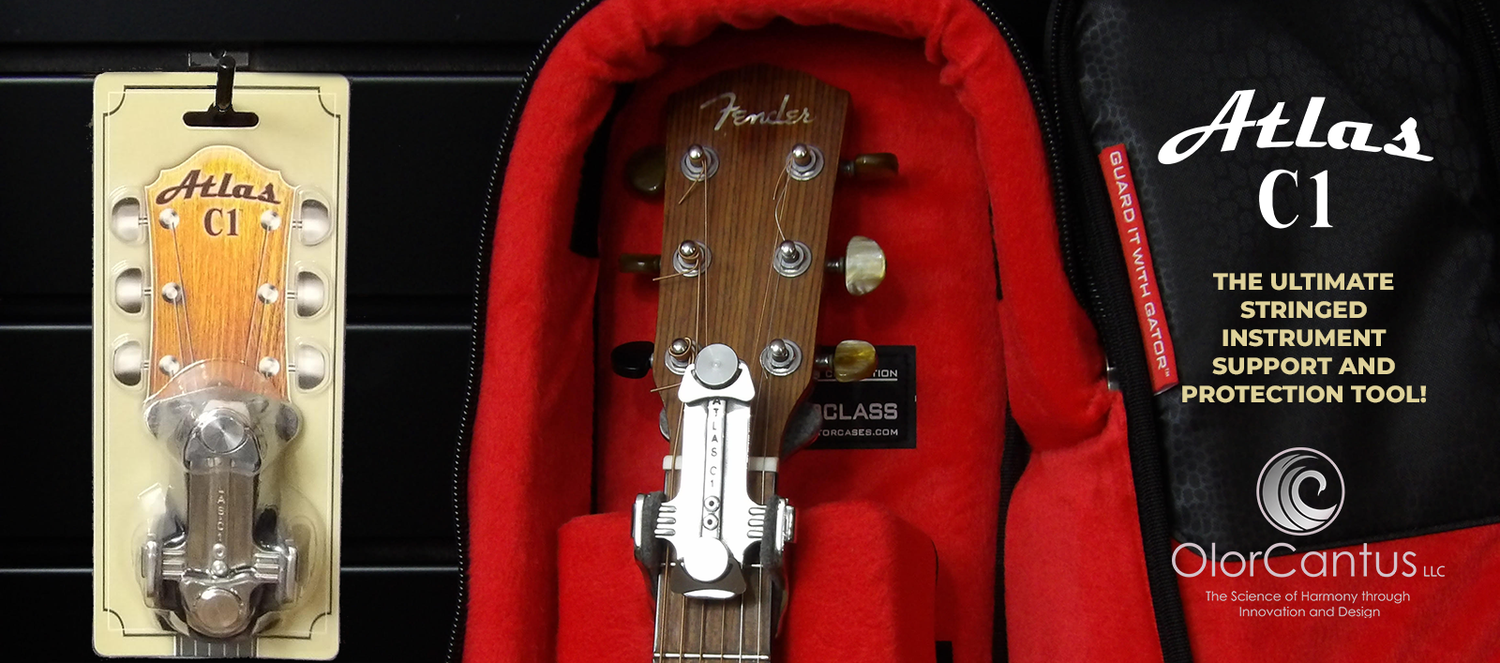
A headstock support holds the neck-headstock junction steady so it cannot flex. Without that support, a drop sends the headstock forward or back, and the thin wood at the junction takes the force. This is exactly the problem the Atlas C1 headstock protection tool is built to solve. It cradles the vulnerable junction and counteracts the tension that pulls on it.
For a full walkthrough, see our step-by-step guide on how to protect a guitar headstock during shipping.
Why the Headstock-Neck Junction Is the Weak Point
String tension pulls constantly on the headstock. Angled headstocks, common on classic designs, concentrate that stress at a thin section of wood. A sudden jolt adds to it.
That is why a well-padded box alone is not enough. Padding absorbs shock. Support stops movement. You need both.
Guitar Shipping Box DIY: Building a Box-Within-a-Box
A guitar shipping box DIY build gives you control over protection and cost. The box-within-a-box method, also called double-boxing, is the standard approach.
Here is how to build one:
- Pick an inner box that fits the guitar or case snugly
- Line the inner box with foam or bubble wrap
- Choose an outer box several centimeters larger on every side
- Fill the gap between boxes with packing peanuts, air cushions, or kraft paper
- Seal both boxes separately with packing tape
The inner box holds the guitar still. The outer box takes the handling damage. The fill between them absorbs shock. This layered approach is the closest thing to a guarantee you can build yourself.
Acoustic, Electric, and Odd Shapes: Packaging Variances That Matter
Acoustic guitars need deeper boxes and more body cushioning because of their size and hollow body. Electric guitars are thinner but often have angled headstocks that need extra support.
Odd shapes need custom treatment:
- Offset bodies: cut foam to fill the gaps around the curves
- Semi-hollow and hollow bodies: extra padding to protect the top
- Pointy or V-shaped guitars: block the tips so they cannot catch on the box
Accessories matter too. Remove tremolo arms, strap buttons that unscrew, and anything loose in the case. Bag small parts and tape them to the inside lid so they cannot rattle against the finish.
Carrier Handling, Dimensional Weight, and Insurance Coverage
Shipping cost depends on carrier pricing rules, which can factor in package size as well as weight. That is a good reason to size the box correctly rather than oversized.
Insurance coverage is the other half of the equation. Declare the full value and keep photos of the packed box and its contents. If damage happens, those photos support your claim.
If a guitar does arrive damaged, act fast. Our guide on what to do when your guitar arrives damaged covers the first steps.
Watch out: skipping declared value to save a little on shipping leaves you with no recourse when a carrier damages the instrument.
Packing Your Guitar for Its Next Trip
A guitar shipping box only protects when the fit, the cushioning, and the headstock support all work together. Get those three right and you prevent the damage that costs the most to fix.
At Atlas C1, we make the Atlas C1 headstock tool to protect the headstock-neck junction. It counteracts string tension and doubles as a pre-aligned repair jig. It is U.S. patent-protected and built for lifetime use. Professional musicians use it, and it is available at Guitar Center.
Get started with Atlas C1 and ship your guitar with confidence.
The Science of Harmony through innovation and design
Long Live the Six String ™
Frequently Asked Questions
What size box do you need to ship a guitar?
Measure your guitar or its case first, then add clearance on every side for cushioning. The box length you need depends on the instrument and how it is carried. The box must be snug enough that the instrument cannot slide but roomy enough for bubble wrap and void fill. Always confirm the guitar shipping box size against your carrier's dimensional weight rules before sealing.
How strong should a guitar shipping box be?
Look for double-wall corrugated construction rather than a single-wall retail box. Double-wall board resists crushing when boxes stack in a truck or sorting facility. Check that seams are glued or stapled cleanly and that the box has no soft spots, water stains, or crushed corners from previous use. A reinforced box with intact flutes holds its shape under load, which is what keeps cushioning effective and prevents the instrument from shifting.
Can you reuse a guitar shipping box?
Yes, if it passes inspection. Reject any box with crushed corners, delamination, water damage, or torn flaps, since those weak points fail under stacking pressure. Remove old labels and tape residue, confirm the internal dimensions still give you clearance, and reinforce the bottom seams with fresh packing tape. A reused box works well for a guitar shipping box DIY approach when you add a second inner box for double-boxing.
Should you ship a guitar in its case?
Ship in a hard case whenever possible, then place that case inside a larger corrugated box with cushioning around it. The case protects the body, but it does not stop the headstock from whipping forward on impact, so add support at the neck and headstock. If you ship without a case, use a guitar shipping box with rigid internal bracing and generous void fill, and consider a headstock support tool to brace the neck junction.