
Table of Contents
- What Is Guitar Neck Reinforcement and Why It Matters
- How Neck Stiffness Affects Tone and Playability
- Truss Rods vs. Carbon Fiber Reinforcement: Core Differences
- Carbon Fiber Neck Reinforcement: Strength and Stability
- Multi-Piece Neck Construction and Laminated Designs
- Steel Reinforcement: Traditional Durability
- Guitar Neck Stability: Long-Term Bowing Prevention
- How to Fix a Broken Guitar Headstock: Installation and Repair
- Reinforcement Materials: Wood Species and Properties
- Protecting Your Instrument: Travel and Storage Solutions
- Reinforcement for Small-Scale and Vintage Instruments
- When to Reinforce: Signs Your Neck Needs Support
- Frequently Asked Questions
Last Updated: October 2, 2026
What Is Guitar Neck Reinforcement and Why It Matters
Guitar neck reinforcement is the practice of adding internal structural support to a guitar neck to prevent bowing, maintain playability, and protect against damage during transport and use.
Protecting your instrument's neck is essential for both casual players and professional musicians. A reinforced neck maintains its structural integrity over decades of use, preserves tone quality, and prevents costly repairs.
The neck's vulnerability becomes especially apparent during travel. A single impact to the headstock-neck junction can result in expensive repairs or permanent damage.
How Neck Stiffness Affects Tone and Playability
Neck stiffness directly impacts how a guitar responds to string vibration and how the instrument plays under your hands.
The relationship between stiffness and tone is subtle but real. A neck with ideal stiffness transmits vibration efficiently from the bridge to the body, allowing the wood to resonate fully.
Professional luthiers measure neck relief (the slight forward bow that counteracts string tension) with feeler gauges to ensure playability. A neck with zero relief will buzz; one with too much relief will have high action that's uncomfortable to play.
Truss Rods vs. Carbon Fiber Reinforcement: Core Differences
The two primary approaches to guitar neck reinforcement each offer distinct advantages and limitations. Understanding the difference helps you choose the right solution for your instrument and playing style.
Adjustable Truss Rods and Neck Relief
An adjustable truss rod is a metal rod (typically steel) running through the interior of the neck that can be tightened or loosened to adjust neck relief. This is the industry standard for electric guitars and most acoustic instruments.
Adjustable truss rods offer flexibility, a technician can fine-tune relief to match seasonal humidity changes or compensate for wood movement. Most guitars require truss rod adjustment at least once during their life.
A common mistake is assuming a truss rod solves all neck problems. It doesn't. A truss rod only controls forward-backward bow; it cannot prevent side-to-side twisting or fix structural damage from impact.
Fixed Carbon Fiber Reinforcement
Carbon fiber reinforcement uses rigid composite material embedded in channels routed along the neck's length. Unlike adjustable truss rods, carbon fiber provides permanent, non-adjustable support.
Carbon fiber offers superior stiffness-to-weight ratio compared to steel. A carbon fiber-reinforced neck weighs less than one with a traditional truss rod, which can improve overall instrument balance and sustain.
The trade-off is permanence. Once carbon fiber is installed, you cannot adjust neck relief without removing and re-routing the reinforcement. This makes it less suitable for vintage instruments or guitars that may need future adjustments.
Carbon Fiber Neck Reinforcement: Strength and Stability
Carbon fiber has become the material of choice for builders prioritizing maximum structural integrity and long-term stability. Its properties make it particularly valuable for instruments subjected to heavy touring, extreme climate changes, or the demands of professional use.
Tensile Strength and Weight-to-Stiffness Ratio
Carbon fiber's tensile strength, its resistance to being pulled apart, far exceeds that of traditional hardened steel. A carbon fiber rod experiences minimal deflection under the full string tension of a guitar, even during aggressive playing or bending.
The weight-to-stiffness ratio is where carbon fiber truly excels. A carbon fiber-reinforced neck achieves the same stiffness as a thicker, heavier traditional neck while using less material.
Professional touring musicians often choose carbon fiber specifically for this reason. A lighter, stiffer neck reduces fatigue during long performances and maintains playability regardless of environmental conditions. The material's stability means fewer trips to the luthier for adjustments.
Climate-Specific Performance
Wood naturally expands and contracts with humidity changes. A neck reinforced with carbon fiber experiences minimal movement because the composite material is dimensionally stable across temperature and humidity ranges. This is crucial for musicians who travel frequently or play in varying climates.
Instruments transported via air between climate zones face extreme humidity swings in short periods. A traditional wooden neck can develop relief changes or even cracks under these conditions.
In dry climates, wood tends to shrink, pulling away from truss rod channels and creating gaps. Carbon fiber's stability prevents this separation. In humid environments, wood swells, potentially causing binding or high spots.
Multi-Piece Neck Construction and Laminated Designs
Some builders use multi-piece neck construction, where the neck is created from separate pieces of wood laminated together. This approach offers unique advantages for stability and allows for creative wood selection.
A laminated neck, typically featuring a center strip of one wood species flanked by pieces of another, can provide superior stability compared to single-piece necks.
Multi-piece necks are particularly common in vintage instruments and high-end custom builds.
The structural integrity of a laminated neck depends entirely on the quality of the glue joint. Poor lamination can fail catastrophically, so this method is best left to experienced luthiers.
Steel Reinforcement: Traditional Durability
Hardened steel reinforcement remains the most common approach in guitar manufacturing, particularly for mid-range and professional instruments. Steel truss rods have proven their reliability over more than a century of guitar building.
A properly installed steel truss rod provides excellent stiffness and can be adjusted throughout an instrument's life.
The durability of steel is well-established. A guitar with a steel truss rod can remain playable for 50+ years with minimal maintenance.
The drawbacks are weight and adjustability limits. Steel is denser than carbon fiber, requiring thicker material for equivalent stiffness.
Guitar Neck Stability: Long-Term Bowing Prevention
Maintaining long-term neck stability requires understanding what causes bowing and taking preventive measures. Wood naturally moves in response to its environment, and the stresses of string tension accelerate this movement.
Bowing typically occurs when the wood loses moisture and shrinks, or when string tension gradually exceeds the neck's stiffness.
Prevention starts with proper humidity control. Guitars should be stored in environments with 45-55% relative humidity. Extreme dryness causes wood to shrink and develop back-bow (reverse relief).
Reinforcement materials, whether steel, carbon fiber, or laminated wood, all help prevent bowing by providing structural resistance to string tension.
How to Fix a Broken Guitar Headstock: Installation and Repair
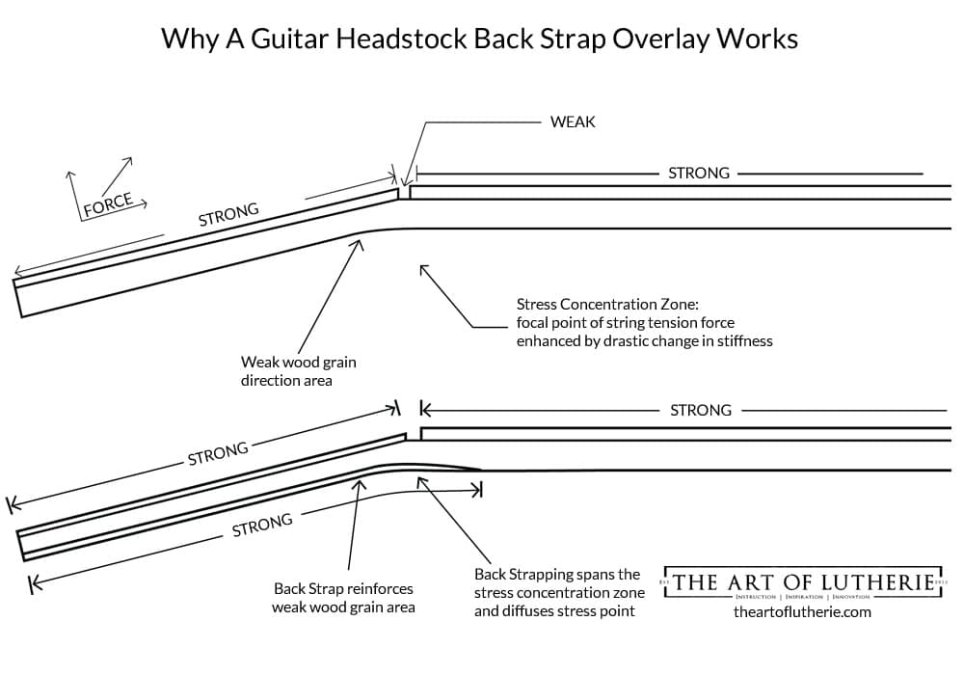
A broken headstock is one of the most serious injuries a guitar can sustain. The headstock-neck junction is the most vulnerable point because it experiences combined stresses: downward pull from string tension (130+ pounds on a typical six-string), lateral forces from impacts, and the natural stress concentration at the angle where the headstock meets the neck.
Structural Mechanics and Deflection Measurement
Before repair begins, a luthier must assess the structural integrity of the break itself.
A properly reinforced headstock should deflect no more than 0.015 inches (roughly 0.4 mm) under full string tension. Breaks that show deflection greater than 0.05 inches indicate inadequate reinforcement or incomplete epoxy penetration.
The angle of the headstock relative to the neck also affects repair success. Most guitars use a 13-17 degree headstock angle. A repair that shifts this angle by even 2 degrees changes the stress distribution at the break and can cause premature failure.
Dry Fitting, Channel Routing, and Tolerance Control
Before any glue is applied, a proper repair begins with dry fitting, assembling the pieces without adhesive to verify alignment and identify any gaps.
Channel routing, the process of cutting the groove that holds reinforcement material, must maintain tight tolerances.
A common mistake is assuming visual alignment is sufficient. Professional repairs use straightedges and dial indicators to verify that the channel is routed parallel to the neck centerline within 0.010 inches over the full length.
For headstock breaks specifically, the reinforcement material should extend at least 2 inches into the neck body beyond the break point.
Epoxy Application, Clamping Pressure, and Cure Verification
Once dry fitting confirms proper alignment, the repair proceeds with epoxy, a two-part adhesive that creates a bond stronger than the surrounding wood when properly applied.
Applying epoxy requires careful technique.
Clamping duration and environmental conditions are critical. Most epoxies require 24 hours of curing before the joint reaches full strength. Removing clamps too early (under 12 hours) can allow the pieces to shift slightly, compromising the repair.
Verifying cure completion requires patience. After 24 hours, the epoxy should be hard enough to resist fingernail scratching.
Common Installation Failure Modes and Prevention
Understanding what can go wrong helps prevent failures. The most common failure modes are:
-
Glue starvation (insufficient epoxy penetration): Voids in the epoxy joint create weak points where the reinforcement material can separate from the wood under string tension. This occurs when epoxy is applied too sparingly or when clamping pressure forces epoxy out of the joint faster than it can flow into the wood. Prevention: Apply epoxy generously to both surfaces and use moderate, consistent clamping pressure.
-
Misalignment during curing: Clamps that slip or insufficient clamping pressure allow pieces to shift, creating stress concentrations at the break. A shift of just 0.05 inches can reduce joint strength by 30-40%. Prevention: Use multiple clamps positioned perpendicular to the break line, and verify alignment every 2-3 hours during the first 12 hours of cure.
-
Inadequate reinforcement material: Using material that's too thin (under 0.25 inches for carbon fiber) or too short (less than 2 inches past the break) fails to span the full break and distribute stress evenly. Prevention: Reinforce at least 2 inches beyond the break on both sides of the headstock-neck junction.
-
Moisture exposure during curing: Epoxy cures best in moderate humidity; excessive moisture (above 70% RH) or immersion in water during cure can interfere with the chemical reaction, leaving the joint tacky or weak. Prevention: Cure in a climate-controlled environment and avoid exposing the repair to water for at least 48 hours after clamping is removed.
-
Over-tightening clamps: Excessive clamping pressure can crush wood fibers around the channel, reducing the wood's ability to support the reinforcement material and creating micro-fractures that propagate under playing stress. Prevention: Use calibrated clamps or a torque wrench, and stop tightening once moderate resistance is felt.
-
Stress concentration from sharp channel edges: If the channel is routed with sharp internal corners rather than rounded edges, stress concentrates at these corners under playing load, causing the epoxy to crack and the reinforcement to separate. Prevention: Route channels with a 0.125-inch radius on all internal corners.
Professional repairs succeed by controlling each of these variables with precision. This is why many musicians trust their instruments to experienced luthiers rather than attempting repairs themselves. However, with careful technique, proper materials, and attention to these quantifiable tolerances, a competent builder can execute a successful repair that restores the headstock to its original strength.
Reinforcement Materials: Wood Species and Properties
The wood species used in neck construction affects both structural properties and tone. Different woods offer different combinations of stiffness, weight, and dimensional stability. Understanding the quantifiable properties of these materials, particularly modulus of elasticity (MOE) and wood movement coefficients, allows builders and musicians to select reinforcement that matches their instrument's intended use and climate exposure.
Stiffness Comparison: Modulus of Elasticity and Practical Implications
Modulus of elasticity (MOE) measures a material's resistance to bending under load. For guitar necks, higher MOE means less deflection under string tension, which translates to more stable playability and reduced need for truss rod adjustment. Typical MOE values for common neck woods are:
- Maple (quarter-sawn): 1.6-1.8 million PSI (pounds per square inch)
- Walnut: 1.4-1.6 million PSI
- Mahogany: 0.8-1.0 million PSI
- Ash: 1.4-1.6 million PSI
- Carbon fiber (typical guitar reinforcement rod): 20-25 million PSI
- Steel (hardened truss rod): 30 million PSI
These numbers reveal why carbon fiber and steel are so effective as reinforcement: they are 12-30 times stiffer than wood.
Quarter-sawn maple is the industry standard for guitar necks because its MOE of 1.6-1.8 million PSI is among the highest for readily available woods, and its grain orientation (perpendicular to the face) resists twisting.
Mahogany, while commonly used in guitar bodies and some vintage necks, has significantly lower stiffness and is rarely used for modern necks without substantial reinforcement.
Dimensional Stability and Climate Response
Wood naturally expands and contracts with humidity changes. The amount of movement depends on the wood species and the direction of the grain.
In dry climates (below 30% relative humidity), wood shrinks.
In humid climates (above 60% relative humidity), wood swells. A neck that was properly relieved at 50% humidity can develop excessive forward bow as the wood expands.
The practical implication is that instruments in variable climates (touring musicians, instruments shipped between regions) benefit most from carbon fiber reinforcement because it eliminates the need for seasonal truss rod adjustments.
Wood Species Selection for Specific Applications
Quarter-Sawn Maple: The gold standard for electric guitar necks.
Walnut: Offers stiffness comparable to maple (1.4-1.6 million PSI) with darker coloring and more dramatic grain patterns.
Ash: Falls between maple and walnut in stiffness (1.4-1.6 million PSI) and offers a light, attractive appearance with prominent grain.
Mahogany: While commonly used in guitar bodies, mahogany's lower stiffness (0.8-1.0 million PSI) makes it unsuitable for necks without substantial reinforcement.
Ebony: The premium fretboard wood, chosen for its extreme density, durability, and appearance.
Reinforcement Material Properties and Trade-Offs
Hardened Steel: MOE of approximately 30 million PSI, making it roughly 17-20 times stiffer than maple. Steel truss rods have proven their reliability over more than a century of guitar building. The material is inexpensive, adjustable, and can be repaired or replaced if necessary.
Carbon Fiber: MOE of 20-25 million PSI, slightly less stiff than steel but with a dramatically better weight-to-stiffness ratio.
Laminated Wood Construction: Multi-piece necks laminated with epoxy can provide superior stability compared to single-piece necks. The glue lines between pieces can actually help distribute stress more evenly than a solid piece of wood.
Protecting Your Instrument: Travel and Storage Solutions
Beyond internal reinforcement, protecting your guitar during travel and storage prevents the damage that reinforcement is designed to survive. A well-protected instrument experiences less stress and requires less maintenance.
During air travel, guitars face impacts, pressure changes, and temperature fluctuations. A quality hard case provides essential protection for the body, but the headstock-neck junction remains vulnerable.
Storage should maintain stable humidity and moderate temperature. Avoid storing guitars in attics, basements, or vehicles where temperature and humidity fluctuate dramatically. A climate-controlled room with 45-55% humidity is ideal.
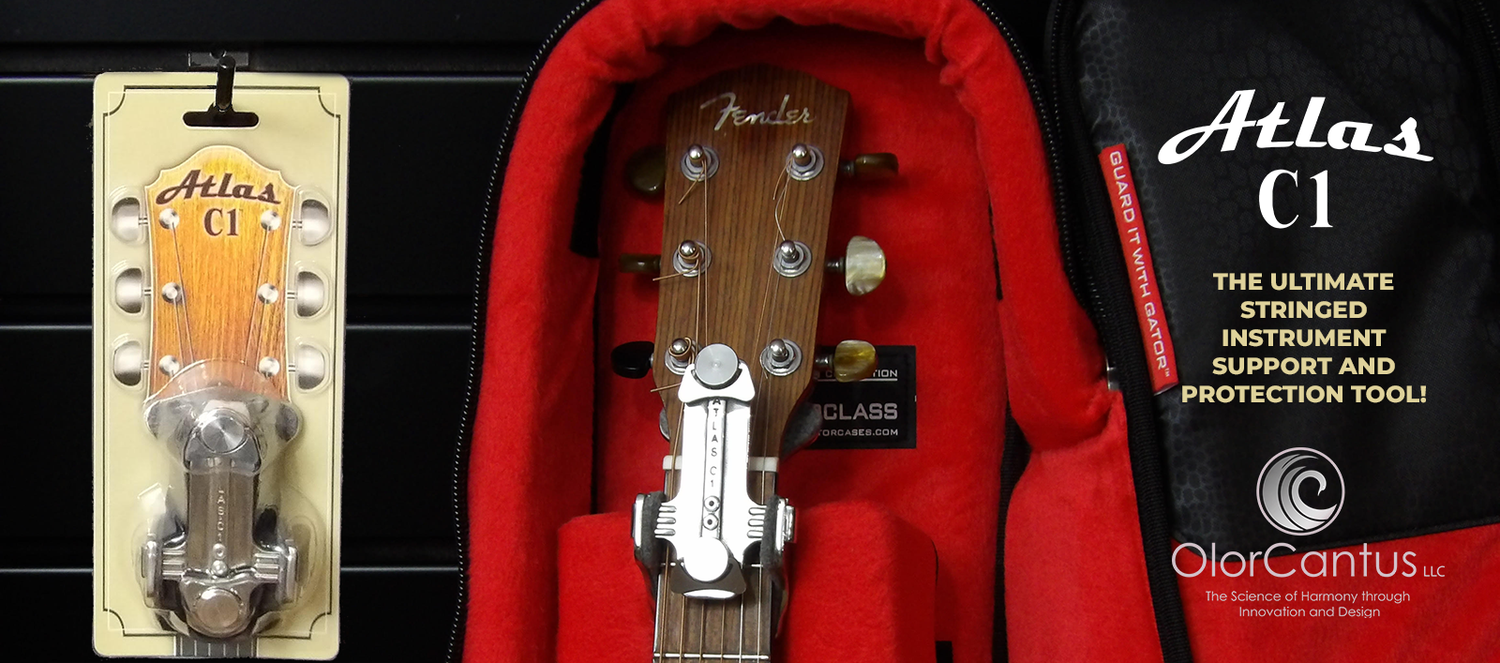
For valuable instruments or those subjected to frequent travel, professional-grade protection solutions provide peace of mind.
Reinforcement for Small-Scale and Vintage Instruments
Small-scale guitars (travel guitars, parlor guitars, and some classical instruments) face unique reinforcement challenges. Their smaller mass and shorter necks experience different stress distributions than full-size instruments.
Vintage instruments present additional complexity. Many vintage guitars were built before modern reinforcement standards and may have weak or deteriorated original reinforcement.
For vintage instruments, conservative reinforcement approaches are often best. Adding a modern carbon fiber rod might improve playability but would compromise originality.
Small-scale instruments benefit from lighter reinforcement that doesn't add excessive weight.
When to Reinforce: Signs Your Neck Needs Support
Recognizing when a neck needs reinforcement prevents catastrophic failure. Common warning signs include:
- Visible bowing when sighting down the fretboard
- Fret buzz that cannot be corrected by bridge adjustment
- High action at the first few frets combined with normal or low action at the higher frets
- Cracks in the wood, particularly at the headstock-neck junction
- Separation between the fretboard and neck wood
- Neck twisting that causes uneven string height across the width of the fretboard
A professional luthier can diagnose neck problems with precision tools and recommend appropriate reinforcement. Some issues can be corrected with truss rod adjustment alone. Others require new reinforcement material or structural repair.
Preventive reinforcement makes sense for instruments subjected to heavy touring, extreme climate exposure, or high-value vintage guitars. Adding reinforcement before problems develop is far less expensive than repairing a broken headstock.
Protecting your guitar's neck is one of the most important investments you can make in instrument longevity.
When headstock damage does occur, having the right tools and knowledge makes repair more straightforward.
Frequently Asked Questions
What is the purpose of guitar neck reinforcement?
Neck reinforcement prevents bowing, twisting, and deflection caused by string tension, which exceeds 130 pounds of pressure. Reinforcement materials like carbon fiber, steel, or laminated wood stringers stabilize the neck, preserve playability, and protect your instrument's structural integrity over decades of use. Without reinforcement, even quality necks can warp under constant tension.
Is carbon fiber better than steel for neck reinforcement?
Carbon fiber offers superior weight-to-stiffness ratio and climate-specific performance advantages, resisting humidity and temperature swings better than steel. Steel provides proven durability and lower cost but adds more weight. Carbon fiber is preferred for high-performance instruments and frequent travelers; steel works well for traditional builds and studio guitars that stay indoors.
Can a guitar neck be reinforced after it has been built?
Yes, but it requires skilled luthier work. Retrofitting reinforcement involves channel routing into the existing neck, which risks structural damage if done incorrectly. Professional installation using proper dry-fit techniques and epoxy application is essential. This is why many musicians invest in protective solutions like headstock support tools to prevent damage that would require costly repairs.
How do truss rods differ from carbon fiber reinforcement?
Truss rods are adjustable metal rods that correct neck relief and bowing after it occurs, while carbon fiber is fixed reinforcement that prevents deflection from happening. Truss rods offer flexibility for seasonal adjustments; carbon fiber provides permanent structural support. Most modern guitars use both: carbon fiber for baseline stiffness and truss rods for fine-tuning playability.
Does neck reinforcement affect guitar tone?
Reinforcement can subtly influence tone by changing how the neck vibrates and transmits string vibration to the body. A stiffer neck typically produces slightly brighter, more defined tone with reduced feedback. However, the effect is minor compared to body wood, pickup selection, and setup. Most players find the stability and durability benefits far outweigh any tonal shift.
What materials work best for neck reinforcement in vintage guitars?
Quarter-sawn maple and walnut are traditional choices that match vintage construction and preserve authenticity. Ebony offers exceptional hardness and aesthetic appeal. Modern carbon fiber can be retrofitted carefully if the vintage guitar requires repair. Always consult a luthier experienced with vintage instruments before reinforcing, improper work can damage a collector's instrument and reduce its value.
How can I protect my guitar headstock during travel?
Use a hard-shell case with internal padding, avoid placing guitars in overhead bins, and consider protective headstock support tools designed for touring musicians. These tools counteract string tension and prevent the headstock-neck junction from cracking during transport or sudden impacts. For frequent travelers, investing in reliable protection prevents costly repairs and gives peace of mind.