
Last Updated: November 2, 2026
Quick Summary
The best way to maintain guitar humidity levels is to keep relative humidity steady around 45% to 55%, using a hygrometer to track conditions and a humidifier or dehumidifier to correct drift. Change conditions gradually, since rapid swings stress the wood more than a slightly off but steady level.
- Aim for roughly 45% to 55% relative humidity for acoustic guitars, with 40% to 50% acceptable for everyday playing.
- Solid-wood acoustics need the most careful humidity control; laminate models tolerate more variation.
- Place a digital hygrometer near the guitar at playing height, away from vents, windows, and direct sunlight.
- Raise dry air gradually with a room humidifier or in-case humidifier, and recheck after a few hours and the next day.
- Watch for cracks, swelling, lifting bridges, and sharp fret ends, and have a qualified technician assess serious damage.
Table of Contents
- Why Guitar Humidity Levels Matter for Your Instrument
- Ideal Humidity Range for Acoustic and Electric Guitars
- Signs of Humidity Damage: Cracks, Swelling, and Warping
- Choosing and Placing a Hygrometer for Accurate Readings
- How to Humidify Your Guitar When Air Is Too Dry
- Reducing Moisture When Conditions Run Too Humid
- Keeping Guitar Humidity Stable at Home, While Traveling, and in Storage
- Your Monthly Humidity Routine: Start Checking Your Guitar's Conditions Today
- Frequently Asked Questions
Your guitar's humidity levels matter more than most players realize. Wood breathes. When the air around it gets too dry or too damp, the wood shifts, and that movement can crack a top, lift a fret, or throw off your setup. The good news is that stable humidity is simple to achieve once you know the target range and a few routine habits. This guide walks you through the steps that keep your instrument stable from season to season.
Why Guitar Humidity Levels Matter for Your Instrument
Wood is hygroscopic, which means it takes on and gives off moisture as the surrounding air changes. A solid-wood acoustic guitar is especially sensitive because its top, back, and sides are thin slices of timber glued together under tension.

Here is what changing humidity can do:
- Dry air can shrink the top and cause cracks, especially along the grain.
- Wet air can make the wood swell, which may cause bridge lifting or tight, sticky action.
- Rapid swings are often harder on an instrument than a steady level that is slightly off target.
Stability is the real goal. Your guitar can handle a range of conditions, but it struggles when conditions keep changing.
Ideal Humidity Range for Acoustic and Electric Guitars
Most guitar makers and repair technicians point to a relative humidity (RH) of roughly 45% to 55% as a comfortable target for acoustic guitars. Many players aim for the middle of that band and treat anything from about 40% to 50% RH as acceptable for everyday playing.
Temperature matters too. Keep the room at a steady, comfortable temperature, since heat and humidity interact. A sudden jump from a cold car to a warm, humid room can stress the wood quickly.
Solid-Wood Acoustics vs. Laminate Models
Solid-wood guitars need the most careful humidity control. Laminate (plywood) guitars are more forgiving because layered wood moves less. They still benefit from a stable environment, but a laminate instrument usually tolerates a little more variation before you see problems.
A practical rule: if your guitar has a solid top, treat humidity control as a priority.
Electric Guitars and Their Humidity Needs
Electric guitars are generally more tolerant of humidity swings than acoustics because they have no large, thin soundboard. Their bodies are often solid or laminated, and their hardware is metal. Still, extreme dryness can affect the neck and fretboard, and high moisture can promote rust on metal parts. A reasonable target is the same stable range that suits your other instruments.
Signs of Humidity Damage: Cracks, Swelling, and Warping
Check your guitar regularly for these warning signs:
- Cracks in the top, back, or sides, often near the soundhole or along the grain
- Swelling that makes the top bulge or the finish look raised
- Warping or a neck that bows, leading to high action or buzzing
- Lifting bridge or gaps at the glue joints
- Sharp fret ends that feel more pronounced after a dry spell
If you see any of these, check your humidity right away and take the steps covered below. For significant damage, a qualified guitar technician can assess the instrument and recommend next steps. A professional opinion is a sensible step before attempting any structural repair yourself.
Choosing and Placing a Hygrometer for Accurate Readings
You cannot manage what you do not measure, and most humidity mistakes start with a bad measurement. A digital hygrometer that displays relative humidity is the workhorse tool here. Look for one that reads in 1% steps, holds max/min memory so you can review overnight swings, and has a display you can read without opening the case. In-case hygrometers with a remote probe are especially useful because they let you check conditions without lifting the lid and releasing the stable air you worked to create.
Placement decides whether your reading is useful or misleading:
- Put the sensor where the guitar actually lives, inside the case near the body, or at the same height as the instrument in the room.
- Keep it away from vents, radiators, windows, exterior doors, and direct sunlight.
- Let it sit for a few hours before trusting the first reading; a meter moved from a cold car to a warm room needs time to settle.
- If you monitor a room, place the hygrometer at playing height rather than on the floor, where readings run cooler and often damper.
Calibration is the step most players skip. A simple saturated salt test gives you a reference point: seal the hygrometer in a container with a small cup of damp salt (a thick paste, not a puddle) and wait several hours. A reliable meter should settle near 75% RH in that environment. If it reads far off, note the offset and apply it mentally to every reading, or replace the meter. Comparing against a second trusted gauge is a faster check; if two meters disagree by more than a few points, one of them is lying to you.
Watch out: a hygrometer that lives in the case but is checked only when the case is open will read the room, not the instrument's microclimate, use a remote probe or read the max/min memory to see what happened while the case was closed.
Conflicting readings are common and usually explainable. A room meter at 35% RH next to a case meter at 48% RH is not a contradiction; the case is doing its job as a buffer. Trust the case reading for the instrument's condition and the room reading for deciding whether to adjust the room. If the two meters disagree in the same location, calibrate both before acting on either. Keep a simple log for a month, date, room RH, case RH, and any action taken, and you will see your space's patterns quickly enough to act before the wood does.
How to Humidify Your Guitar When Air Is Too Dry
Winter heating and dry climates routinely pull indoor RH below 40%, and that is when action matters. The goal is not to flood the instrument but to raise humidity gradually and hold it in the target band. A repeatable sequence works better than guessing:

- Measure first. Confirm the reading with your hygrometer in the guitar's location, not in a distant corner.
- Choose the smallest intervention that works. For a guitar stored in its case, an in-case humidifier or humidity-control pack is usually enough. For a room full of instruments or a guitar kept on a stand, a room humidifier is the better tool.
- Add moisture slowly. Aim to move RH a few points at a time rather than jumping from 30% to 50% in an hour.
- Recheck after a few hours and again the next day. Adjust the output, not the target.
- Hold steady for a week before deciding the problem is solved; wood responds slowly.
Your main options and their trade-offs:
- Room humidifier: Controls the whole space and suits players who keep instruments out on stands. It needs regular filling, wick or filter changes, and monitoring, because output drifts as the unit cycles.
- In-case humidifier: A small device that sits inside the case and targets the instrument's microclimate. It is efficient for storage and travel, but it only protects what is inside the case.
- Humidity-control pack: Two-way packs that release or absorb moisture to hold a target level inside the case. They are low-maintenance but need replacing or recharging on the manufacturer's schedule.
Watch out: never place a humidifier directly against the instrument, never put water directly on the wood, and do not overcorrect, pushing RH well above the target band causes swelling and bridge stress just as dryness causes cracks.
Severely dry instruments need a gentler plan. If a guitar has been in very low humidity for weeks and shows sharp fret ends, a sunken top, or a new crack, bring it up gradually over several days rather than sealing it in a soaking-wet case. A common pattern is to raise case RH a few points per day and inspect daily for changes. If the instrument has an open crack, a lifting bridge, or a neck that will not settle, stop adjusting and have a qualified technician assess it before you continue, structural repair is not a humidity problem, and adding moisture will not fix it.
For players who do their own adjustments, a stable workspace matters as much as a stable case. A repair jig can support a neck or headstock during work, which reduces handling stress on an already fragile instrument. Keeping the repair area at the same stable humidity as your guitar is a sensible habit.
Reducing Moisture When Conditions Run Too Humid
Summer and damp basements can push RH too high. To bring it down:
- Run a dehumidifier in the room, and empty or drain it on schedule.
- Improve airflow so moisture does not collect in one corner.
- Store the guitar out of the most humid part of the house.
- Use silica gel or charcoal packs inside the case, and replace or recharge them as directed.
Watch for swelling and rust on metal hardware. If the guitar has been exposed to very high moisture for a long time, let the instrument acclimate slowly rather than moving it straight into a dry room.
Keeping Guitar Humidity Stable at Home, While Traveling, and in Storage
Stability depends on your routine across different situations.
At home: Keep the guitar in the same room with a hygrometer nearby. Avoid placing it next to heating vents, fireplaces, or windows.
While traveling: Let the case sit closed for a while after a temperature change so the instrument can adjust. Pack a case humidifier or humidity pack, and avoid leaving the guitar in a hot car or an unheated cargo area. For air travel, check the airline's musical instrument policy before you fly, since rules on carry-on and checked instruments vary.
In storage: Pick a climate-controlled space when you can. If storage is unheated, a case humidifier and a hygrometer inside the case will help you watch conditions over time.
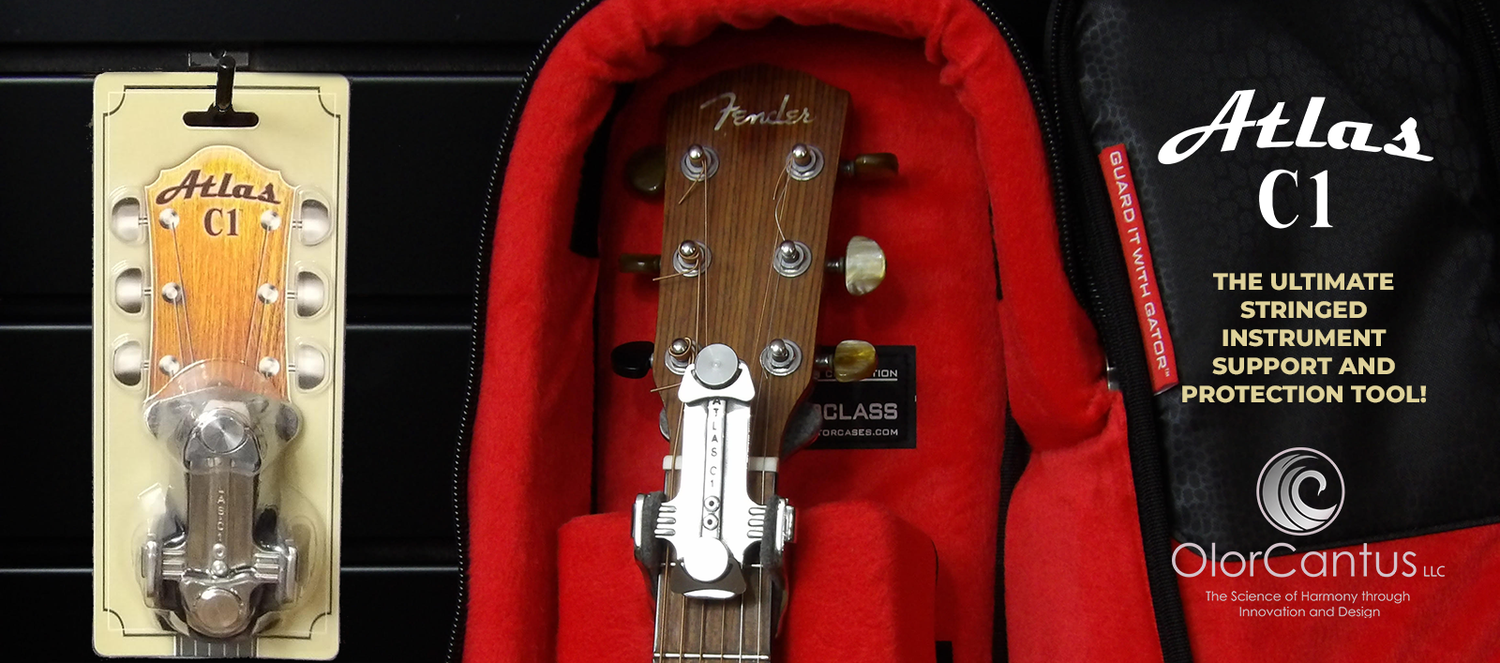
For players who repair their own instruments, a sturdy workspace matters too. A repair jig such as the Atlas C1 can support a neck or headstock during adjustments, which reduces the handling and stress that can aggravate an already fragile instrument. Atlas C1 designs its tools for stable, protected work, and we recommend keeping the repair area at the same stable humidity as your guitar.
Your Monthly Humidity Routine: Start Checking Your Guitar's Conditions Today
Consistency beats perfection. Here is a simple routine you can start this week:
- Check the hygrometer every morning and log the reading.
- Adjust your humidifier or dehumidifier when readings drift outside the 40% to 50% RH band.
- Inspect the guitar for cracks, swelling, lifting, or fret issues once a month.
- Replace or recharge case packs on the schedule the manufacturer recommends.
- Review your log at the end of each month to spot seasonal patterns.
- Plan ahead for seasonal changes, such as turning on a humidifier before winter heating starts.
- Book a professional setup if you notice persistent problems, buzzing, or structural concerns.
Start with the first two steps today. Within a month you will know your room's habits, and your guitar will thank you for it.
The Science of Harmony through innovation and design
Long Live the Six String™
Here is a quick reference for the routine and the key targets covered above.
| Task | Frequency | Target or note |
|---|---|---|
| Check hygrometer | Every morning | Log the reading |
| Adjust humidifier or dehumidifier | When readings drift | Stay in the 40% to 50% RH band |
| Inspect guitar | Once a month | Look for cracks, swelling, lifting, fret issues |
| Replace or recharge case packs | Per manufacturer schedule | Follow the manufacturer's guidance |
| Review humidity log | End of each month | Spot seasonal patterns |
| Plan for seasonal change | Before winter heating | Turn on humidifier in advance |
| Book professional setup | When problems persist | For buzzing or structural concerns |
Frequently Asked Questions
What is the best way to keep my guitar humidified?
The most reliable approach is a case humidifier or humidity-control pack sized for your case, combined with a digital hygrometer so you can see the actual reading. Place the humidifier in the case, close the lid, and check the hygrometer weekly during dry months. Room humidifiers help if you keep the guitar on a stand at home, and they work best when the room stays at a steady level rather than swinging between wet and dry. Avoid placing any humidifier directly against the wood, and never soak sponges or packs beyond the manufacturer's instructions. Consistent conditions protect the top, neck and bridge far better than occasional large corrections.
Is 60% humidity too high for a guitar?
Sustained relative humidity around 60% is generally considered high for acoustic guitars, because solid wood tends to absorb moisture and swell, which can affect action, intonation and the fit of the neck. Short exposures during a humid summer day are less risky than leaving an instrument in damp conditions for weeks. If your hygrometer reads consistently above 55%, move the guitar to a drier room, use a dehumidifier or a case humidity-control pack that is designed to reduce moisture, and recheck the reading after a few days. Electric guitars with laminate or painted bodies handle humidity differently, so monitor them with the same care.
Is 35% humidity too low for guitars?
A reading near 35% relative humidity is on the dry side for most acoustic guitars, and prolonged exposure can lead to shrinkage, sharp fret ends, cracks along the seams or top, and lifting bindings. Winter heating often pushes indoor humidity this low. Aim to bring readings back into the 40% to 50% range with a case or room humidifier, and avoid rapid swings, since quick changes stress the wood more than a steady but slightly dry environment. Check the guitar after adjusting, and watch for any new cracks or changes in playability.
How often should I check my guitar's humidity?
Check your hygrometer at least once a week during seasons with large swings, such as winter heating or humid summers, and at least once a month during stable weather. Each time you open the case, glance at the reading to catch problems early. Place the hygrometer inside the case or near the instrument rather than on a wall, because room readings can differ from conditions around the guitar. Recalibrate or compare your hygrometer against a known reference periodically, since inexpensive gauges can drift over time.