
Table of Contents
- Why Headstock Damage Happens in Soft Cases
- Understanding the Vulnerable Headstock-Neck Junction
- How to Protect Angled Guitar Headstocks During Transport
- Padding and Cushioning Techniques for Soft Cases
- Immobilizing Your Guitar Neck and Headstock
- Guitar Neck Support Tools and Their Role
- Soft Case vs. Gig Bag: Structural Limitations and Solutions
- Travel and Air Transport: Special Considerations
- Protecting Your Investment Long-Term
- Frequently Asked Questions
Last Updated: September 27, 2026
Why Headstock Damage Happens in Soft Cases
Soft cases offer convenience but expose your guitar's headstock to serious risk, making it essential to prevent guitar headstock damage during transport. Your strings pull with over 130 pounds of tension, concentrating force at the neck joint. When a soft case shifts during transport, that junction absorbs the impact. Hard cases distribute shock evenly; soft cases compress inward, focusing pressure directly on the headstock.
Air travel compounds the risk. Baggage handlers drop cases, and cargo holds experience pressure changes and temperature swings that weaken glue joints. A break that might take months to develop at home can happen in days of travel.
Extra padding helps but isn't enough. Real protection requires immobilization, the neck needs support that prevents any movement inside the case. Without it, even gentle handling causes micro-abrasions that lead to structural failure.
Understanding the Vulnerable Headstock-Neck Junction
The headstock-neck joint is the most common break point on any stringed instrument. The glue joint is engineered for normal playing but not for impact from dropped cases or pressure changes. The wood is thin and vulnerable to splitting.
Angled headstocks face extra risk, the tilt increases lever force on the joint. Straight headstocks distribute stress more evenly, but both styles need protection during transport.
A broken headstock compromises the entire instrument's playability and value, potentially damaging the truss rod access point as well.
Temperature and humidity add critical risk. Glue joints weaken when humidity drops below 40%; cargo holds can reach 20%, making glue brittle and gentle bumps into breaks.
How to Protect Angled Guitar Headstocks During Transport
Angled headstocks need targeted support. Start with proper case positioning: place your guitar so the headstock points toward the case's thickest wall, away from the opening to reduce impact exposure.
Create a support structure inside the case using a foam insert or padding block that supports the neck at the headstock junction, preventing tilting or movement.
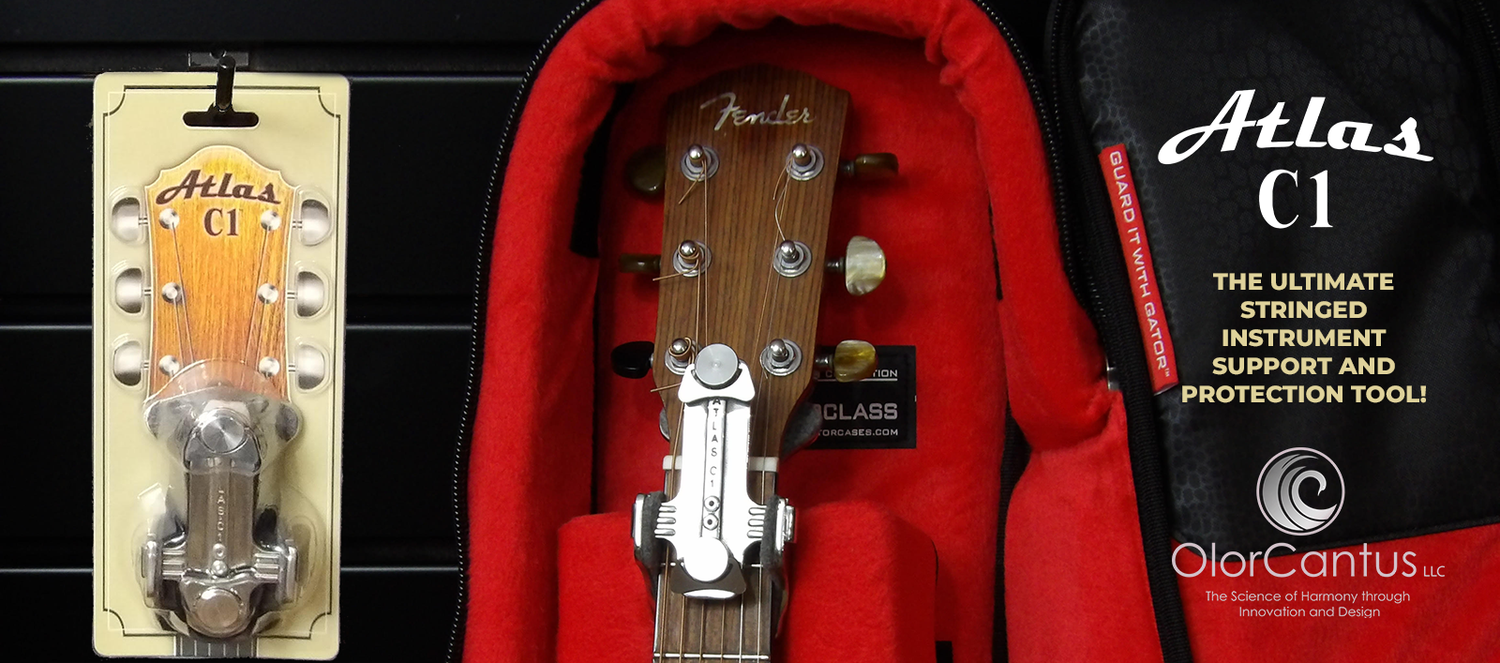
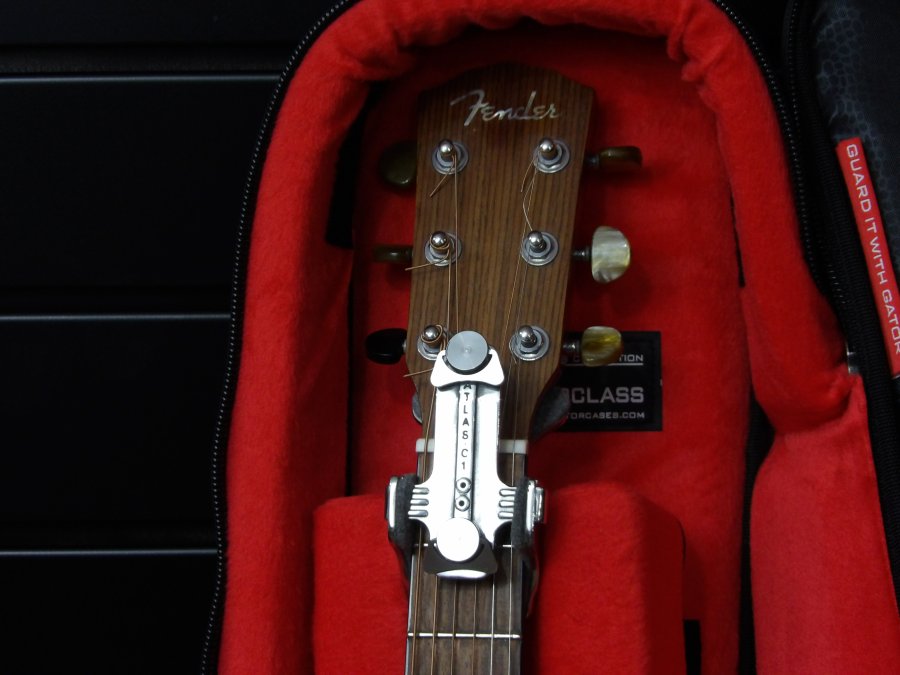
The Atlas C1 provides precision support at this critical junction. It's engineered to hold the neck at the exact angle your guitar needs. Unlike improvised padding, it maintains consistent pressure without crushing the finish.
Secure the guitar with soft straps or ties to prevent sliding without pinching the finish. Add 2-3 inches of closed-cell foam around the headstock for vibration dampening, it absorbs shock better than bubble wrap and prevents headstock contact with the case wall.
Test your setup before traveling by gently shaking the case. You should hear no movement inside. If it shifts, add more padding or adjust your support structure.
Padding and Cushioning Techniques for Soft Cases
Proper padding is your first line of defense. Wrap the headstock in tissue paper first to protect the finish, then add 2-3 inches of closed-cell foam, which resists compression better than open-cell varieties.
Bubble wrap is less ideal than closed-cell foam, bubbles pop over time, creating hollow spots. Closed-cell foam maintains its cushioning properties indefinitely.
Layer your padding strategically:
- Tissue paper against the finish
- 1 inch of closed-cell foam
- Another tissue layer
- 1-2 inches of additional foam
- Final tissue layer
This multi-layer approach prevents micro-abrasions and provides redundancy if one layer compresses.
Pay special attention to the volute, the reinforcement area where the headstock meets the neck. Wrap it with 3-4 inches of extra padding.
Don't compress padding too tightly, aim for snug but not crushing. Replace padding before each trip, as compressed foam loses effectiveness and old foam becomes brittle.
Immobilizing Your Guitar Neck and Headstock
Complete immobilization prevents impact and vibration damage. Use a wedge-shaped neck support block under the neck at its natural angle to prevent headstock tilting or dropping.
Position the support block under the neck about 6 inches from the headstock to prevent the most common failure point from moving.
Add side supports using firm foam padding on both sides of the headstock to prevent left-right movement. Secure everything with soft straps at three points: across the body, upper neck, and headstock area. Make straps snug but not tight to prevent movement without creating pressure points.
The Atlas C1 serves as both support and immobilization tool. It holds the neck at the precise angle needed. It prevents all movement at the vulnerable junction. This is more effective than improvised solutions because it's engineered for this specific purpose.
Guitar Neck Support Tools and Their Role
Neck support tools provide precision that padding alone cannot match by holding the neck in a fixed position. A basic neck support block is a wedge-shaped piece of foam or wood with contoured shapes that match guitar neck profiles.
Advanced tools provide full immobilization by supporting the neck and headstock simultaneously while counteracting the 130+ pounds of string tension that tries to pull the headstock away from the neck.
Look for tools that support the neck at multiple points, hold the headstock at its natural angle, accommodate different guitar styles, don't damage the finish, and provide consistent support. Some tools double as repair jigs, allowing you to repair a broken headstock yourself without expensive luthier visits.
The Atlas C1 functions as both a travel protection tool and a repair jig. It's engineered to provide precision support. It counteracts string tension. It prevents movement from all directions. This dual function makes it a lifetime investment.
Soft Case vs. Gig Bag: Structural Limitations and Solutions
Soft cases and gig bags lack internal immobilization systems. Soft cases have 1-2 inches of padded walls that compress under impact and shift during transport, creating gaps where the headstock contacts the case wall. Gig bags are thinner (under 1 inch) and designed for short trips, not air travel, the walls compress easily and padding shifts readily, offering minimal protection against impact or pressure changes.
Neither case type provides active support at the headstock-neck junction. String tension (130+ pounds) pulls the headstock away from the neck, and without counter-support, this increases stress on the glue joint during transport.
DIY Soft Case Reinforcement: You can retrofit a soft case to provide semi-rigid protection. Create a wedge-shaped neck support block (6-8 inches long, 2-inch closed-cell foam) that sits under the neck about 6 inches from the headstock. Build headstock side supports using two rectangular foam pieces (4 inches wide by 8 inches tall) on either side of the headstock. Add a U-shaped foam cradle (3-4 inches deep, lined with tissue paper) around the headstock's back and sides. Layer 1-2 inches of closed-cell foam padding over your rigid inserts. Secure everything with soft straps across the body, upper neck, and headstock area, snug but not tight.
Testing Your Retrofit: After assembly, gently shake the case in all directions. You should hear no movement inside. The guitar should feel locked in place. If it shifts, add more padding or adjust the rigid inserts. This semi-rigid environment mimics the protection of a hard case while keeping your soft case portable.
Gig Bag Reinforcement (Limited Options): Gig bags are harder to retrofit because they lack interior space. Your best options are:
- Add 2-3 inches of additional closed-cell foam padding around the headstock (this increases bulk significantly)
- Use a rigid neck support block that extends outside the bag slightly
- Never check a gig bag on flights; carry it as a personal item only
- Reserve gig bags for local transport only, not air travel
For frequent travelers, a soft case with DIY reinforcement is superior to a gig bag. The extra padding and structure provide a foundation. You can build a semi-rigid protection system on top of it. A gig bag, even with added padding, cannot match this level of protection.
When to Upgrade: If you travel more than 4 times per year, or if your guitar is worth more than $1,500, invest in a hard case instead. The cost is justified by the superior protection. Hard cases eliminate the structural limitation entirely. They provide rigid support and shock absorption that soft cases cannot match, even with DIY reinforcement.
Travel and Air Transport: Special Considerations
Air travel is the highest-risk scenario for your guitar. Cargo holds expose your instrument to conditions far more extreme than ground transport. Understanding the specific mechanisms of damage, and how to counteract them, is essential for protecting your headstock.
The Cargo Hold Environment: Cargo holds are unpressurized or partially pressurized. Temperature drops to 40-50°F at cruising altitude. Humidity plummets to 10-20% (compared to the 45-55% ideal for guitars). Pressure changes stress the wood. These conditions don't just feel uncomfortable; they actively weaken the glue joints that hold your headstock to the neck.
How Temperature and Humidity Damage Headstock Glue Joints: The headstock-neck joint is glued with hide glue (on vintage guitars) or modern polyurethane adhesive. Both types are sensitive to moisture and temperature.
When humidity drops below 40%, wood loses moisture and shrinks. The grain structure tightens. Glue becomes brittle and loses flexibility. A joint that flexes safely at 50% humidity becomes rigid and prone to cracking at 20% humidity. The wood shrinks around the glue line, creating micro-gaps. These gaps weaken the joint's structural integrity.
Temperature changes compound this effect. Cold air holds less moisture. A 10-hour flight in a 40°F cargo hold can drop your guitar's wood moisture content by 5-10%. This happens faster than the wood can acclimate. The result is uneven shrinkage: the outer layers shrink faster than the interior, creating internal stress.
When you land and the guitar warms up, it absorbs moisture again. But the reabsorption is slower than the loss. Your headstock joint has been weakened. A gentle bump during baggage handling, or even a hard landing, can cause a break that wouldn't have happened on the ground.
Protecting Against Humidity and Temperature Damage:
-
Wrap the entire guitar in plastic: Use a plastic garbage bag or plastic wrap. This creates a vapor barrier that slows moisture loss. It won't prevent all damage, but it reduces the rate of shrinkage. Wrap the guitar loosely, you don't want to trap condensation.
-
Loosen strings before flight: Reduce string tension by a half-step (or one full step for long flights). This reduces the pulling force on the headstock joint. The joint experiences less stress during the flight. Retune after landing and allowing 24 hours for acclimation.
-
Pack a humidity buffer: Include a small humidifier pack (the type used for cigar cases) in your case. These maintain 45-50% humidity in a sealed space. They won't prevent all moisture loss, but they slow it significantly. Replace the pack before each trip.
-
Allow 24-hour acclimation: After landing, leave your guitar in its case for at least 24 hours before playing. This allows the wood to gradually reabsorb moisture and return to its normal state. Playing immediately after a flight stresses the weakened joint.
Baggage Handling and Impact Protection: Baggage handlers drop cases. They stack heavy items on top. Soft cases absorb impacts they weren't designed for. The padding compresses. Your guitar's headstock takes the full force.
Minimize impact exposure:
- Use the thickest padding available (3-4 inches around the headstock)
- Immobilize the headstock completely with rigid supports
- Add reinforcement around the case exterior (wrap the case in a protective bag)
- Consider purchasing additional baggage protection from the airline
- Mark the case "FRAGILE" and "THIS SIDE UP" clearly
Check-In vs. Carry-On Strategy: Checked baggage experiences more impact and pressure changes. Carry-on baggage is safer but may not be allowed for soft cases on some airlines.
Negotiating Soft-Case Carry-On Policies: Most airlines allow guitars as carry-on items if they fit in the overhead bin or under the seat. A soft case is typically smaller than a hard case and more likely to fit. However, policies vary by airline and aircraft type.
Before booking:
- Check the airline's specific instrument policy (not just "soft case" but "guitar in soft case")
- Verify the overhead bin dimensions for your aircraft type
- Call the airline 48 hours before your flight to confirm your soft case will be accepted
- Request a gate-check option if the bin is full (the guitar travels in the cabin, not cargo)
If the airline requires check-in:
- Use the thickest padding available
- Immobilize the headstock completely
- Wrap the case in a protective bag
- Consider shipping the guitar instead (often cheaper than risk of damage)
Flight Duration and Risk Escalation: A 2-hour flight is lower risk than a 10-hour flight. Longer flights mean more handling, more pressure changes, and more time in the cargo hold. More time in low humidity means greater moisture loss.
For flights over 6 hours, consider:
- Shipping the guitar instead of flying with it
- Using a hard case instead of a soft case
- Adding extra humidity protection
- Loosening strings by a full step (not just a half-step)
Your Guitar's Age and Fragility: Vintage instruments (pre-1980) are more fragile. Old glue joints are weaker. The wood is drier and more brittle. Newer guitars (post-2000) have stronger joints and more stable wood. But all guitars benefit from proper protection.
If your guitar is vintage or worth more than $2,000, strongly consider shipping it instead of flying with it. The cost of shipping is insurance against a costly repair bill.
Post-Flight Inspection: After landing, inspect your guitar carefully:
- Look for hairline cracks around the headstock
- Check the neck joint for separation or gaps
- Listen for new buzzing or rattling sounds
- Gently flex the neck to feel for movement at the joint
Early detection prevents small problems from becoming major breaks. If you notice any damage, have a luthier inspect it before playing.
Protecting Your Investment Long-Term
Headstock damage reduces your guitar's value significantly. Headstock damage reduces your guitar's value significantly. Some damage is irreparable.
Prevention is always cheaper than repair. Proper protection during transport prevents costly damage. It maintains your instrument's structural integrity. It preserves resale value.
Long-term protection requires consistency. Use the same protection system every time you travel. Don't skip steps to save time. Damage from a single unprotected trip can be permanent.
Store your guitar properly when not traveling. Use a guitar stand or wall mount. Keep it away from direct sunlight. Maintain humidity between 45-55%. These conditions prevent the wood from drying and cracking.
Check your guitar regularly for signs of damage. Look for hairline cracks around the headstock. Check the neck joint for separation. Listen for buzzing that wasn't there before. Early detection prevents small problems from becoming major breaks.
Replace padding and protection materials regularly. Foam degrades over time. Padding loses effectiveness.
Consider your guitar's value. If it's worth more than $1,000, invest in professional-grade protection. Cheap padding might fail when you need it most. Quality protection is insurance against costly damage.
The Atlas C1 provides long-term protection that lasts a lifetime. It doesn't degrade like foam padding. It maintains consistent support through hundreds of trips. It's an investment that pays for itself by preventing a single headstock break.
Protecting your guitar's headstock during travel requires more than hope. Soft cases are convenient, but they don't provide the immobilization your instrument needs. The headstock-neck junction faces constant stress from string tension and transport impacts.
Proper padding, strategic positioning, and active immobilization work together to prevent guitar headstock damage effectively. But the most reliable protection comes from a tool engineered for this specific purpose. The Atlas C1 provides precision support at the vulnerable junction where most breaks occur. It counteracts the 130+ pounds of string tension. It prevents movement from all directions. It doubles as a repair jig if a break does happen.
When you're ready to invest in lasting protection, take advantage of our 10% product discount and free shipping to get started with the Atlas C1 and protect your guitar for life.
Frequently Asked Questions
Why are angled headstocks more prone to breaking than straight ones?
Angled headstocks, common on Gibson-style guitars, create a mechanical disadvantage at the neck joint. The angle concentrates string tension and impact forces directly at the junction where the headstock meets the neck. This stress point is more vulnerable than straight headstocks found on Fenders and Telecasters, where tension is distributed more evenly. During transport, even minor impacts to the case can transmit force directly to this weak point, making angled headstocks significantly more susceptible to cracks or complete breaks.
Can you ship a guitar in a soft case, or do I need a hard case?
Soft cases provide reasonable protection for local transport and occasional travel, but hard cases offer superior impact absorption for shipping. If you must ship in a soft case, reinforce the headstock area with multiple layers of padding, bubble wrap, and foam inserts. Use internal bracing or a guitar neck support tool to immobilize the headstock completely. For valuable instruments or frequent air travel, a hard case is the safer choice. The structural integrity of hard shells absorbs shock better and prevents compression damage during baggage handling.
What's the difference between a gig bag and a soft case for headstock protection?
Gig bags prioritize portability with minimal padding, offering less structural support than soft cases. Their flexible design means the headstock has more room to move during impacts. Soft cases provide firmer walls and better impact resistance, but both lack the rigid protection of hard cases. Neither gig bags nor soft cases alone provide adequate headstock protection for frequent travelers. Adding specialized support tools or DIY reinforcement with foam inserts and bracing materials significantly improves safety in both case types.
How do temperature and humidity changes affect headstock glue joints during transport?
Rapid temperature and humidity fluctuations weaken the glue joints that bond the headstock to the neck. When guitars move between heated vehicles, cold air, or humid environments, wood expands and contracts at different rates, stressing these joints. Headstocks with existing micro-cracks or age-related glue degradation are especially vulnerable. Minimize exposure by transporting guitars in climate-controlled vehicles when possible. Keep guitars in their cases during temperature transitions, and allow time for acclimation before playing. For vintage or high-value instruments, consider using a neck support tool that stabilizes the joint and reduces stress from string tension and movement.