
Last Updated: October 25, 2026
Quick Summary
If your damaged guitar arrives, photograph the sealed box before opening, film a continuous unboxing, and keep all packing materials. Do not tune or play it, and contact the seller in writing within 24 hours. Report to the carrier the same day and confirm who files the claim.
- Photograph all six sides of the box and film the unboxing in one unbroken take.
- Never tune or play the guitar before documenting damage, since string tension can worsen cracks.
- Report the damage to the carrier the same day and get a claim or report number.
- The party who bought the shipping label usually owns the carrier claim.
- Get a written repair estimate from a qualified tech before accepting any partial refund.
Table of Contents
- Your First Hour: A Damaged Guitar Action Checklist
- Inspect the Shipping Box and Packing Materials Before You Open It
- How to Inspect a Guitar Safely Before You Tune or Play It
- How to Report a Damaged Guitar Delivery to the Carrier
- Guitar Shipping Damage Photos: The Evidence Checklist That Wins Claims
- How to Contact the Seller About a Damaged Guitar
- Filing a Damaged Guitar Shipping Claim: Who Owns It and How to Support It
- Repair, Replace, Refund, or Keep It: A Decision Tree
- Protect the Next Guitar With the Atlas C1
- Frequently Asked Questions
Your First Hour: A Damaged Guitar Action Checklist
A guitar that arrives damaged is a shipping problem, not a playing problem, and the first hour decides whether your claim holds up. At Atlas C1, we build headstock protection gear, so we spend a lot of time talking to players after the worst has already happened. The pattern is always the same: the people who get made whole are the ones who slow down, document everything, and contact the right party before touching the instrument.
Here is the short version of what to do if your guitar arrives damaged:
- Photograph the sealed box from every side before opening it
- Film yourself opening the package in one continuous take
- Keep every piece of packing material exactly where you found it
- Inspect the guitar without tuning or playing it
- Save the receipt, order confirmation, and tracking number
- Contact the seller in writing within 24 hours
- Do not ship anything back until you have written instructions
That checklist takes about twenty minutes. Skipping it can cost you the whole claim.
Damaged guitar claims are won or lost on evidence collected in the first 24 hours. Most carriers and retailers have narrow reporting windows, and a polite, well-documented message sent early beats an angry one sent late every single time.
Inspect the Shipping Box and Packing Materials Before You Open It
Look at the box before you look at the guitar. A crushed corner, a puncture, water staining, or a box that has clearly been re-taped tells you where the damage likely started, and that detail matters when the carrier reviews your claim.
Set the box on a clean floor in good light. Photograph all six sides. Then film the unboxing in one unbroken shot, narrating what you see. This sounds fussy until you need it.
If you want to know how a guitar should have been packed in the first place, our guide on how to ship vintage guitars safely walks through proper packing layer by layer. Compare what you find inside against it. Loose packing, a case rattling inside a box, or no padding around the headstock all point to a packing failure rather than rough handling, and that changes who is responsible.
Keep the box. Keep the paper. Keep the foam. Do not flatten anything.
How to Inspect a Guitar Safely Before You Tune or Play It
Do not tune the guitar. Do not plug it in. Do not play a chord to "see if it's fine." Tuning adds string tension to a neck that may already be compromised, and on an angled headstock that tension is exactly what turns a crack into a break.
Inspect in this order:
- Headstock and neck junction. Look for hairline cracks, finish lifting, or a visible seam where the headstock meets the neck.
- Nut and tuners. Check for bent posts, cracked nut slots, and tuners that will not turn smoothly.
- Neck relief and straightness. Sight down the edge of the fretboard from the body toward the headstock.
- Body and finish. Note scratches, dents, and cracks, and photograph each one with a ruler or coin for scale.
- Electronics. Look for loose knobs, cracked pickguards, and output jacks pushed inward.
- Case or bag. Inspect the case too, since damage to it tells you how hard the impact was.
A guitar that arrived in a gig bag had far less protection than one in a hard case or flight case, and knowing that difference helps you judge what to expect inside. Our comparison of flight cases versus gig bags explains how much protection each actually provides.
Watch out: tightening the truss rod or tuning to pitch before documenting damage can void your claim and make a repairable crack worse.
How to Report a Damaged Guitar Delivery to the Carrier
Report the damage to the carrier as soon as you have photos, ideally the same day the package arrives. Call the carrier's customer service line, give them the tracking number, and ask them to open a damage report. Then follow up in writing so you have a record.
What to have ready:
- Tracking number and delivery date
- Photos of the box exterior before opening
- Photos and video of the unboxing
- Photos of the damage itself
- The declared value on the shipment
Ask the representative for a claim or report number and write it down. Our travel cases for extreme weather guide helps you judge whether the case or the carrier conditions contributed to the damage. Ask what the deadline is for filing, because these windows are short and vary by carrier. Get the answer in writing if you can.
One thing most people get wrong: they accept the package without noting visible box damage at delivery. If you are home when the box arrives and it looks crushed, note it with the driver before signing. That single note makes everything downstream easier.
Who Actually Owns the Claim
The party who bought the shipping label usually owns the claim. If the seller arranged shipping, the seller files. If you arranged shipping, you file. Ask directly: "Who is filing the carrier claim?" Get a name and a date. This single question prevents the most common failure mode, where both sides assume the other is handling it until the reporting window closes.
Deadlines and Documentation by Carrier
Reporting windows vary by carrier and by whether the shipment was insured. A common pattern is that visible damage must be noted at delivery, while concealed damage must be reported within a short window after delivery. Do not rely on memory: ask the representative for the specific deadline in writing and calendar it. If the carrier requires an inspection, keep the guitar and all packaging available. Many carriers want to see the item before they pay out, and discarding the box ends the claim.
When the Carrier Denies the Claim
If the carrier denies the claim, do not stop there. Ask for the denial reason in writing. Then escalate to the seller, your payment provider's dispute process, or your card issuer. For high-value instruments, small claims court is a real option, and a well-organized evidence file is what makes that path work.
A Note on Purchase Channels
Responsibility shifts depending on where you bought the guitar. A retailer generally owns the shipment until it reaches you, so start there. A private seller may push you toward the carrier, and a platform sale often has its own dispute process. International orders add customs and freight-forwarder layers, so confirm which party is the shipper of record before you file anything. Keep every message in the same thread so the timeline is easy to reconstruct.
Guitar Shipping Damage Photos: The Evidence Checklist That Wins Claims
Guitar shipping damage photos are the core of your claim, and a good set takes ten minutes to shoot. Bad photos are blurry, unlit, and missing context. Good photos show the damage, the scale, and the packaging all in one frame.

Shoot this set:
- Wide shot of the closed box on the floor, all sides
- Close-ups of any box damage, with the shipping label visible
- The open box showing how the guitar sat inside
- Packing materials arranged exactly as you found them
- The guitar as a whole, front and back
- Each damage point, shot straight on and at an angle
- A scale reference next to the damage, like a coin or ruler
- The headstock and neck junction from both sides
Keep the originals. Do not crop, filter, or compress them. Send copies, never the only version.
The evidence set that wins a claim is the one that shows the damage, the packaging, and the shipping label in a single unbroken story. If a reviewer cannot connect the crack in the photo to the box in the photo, the claim gets harder.
How to Contact the Seller About a Damaged Guitar
Contact the seller in writing within 24 hours of delivery, and put everything in one message. Email or the platform's messaging system both work, as long as it is in writing and time-stamped.
Include:
- Order number and date
- Tracking number
- A short description of the damage
- Your photo set attached or linked
- What you want: repair, replacement, refund, or return
Here is a template you can copy:
Subject: Damaged guitar on order #[ORDER NUMBER], delivered [DATE]
Hi [NAME],
The [MAKE AND MODEL] I ordered arrived today and is damaged. The box showed [DESCRIBE BOX DAMAGE], and on opening it I found [DESCRIBE GUITAR DAMAGE].
I have attached photos of the box before opening, the unboxing, the packing materials, and the damage itself. I have not tuned or played the guitar.
I would like to [REPAIR / REPLACE / REFUND / RETURN]. Please let me know the next step and whether you will be filing the carrier claim or whether I should.
Thanks, [YOUR NAME] [PHONE]
Who is responsible depends on where you bought it. A retailer generally owns the shipment until it reaches you, so start there. A private seller may push you toward the carrier, and a platform sale often has its own dispute process. Keep every message in the same thread.
Filing a Damaged Guitar Shipping Claim: Who Owns It and How to Support It
The party who bought the shipping label usually owns the claim. If the seller arranged shipping, the seller files. If you arranged shipping, you file. Ask directly: "Who is filing the carrier claim?" Get a name and a date.
To support the claim, send the carrier the same evidence set you sent the seller, plus the receipt and declared value. Keep the guitar and all packaging available for inspection. Many carriers want to see the item before they pay out, and discarding the box ends the claim.
If the carrier denies the claim, do not stop there. Ask for the denial reason in writing. Then escalate to the seller, your payment provider's dispute process, or your card issuer. For high-value instruments, small claims court is a real option, and a well-organized evidence file is what makes that path work.
Watch out: accepting a partial refund before the claim closes can be treated as settling the matter.
Repair, Replace, Refund, or Keep It: A Decision Tree
Pick your outcome based on the damage, not on emotion. The table below is a starting point, but the real decision depends on three things: severity, playability, and who you bought from.
| Situation | Best move | Why |
|---|---|---|
| Headstock crack or break | Repair or replace | Structural, affects tuning and value |
| Cracked neck, twisted | Replace or full refund | Expensive to fix correctly |
| Finish cracks only | Partial refund, then keep | Cosmetic, does not affect play |
| Loose electronics, bent tuners | Repair or partial refund | Straightforward fix |
| Vintage or rare instrument | Repair | Replacement may be impossible |
| Seller offers full refund plus return label | Take it | Cleanest exit |
Severity and Playability First
Before you choose an outcome, answer two questions. First, is the damage structural or cosmetic? A crack at the headstock-neck junction, a twisted neck, or a separated bridge is structural and will affect tuning, intonation, and resale value. Finish checking, a scratch, or a dent is cosmetic and usually does not justify a return. Second, does the guitar play? If you can tune it to pitch and the notes ring cleanly up the neck, the damage may be repairable without replacing the instrument. If tuning makes the damage worse, stop and treat it as structural.
Match the Outcome to the Purchase Channel
A retailer generally has a return window and a process, so a replacement or refund is usually straightforward. A private seller may not accept returns, which pushes you toward a repair estimate and a partial refund negotiation. A platform sale often has a dispute process with its own deadlines, so check the platform's resolution center before you agree to anything outside it. International orders complicate returns because shipping costs and customs duties may not be refundable, so a partial refund and local repair is often the practical path.
The Repair Estimate Is Your Number
If you keep the guitar and repair it, get a written estimate from a qualified tech before agreeing to any partial refund. The estimate is your number, not a guess. Ask the tech to note whether the repair is structural or cosmetic, because that language supports your negotiation with the seller. Our breakdown of case padding versus structural support explains what actually protects a repaired neck going forward, which matters if you plan to keep and ship the instrument again.
When to Walk Away
If the guitar is a total loss and the seller will not cooperate, a chargeback through your card issuer is the next step. Document the timeline and attach your evidence file. If the seller offers a full refund plus a return label, take it: that is the cleanest exit and it avoids the risk of a repair that does not hold. If the guitar has sentimental value or is irreplaceable, repair is often the only path, even if the cost exceeds the guitar's market value.
Protect the Next Guitar With the Atlas C1
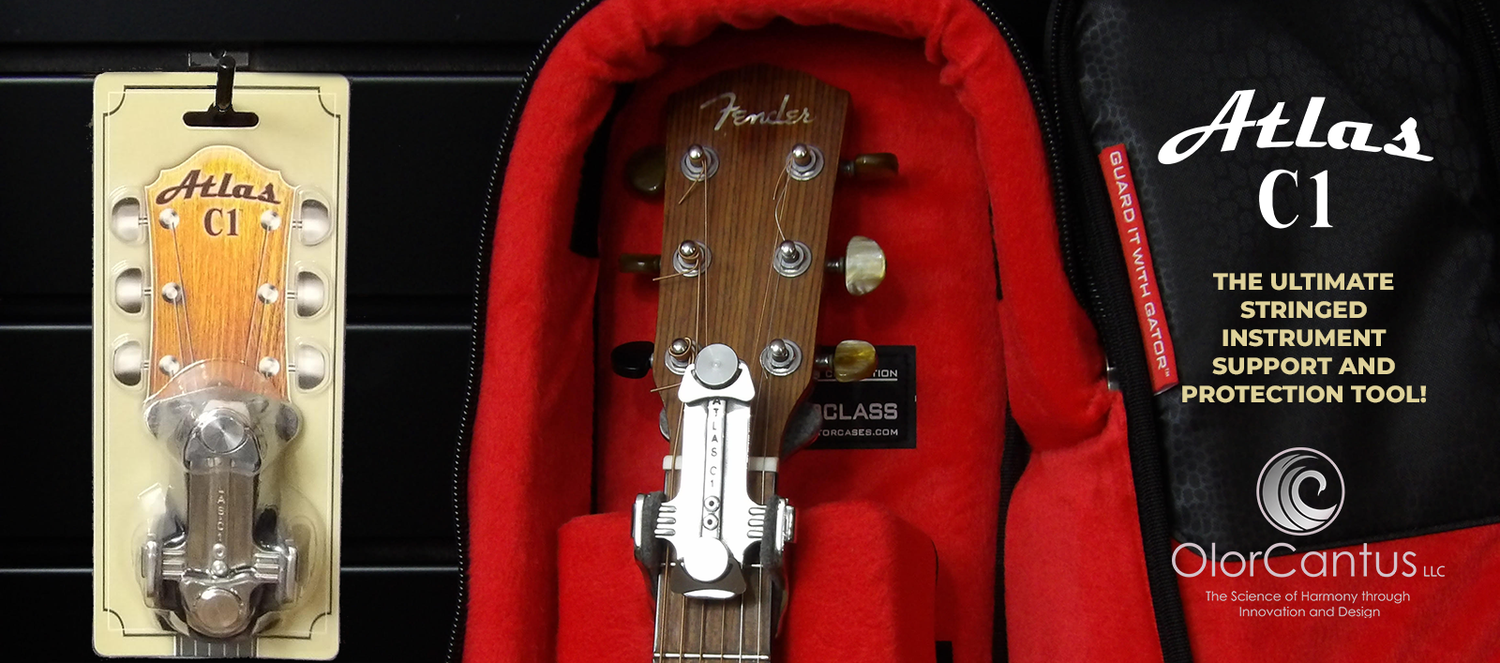
The best claim is the one you never have to file. Most shipping damage we see lands on the headstock-neck junction, the weakest point on any guitar and the spot where string tension does the most harm. That is the exact problem the Atlas C1 was built to solve.
The Atlas C1 is a universal, multi-function headstock tool that supports the headstock-neck junction during travel, shipping, and storage. It counteracts the string pressure that turns a small impact into a break, and it doubles as a pre-aligned repair jig if a break happens anyway. The design is U.S. patent-protected, and it is built for a lifetime of use.
Professional players including Pete Townshend, Greg Martin, and Vic Johnson use it, and it has been featured in Premier Guitar Magazine.
Best for: touring musicians, collectors, and anyone shipping or storing a guitar with an angled headstock. Skip if: your guitar never leaves a climate-controlled room and never ships.
You can get the Atlas C1 headstock support tool and stop worrying about the junction before the box ever leaves the seller. And if you are ordering a replacement guitar or a spare Atlas C1 while you sort out the claim, keep an eye out for our 10 % product discount and free shipping offers, so the next instrument arrives better protected without costing you extra.
Frequently Asked Questions
What should I do first if my guitar arrives damaged?
Do not tune or play it. Photograph the sealed box from every side before opening, then photograph the packing materials and the damage itself. Keep the box and all inserts. Contact the seller within 24 hours with your order number, photos, and a short description of the damage. If the box shows crushing or punctures, also notify the carrier the same day. Fast, documented action protects your return, replacement, or shipping claim options.
Who is responsible if a guitar is damaged during shipping?
It depends on the purchase channel. Buying from a retailer usually means the retailer owns the problem until delivery, so start there. Buying from a private seller shifts responsibility based on the shipping terms and who bought the insurance. When a carrier claim is needed, the person who purchased the label or insurance typically files it. Ask the seller who holds the claim before you spend time on paperwork.
Should I keep the box if my guitar is damaged during shipping?
Yes. Keep the shipping box, packing materials, and any inserts until the claim or return is fully resolved. Carriers and retailers often ask to inspect the original packaging, and some claims are denied without it. Store everything in a dry space, out of the way. Once you receive a written resolution, you can discard the packaging.
Can I return a guitar that arrived damaged?
Most retailers accept returns on a damaged guitar, but the window and process vary. Check the return policy for the deadline and whether you need a return label from customer service. Document the damage before shipping it back and photograph the repackaged box. Keep the tracking number and receipt. If the seller offers a partial refund instead, compare it against a local repair quote before deciding.
Shipping damage is stressful, but it is survivable when you document first and act fast. At Atlas C1, we would rather you never need this guide, which is why we build protection for the one part of the guitar most likely to break. Our tool supports the headstock-neck junction, doubles as a repair jig, and is designed to last the life of your instrument. Get started with Atlas C1 and protect the next guitar before it ships.